 NL·0299
Herbarium of the Nature Library
- Name
- Rhinoplax vigil
- Family
- Bucerotidae
- Native to
- Southern Myanmar and Thailand, Peninsular Malaysia, Sumatra and Borneo
- Habitat
- Tropical rainforest
On eBird ↗
Helmeted Hornbill
Live sightings near you, the range map, bar charts of when it is seen, and Macaulay Library photos and recordings.
Helmeted hornbill
Rhinoplax vigil
Also calledTebang mentua (Malay; 'fell the mother-in-law') · Kuì xīniǎo 盔犀鸟 (Chinese)
A massive hornbill with a solid, ivory-like casque on its forehead and two very long central tail feathers, whose accelerating hooting call ends in a burst of maniacal laughter. Hunted for 'red ivory', it was uplisted straight from Near Threatened to Critically Endangered in 2015.
The helmeted hornbill is a very large bird in the hornbill family. It is found on the Malay Peninsula, Sumatra, Borneo, Thailand and Myanmar. The casque accounts for some 11% of its 3 kg weight. Unlike any other hornbill, the casque is almost solid, and is used in head-to-head combat among males. It is a belief among the Punan Bah that a large helmeted hornbill guards the river between life and death. Wikipedia
What it can do
- iThe only hornbill with a solid casque, used in head-butting aerial contests between males
- iiCall is one of the loudest in Asian rainforests
- iiiDisperses the seeds of strangler figs
In the field
Field marks
- aVery large brown-black hornbill with white belly and white tail with a black band
- bShort, deep red casque and yellow-and-red bill; casque is solid
- cBare wrinkled throat skin, red in males and pale bluish in females
- dTwo very long, white central tail feathers trailing behind
- Voice
- A long series of loud 'took' notes, spaced at first and accelerating, ending in a cackling, laugh-like crescendo
- Not to be confused with
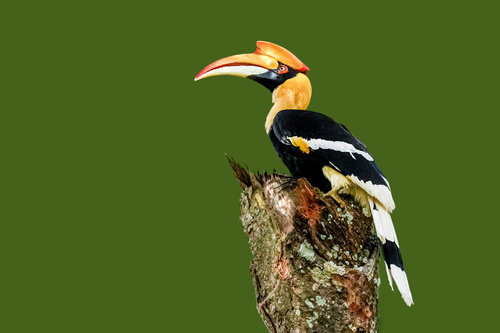
- Rhinoceros hornbill has a large upturned orange casque and no long tail plumes; Great hornbill has a flat yellow casque and a white neck.
- Where to see it
- Danum Valley and Tabin (Sabah), Gunung Leuser (Sumatra), Budo-Sungai Padi (Thailand)
- When
- Resident year-round
Listen
Looking for field recordings…
Life & habits
- Diet
- Mainly figs; also small animals
- Habitat
- Tall lowland and hill dipterocarp rainforest
- Size
- About 110–120 cm long, plus central tail feathers up to about 50 cm
Males clash in flight, striking their casques together with a loud crack; the female seals herself into a tree hole to nest.
Where it lives
Recorded sightings
—
geo-referenced records in GBIF, from museums, herbaria and field observers.
Native range
Southern Myanmar and Thailand, Peninsular Malaysia, Sumatra and Borneo
Drag the globe to turn it. Dots are where records exist, not a range map; darker means more records.
In the old herbals & bestiaries
No plate in the Source Library names this exact species, so these show its closest relatives as the old naturalists drew them: same genus, or the same kind of animal. Click a plate to read the page it came from, with translation.

The Malay Archipelago: The Land of the Orang-Utan and the Bird of Paradise
Relative · Alfred Russel Wallace · 1869 · p.167

Ornithology
Relative · Ulisse Aldrovandi · 1599 · p.840

De Indiae utriusque re naturali et medica
Relative · Willem Piso · 1658 · p.464

Ornithology: The History of Birds
Relative · Ulisse Aldrovandi · 1599 · p.837

Ornithology: The History of Birds
Relative · Ulisse Aldrovandi · 1599 · p.818

Ornithologiae: de avibus historiae libri XII
Relative · Ulisse Aldrovandi · 1599 · p.824

De Indiae utriusque re naturali et medica
Relative · Willem Piso · 1658 · p.466
In the stacks
Searching the stacks…
Every page naming Rhinoplax vigil in the Biodiversity Heritage Library →
Marginalia
Its solid casque, 'hornbill ivory' (ho-ting in Chinese), was carved into belt buckles, snuff bottles and ornaments during the Ming and Qing dynasties and traded from Borneo for centuries. In Borneo, the Iban and other Dayak peoples revered the bird and wore its tail feathers.
Curiosity
Its Malay name 'tebang mentua' comes from a folk tale of a man who chopped down the posts of his mother-in-law's house while she was inside and was turned into the bird: the call's accelerating 'took' notes are his axe blows, and the final cackle is his laughter as the house falls.
Kinship




Fact-checked: 1 correction made to this sheet. Photographs: iNaturalist contributors under the licences shown. Records: GBIF.org. Historical plates: Source Library (CC BY-SA 4.0; originals public domain). Summary text: Nature Library editors and Wikipedia (CC BY-SA). Medicinal and edibility notes are historical and educational, not advice. iNaturalist taxon 72577.