- Animals
- ›Chordates
- ›Vertebrates
- ›Birds
- ›Woodpeckers and Allies
- ›Woodpeckers
- ›Typical woodpeckers
- ›Pied woodpeckers and allies
- ›Melanerpes
On eBird ↗
Beautiful Woodpecker
Live sightings near you, the range map, bar charts of when it is seen, and Macaulay Library photos and recordings.
Beautiful Woodpecker
Melanerpes pulcher
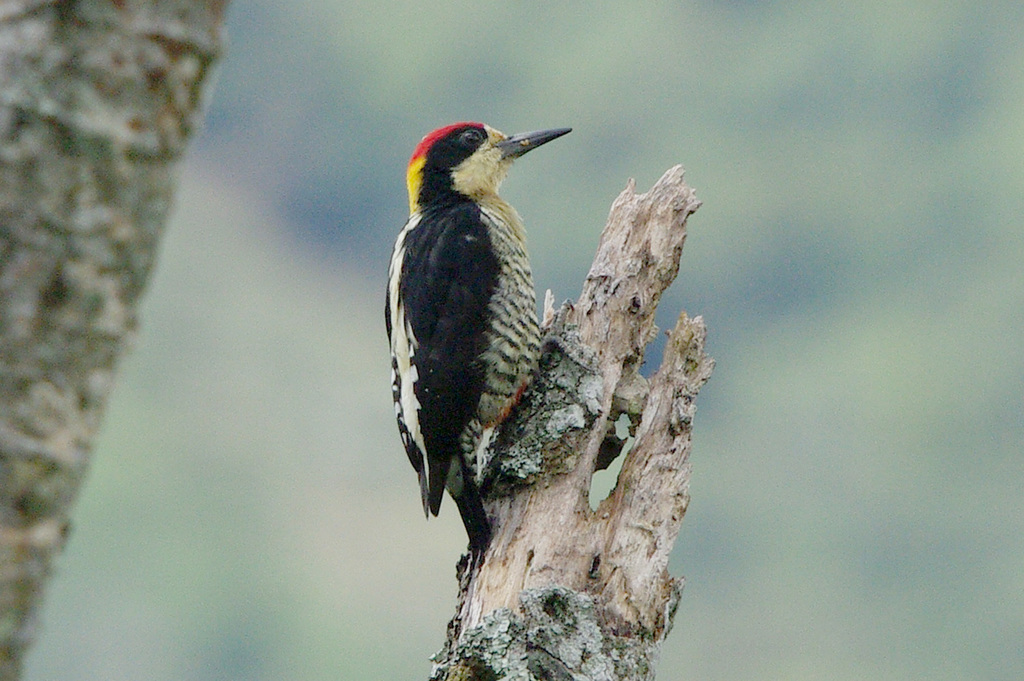
The beautiful woodpecker (Melanerpes pulcher) is a species of bird in subfamily Picinae of the woodpecker family Picidae. It is endemic to Colombia.
From the article Beautiful woodpecker on Wikipedia (CC BY-SA), quoted section by section
Description
The beautiful woodpecker is about 17 to 18 cm (6.7 to 7.1 in) long. The sexes are alike except for their head pattern. Adult males have a whitish forehead, a scarlet crown, and a golden yellow lower nape and hindneck. Adult females have the same whitish forehead and yellow hindneck but a black forecrown and a scarlet hindcrown and nape. Both sexes have black around the eye that extends down the side of the neck. Their lores, cheeks, chin, throat, and breast are white to cream or pale yellow. Their mantle and upper wings are mainly black, with some white barring of the flight feathers, and the back and rump are white, sometimes blotched with black. Their tail is brownish black, the lower breast, belly, and flanks are barred black and white, and there is a red patch on mid-belly. Their iris is very dark brown, the beak is blackish with a paler base, and the legs are gray. Juveniles are duller than adults, their black areas are browner, the underparts' barring is less contrasting, and the belly patch is smaller and more orange.
Range & habitat
The beautiful woodpecker is endemic to the valley of the Magdalena River in north central Colombia. It primarily inhabits mature open forests, both dry and humid. It sometimes occurs in plantations, and occasionally in fragmented and secondary forest. In elevation it ranges between 400 and 1,500 m (1,300 and 4,900 ft).
Wikipedia: “Distribution and habitat”
What it does
The beautiful woodpecker mostly forages high in the forest, in the canopy and just below it. It feeds on insects including adult and larval wood-boring beetles and winged termites; it sometimes hawks flying insects above the tops of the trees. In addition to insects it feed on much fruit including figs, bananas, and fruits of the Cecropia tree.
Wikipedia: “Feeding”
Listen
Looking for field recordings…
Where it lives
Recorded sightings
—
geo-referenced records in GBIF, from museums, herbaria and field observers.
Drag the globe to turn it. Dots are where records exist, not a range map; darker means more records.
In the stacks
Searching the stacks…
Every page naming Melanerpes pulcher in the Biodiversity Heritage Library →
This page is assembled live from iNaturalist, GBIF, Wikipedia, the Source Library and the Internet Archive. It is not yet part of the hand-edited codex. iNaturalist taxon 73021.