On eBird ↗
Bukidnon Woodcock
Live sightings near you, the range map, bar charts of when it is seen, and Macaulay Library photos and recordings.
Bukidnon Woodcock
Scolopax bukidnonensis
The Bukidnon woodcock (Scolopax bukidnonensis), or Philippine woodcock is a medium-sized wader. It was only described as new to science as recently as 2001, although the initial specimens had been collected on Luzon in the 1960s, these were originally misidentified as Eurasian woodcock specimens. It was not until the bird was heard calling in 1993, and new specimens obtained on Mindanao in 1995, that it was realised that the species was new. It is listed as Least Concern by the IUCN.
From the article Bukidnon woodcock on Wikipedia (CC BY-SA), quoted section by section
Description
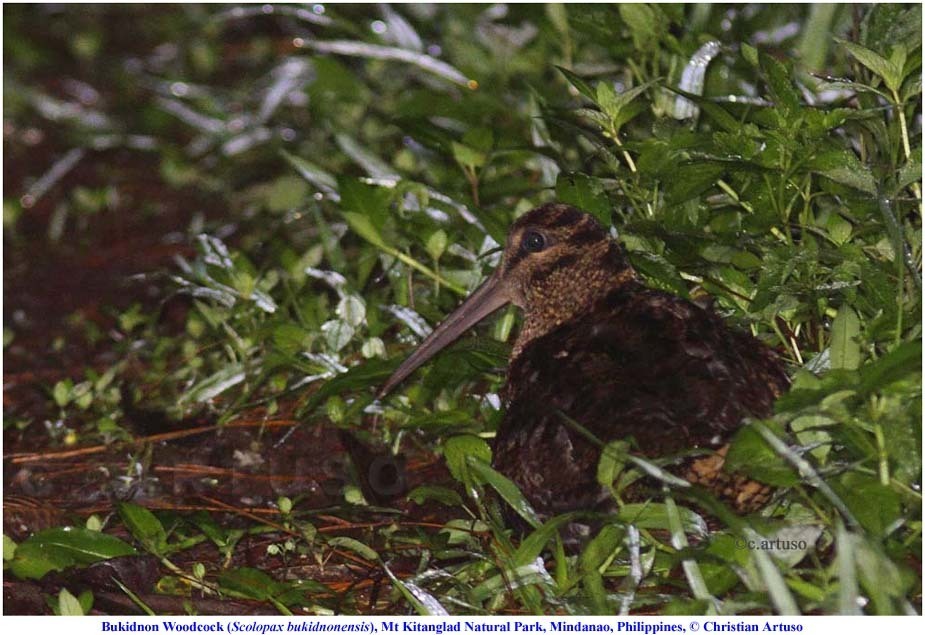
The Bukidnon woodcock is rich reddish-brown above, finely barred and vermiculated with black and broadly barred with blackish markings across the crown, the underparts are paler and buffer. The eye is placed high and far back on the head, and the beak is long with a flexible tip to extract worms and other invertebrates from the soil.
Wikipedia: “Description and taxonomy”
Range & habitat
This species is restricted to mountain forests (over 1000 meters above sea level) on the islands of Mindanao (four mountaintops) and Luzon (center and north) in the Philippines. Its habitat is extremely remote and rugged, and is unsuitable for either logging or agriculture. The Bukidnon woodcock has a large range and it is relatively common within that range. Its population size has not been quantified but the IUCN has listed it as being of "Least Concern", believing that any decline in population is too slow as to justify placing the bird in a more threatened category. As it occurs in rugged and inaccessible mountains, this has allowed a large portion of its habitat to remain intact. However, there it is still affected by habitat loss through deforestation, mining, land conversion and slash-and-burn - just not to the same extent as lowland forest.
Wikipedia: “Habitat and conservation”
What it does
Believed to feed at night or at dusk in areas with thick moss and foliage where it possibly feeds on worms and other invertebrates These birds fly in a wide circuit over the forest, giving a loud, metallic, rattling `pip-pip-pip-pip-pip` interspersed by very quiet grunts. Little is known about the bird in the wild. It is described as having a "roding" display flight in January to March just before dawn, like other birds of the genus. Nest has been recorded in February and September with 2 eggs.
Wikipedia: “Behaviour and ecology”
Listen
Looking for field recordings…
Where it lives
Recorded sightings
—
geo-referenced records in GBIF, from museums, herbaria and field observers.
Drag the globe to turn it. Dots are where records exist, not a range map; darker means more records.
In the stacks
Searching the stacks…
Every page naming Scolopax bukidnonensis in the Biodiversity Heritage Library →
This page is assembled live from iNaturalist, GBIF, Wikipedia, the Source Library and the Internet Archive. It is not yet part of the hand-edited codex. iNaturalist taxon 73375.