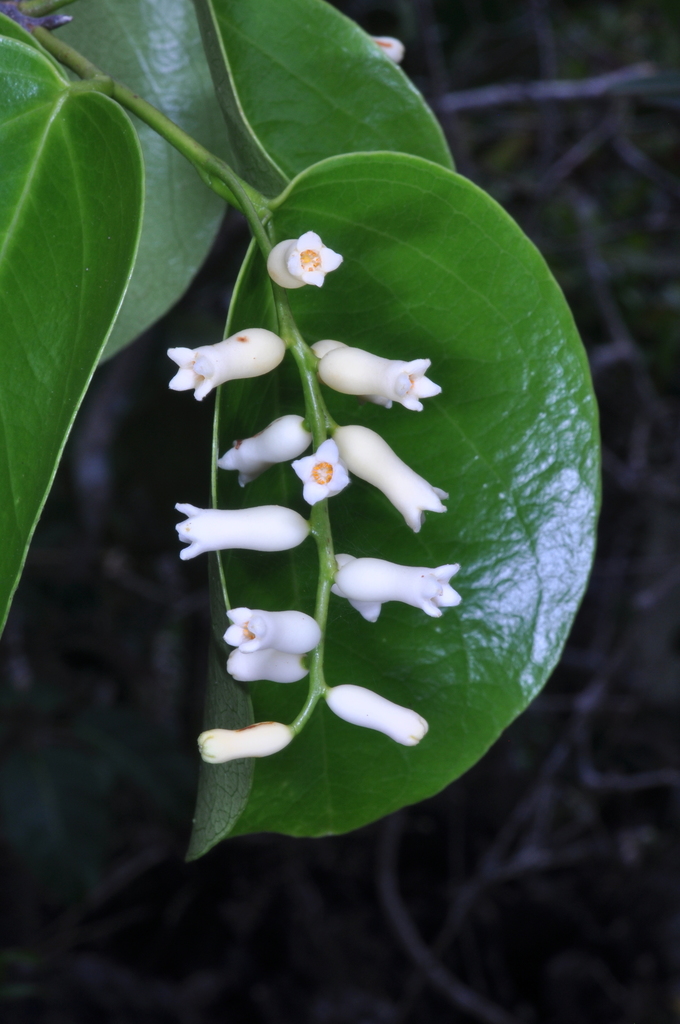
Lacebark tree
Lagetta lagetto
Lagetta lagetto is a species of tree native to several Caribbean islands. It is called the lacebark or gauze tree because the inner bark is structured as a fine netting that has been used for centuries to make clothing as well as utilitarian objects like rope.
From the article Lagetta lagetto on Wikipedia (CC BY-SA), quoted section by section
Description
Lagetta lagetto is a small, narrow, pyramidal tree, growing between 12 and 40 feet (3.7 and 12.2 m) tall. It has a straight trunk with a rough outer bark. It forms part of the subcanopy of the Caribbean forest, sprouting from crevices of rocky limestone slopes. It has been recorded all along the central spine of Jamaica at altitudes of from 1,400 to 2,700 feet (430 to 820 m) as well as along other mountainous ridges in the west central parts of the island. The lacebark tree has smooth, dark green, leathery, somewhat heart-shaped evergreen leaves, roughly 4 inches (10 cm) long by 2.5 inches wide. The small, white, tubular-bell-shaped flowers are produced as racemes in a pattern of alternating flower-stalks along the branchlets. There is no calyx, but the corolla divides into four points at its outer tip. There are eight short filamentous stamens concealed within the flower. It produces a roundish, hairy drupe inside of which is a dark-brown, ovoid kernel about one-quarter inch long. In the 18th and 19th centuries, L. lagetto was reported to be abundant and widespread in Jamaica. By the late 19th century, however, there are reports of growing scarcity attributed to overharvesting without replanting. It is now rare, probably in large part due to such overexploitation combined with more general loss of forest lands in the same period. …
Wikipedia: “Description and habitat”
At the table
The inner bark of Lagetta species—the phloem layer that carries nutrients from the leaves to the roots—consists of twenty to thirty tough, thin, dense layers of interlacing bast fibers. Whereas in most economically important fibrous plants the bast fibers are formed in straight, parallel lines, in the Lagetta species they separate and rejoin to form a fine natural net or mesh of tiny rhomboids. The lacebark tree's layers of inner bark can be carefully pulled apart to produce multiple sheets of white netting known eponymously as lacebark. Lacebark is thus unique among other tropical barkcloths in being produced without having to be beaten into shape. Although the main steps of lacebark production are clear—detaching the entire bark from the tree, extracting the inner bark, and pulling apart the layers—the details of the process are not well documented. The naturalist Philip Gosse supplied a general account of lacebark tree harvesting from a stopover in Haiti in 1846, while contemporary accounts by Emily Brennan, Mark Nesbitt, and others rely in large part on oral accounts from the few remaining lacebark harvesters. It appears that lacebark was sourced from trees growing wild (rather than under cultivation), and though sometimes an entire tree would be felled to get at the bark, in many cases a single branch would be lopped off to preserve the tree for further harvesting. …
Wikipedia: “Uses”
Where it lives
Recorded sightings
—
geo-referenced records in GBIF, from museums, herbaria and field observers.
Drag the globe to turn it. Dots are where records exist, not a range map; darker means more records.
In the old herbals & bestiaries


In the stacks
Searching the stacks…
Every page naming Lagetta lagetto in the Biodiversity Heritage Library →
This page is assembled live from iNaturalist, GBIF, Wikipedia, the Source Library and the Internet Archive. It is not yet part of the hand-edited codex. iNaturalist taxon 735197.