- Plants
- ›Vascular Plants
- ›flowering plants
- ›Dicots
- ›saxifrages, stonecrops, and allies
- ›stonecrop family
- ›Sempervivoideae
- ›Sedeae
- ›Sedum
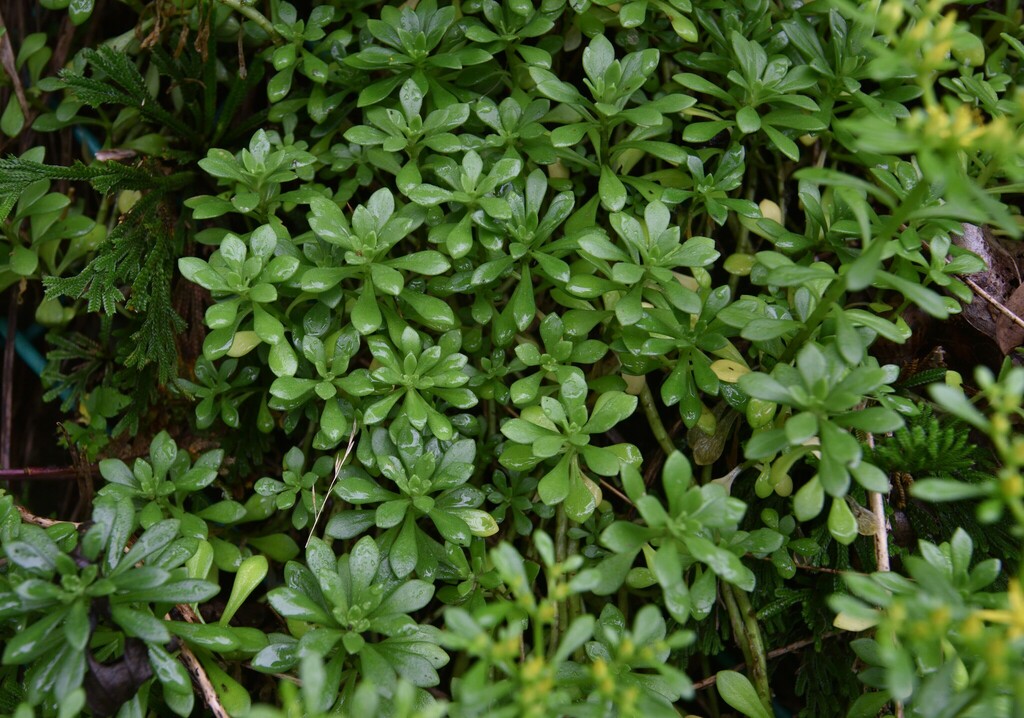
Sedum sekiteiense
Sedum sekiteiense is a Taiwan-endemic species of the family Crassulaceae in the Sedum genus. It is also one of the few wild plants named after Shiding. The species was first published by Yoshimatsu Yamamoto in 1934 in the Supplementa Iconum Plantarum Formosanarum. Although its taxonomic status has been stable, little is known about its ecological habits due to its rarity, limited distribution, and habitats that are often located on steep and inaccessible cliffs that are difficult to observe. The species is classified as “Vulnerable (VU)” in “The Red List of Vascular Plants of Taiwan, 2017.”
From the article Sedum sekiteiense on Wikipedia (CC BY-SA), quoted section by section
Description
A succulent herb with a fibrous root system. The entire plant is smooth in texture, with the lower part of the plant creeping and the upper part leaning or nearly erect, reaching a height of approximately 6 to 12 cm (2.4 to 4.7 in). The leaves are spatulate or slightly rhomboid, with entire leaf margins, with a slightly protruding or short-pointed apex. The leaves are arranged alternately and are approximately 10 to 25 mm (0.39 to 0.98 in) in length and 4 to 6 mm (0.16 to 0.24 in) in width. The inflorescence is a scorpioid cyme composed of basic units of cymes. The flowers are sessile and arranged closely together, with a distance of only approximately 5 mm (0.20 in) between each flower. The calyx is green with five sepals usually in varying sizes that are approximately 2.8 to 4 mm (0.11 to 0.16 in) in length and 0.9 mm (0.035 in) in width, spathulate, free at the base and spurred; they remain in a horizontal position when the fruit is ripe. The corolla is bright yellow with five elliptic-lanceolate-shaped petals. The stamens are arranged in two whorls of ten, with the outer whorl located between the petals and the filaments fused at the base with the adjacent petal bases. The inner whorl is opposite to the petals, with the filaments fused to the central base of the petals. The pistil is composed of five carpels that are generally free and partially fused at the base. …
Range & habitat
Endemic to Taiwan, this is one of the narrowly distributed plants of the Sedum genus that are distributed in low-altitude areas of the island, along with S. uniflorum Hook. & Arn., Sedum drymarioides Hance, S. tarokoense H. W. Lin & J. C. Wang. Its distribution ranges from Datun Mountain in the north to Pingxi, Shiding Mountains, to Yilan. The habitats are often located on steep cliffs with moist and semi-shaded rocks near ridgelines. The population size consists of only a few dozen. The “Red List of Vascular Plants of Taiwan, 2017,” assessed its threat level as “Vulnerable (VU)” due to its small population and the possibility of less than 1000 mature individuals.
Wikipedia: “Distribution”
Where it lives
Recorded sightings
—
geo-referenced records in GBIF, from museums, herbaria and field observers.
Drag the globe to turn it. Dots are where records exist, not a range map; darker means more records.
In the stacks
Searching the stacks…
Every page naming Sedum sekiteiense in the Biodiversity Heritage Library →
This page is assembled live from iNaturalist, GBIF, Wikipedia, the Source Library and the Internet Archive. It is not yet part of the hand-edited codex. iNaturalist taxon 736474.