- Plants
- ›Vascular Plants
- ›flowering plants
- ›monocots
- ›grasses, sedges, cattails, and allies
- ›Sedges
- ›Cyperoideae
- ›Cariceae
- ›Carex
- ›Carex
- ›Lageniformes
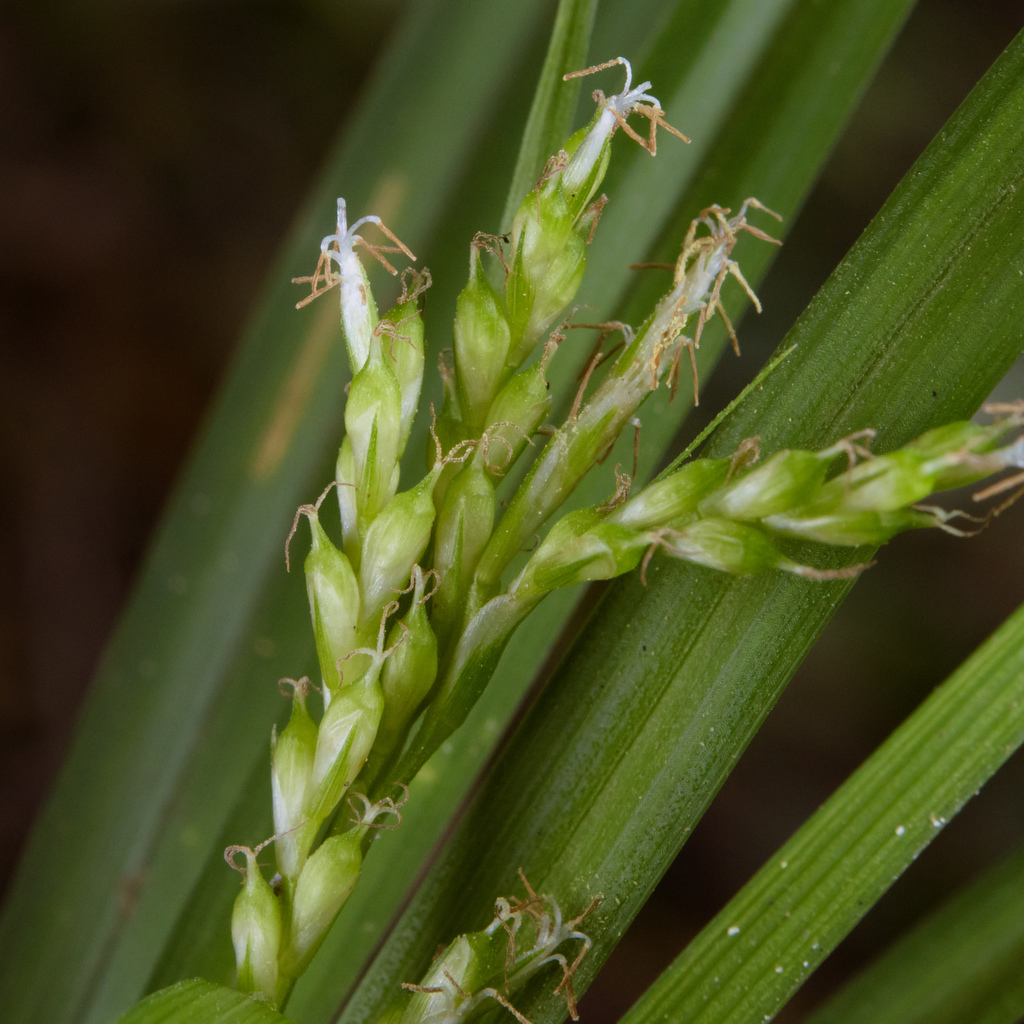
Carex breviscapa
Carex breviscapa is a tussock-forming perennial in the family Cyperaceae. It is native to eastern parts of the south east Asia and north eastern Australia
From the article Carex breviscapa on Wikipedia (CC BY-SA), quoted section by section
Description
The sedge has a short rhizome and culms that reach a height of 10 to 20 cm (3.9 to 7.9 in). It has dark brown coloured basal sheaths that eventually split down into fibers. The flat, leathery and smooth dark green coloured leaves are usually have a greater length that the culms Leaves longer than culm and have a width of 4 to 7 mm (0.16 to 0.28 in). It has modified leaflets that grow at the base of the inflorescence that are much longer than the inflorescence itself. Each inflorescence has three to five nodes with three to five spikes at each node. The mal spikes are located at the end of the culm and have a linear shape with a length of 17 to 45 mm (0.67 to 1.77 in) and a width of 1 to 1.5 mm (0.039 to 0.059 in). the female spikes are located laterally and have a narrow cylindrical shape that are 4 to 4.5 cm (1.6 to 1.8 in) in length and about 3 m (9.8 ft) wide.
Range & habitat
The sedge is often found in forested areas at an elevation of 400 to 1,000 m (1,300 to 3,300 ft). The range extends from China in the north west to Japan in the north east. It is also found as far west as Sri Lanka and then south of China in Thailand, Vietnam and Malaysia then through the islands of Borneo, Philippines, Indonesia and New Guinea and as far south east as Queensland in north east of Australia.
Wikipedia: “Distribution”
Where it lives
Recorded sightings
—
geo-referenced records in GBIF, from museums, herbaria and field observers.
Drag the globe to turn it. Dots are where records exist, not a range map; darker means more records.
In the stacks
Searching the stacks…
Every page naming Carex breviscapa in the Biodiversity Heritage Library →
This page is assembled live from iNaturalist, GBIF, Wikipedia, the Source Library and the Internet Archive. It is not yet part of the hand-edited codex. iNaturalist taxon 736487.