- Plants
- ›Vascular Plants
- ›flowering plants
- ›Dicots
- ›Legumes, Milkworts, and Allies
- ›Legumes
- ›Faboideae
- ›Mirbelieae
- ›Daviesia
Daviesia hakeoides
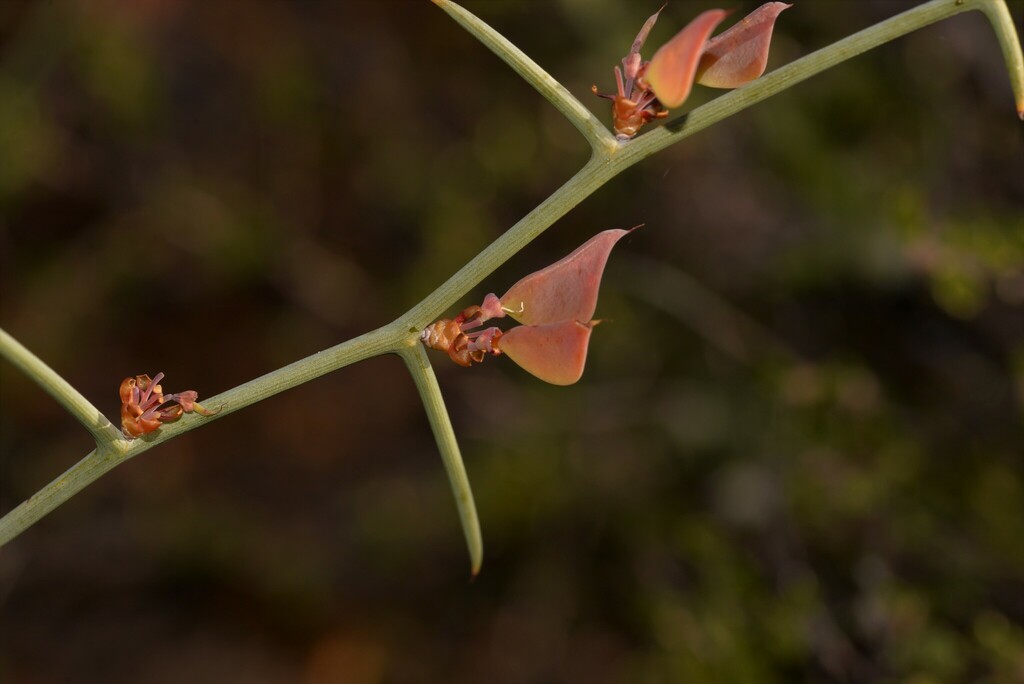
Daviesia hakeoides is a species of flowering plant in the family Fabaceae and is endemic to the south-west of Western Australia. It is a shrub with many tangled stems, scattered sharply-pointed phyllodes and yellow or orange and dark red flowers.
From the article Daviesia hakeoides on Wikipedia (CC BY-SA), quoted section by section
Description
Daviesia hakeoides is a glabrous shrub that typically grows to 0.3–1 m (1 ft 0 in – 3 ft 3 in) high and 0.5–2 m (1 ft 8 in – 6 ft 7 in) wide and has many tangled stems. The phyllodes are scattered, sharply-pointed and needle-shaped, up to 80 mm (3.1 in) long and 1.5 mm (0.059 in) wide at the base. The flowers are borne in groups of two to six in leaf axils on a peduncle 1.0–1.5 mm (0.039–0.059 in) long, the rachis less than 2 mm (0.079 in) long, each flower on a pedicel 1–6 mm (0.039–0.236 in) long with overlapping bracts about 1–2 mm (0.039–0.079 in) long at the base. The sepals are 2.0–2.5 mm (0.079–0.098 in) long and joined at the base, the upper two lobes more or less joined for most of their length and the lower three pointed and spread apart. The standard petal is broadly elliptic, 4.5–6 mm (0.18–0.24 in) long and yellow or orange with a dark red centre, the wings 5.0–5.5 mm (0.20–0.22 in) long and dark red, and the keel about 5 mm (0.20 in) long and dark red. Flowering mainly occurs from May to July and the fruit is an slightly inflated triangular pod 14–17 mm (0.55–0.67 in) long.
Range & habitat
This hakea grows in open forest and woodland from Kalbarri to near Albany and inland to the wheatbelt. Subspecies seminuda grows in drier places further inland than the autonym, more often in kwongan from Yuna to Mount Barker and the wheatbelt.
Wikipedia: “Distribution and habitat”
Where it lives
Recorded sightings
—
geo-referenced records in GBIF, from museums, herbaria and field observers.
Drag the globe to turn it. Dots are where records exist, not a range map; darker means more records.
In the stacks
Searching the stacks…
Every page naming Daviesia hakeoides in the Biodiversity Heritage Library →
This page is assembled live from iNaturalist, GBIF, Wikipedia, the Source Library and the Internet Archive. It is not yet part of the hand-edited codex. iNaturalist taxon 737471.