Bossiaeeae
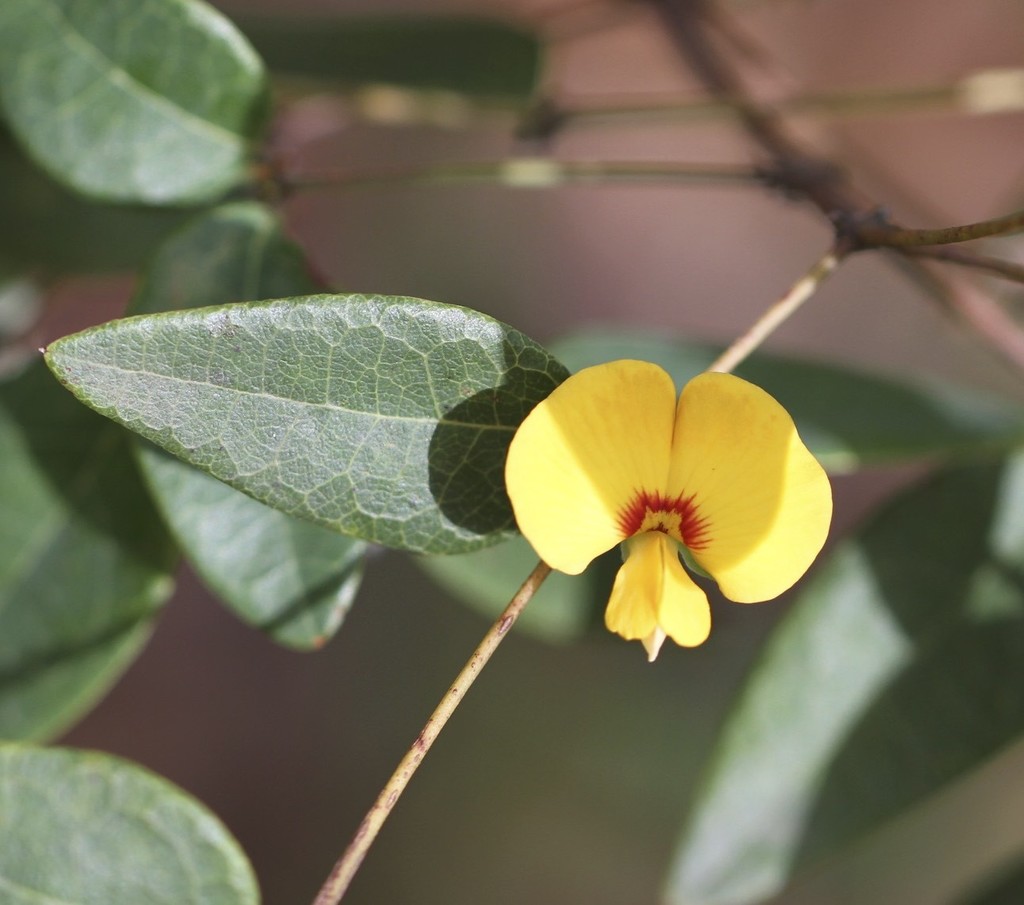
The Mirbelioids are an informal subdivision of the plant family Fabaceae that includes the former tribes Bossiaeeae and Mirbelieae. They are consistently recovered as a monophyletic clade in molecular phylogenies. The Mirbelioids arose 48.4 ± 1.3 million years ago (in the early Eocene). Members of this clade are mostly ericoid (sclerophyllous) shrubs with yellow and red ('egg and bacon') flowers found in Australia, Tasmania, and Papua-New Guinea. The name of this clade is informal and is not assumed to have any particular taxonomic rank like the names authorized by the ICBN or the ICPN. Members of this clade exhibit unusual embryology compared to other legumes, either enlarged antipodal cells in the embryo sac or the production of multiple embryo sacs. There has been a shift from bee pollination to bird pollination several times in this clade. Mirbelioids produce quinolizidine alkaloids, but unlike most papilionoids, they do not produce isoflavones. Many of the Mirbelioids have pseudoraceme inflorescences.


Where it lives
Recorded sightings
—
geo-referenced records in GBIF, from museums, herbaria and field observers.
Drag the globe to turn it. Dots are where records exist, not a range map; darker means more records.
In the stacks
Searching the stacks…
Every page naming Bossiaeeae in the Biodiversity Heritage Library →
This page is assembled live from iNaturalist, GBIF, Wikipedia, the Source Library and the Internet Archive. It is not yet part of the hand-edited codex. iNaturalist taxon 737822.