 NL·0425
Herbarium of the Nature Library
- Name
- Micrurus fulvius
- Family
- Elapidae
- Native to
- Southeastern United States: coastal plain from North Carolina to Florida and west to Louisiana (the Texas coral snake, Micrurus tener, replaces it further west)
- Habitat
- Pine flatwoods, Sandhill, Hardwood hammock, Suburban gardens
Eastern coral snake
Micrurus fulvius
Also calledHarlequin coral snake · Coralillo (Spanish) · Candy-stick snake
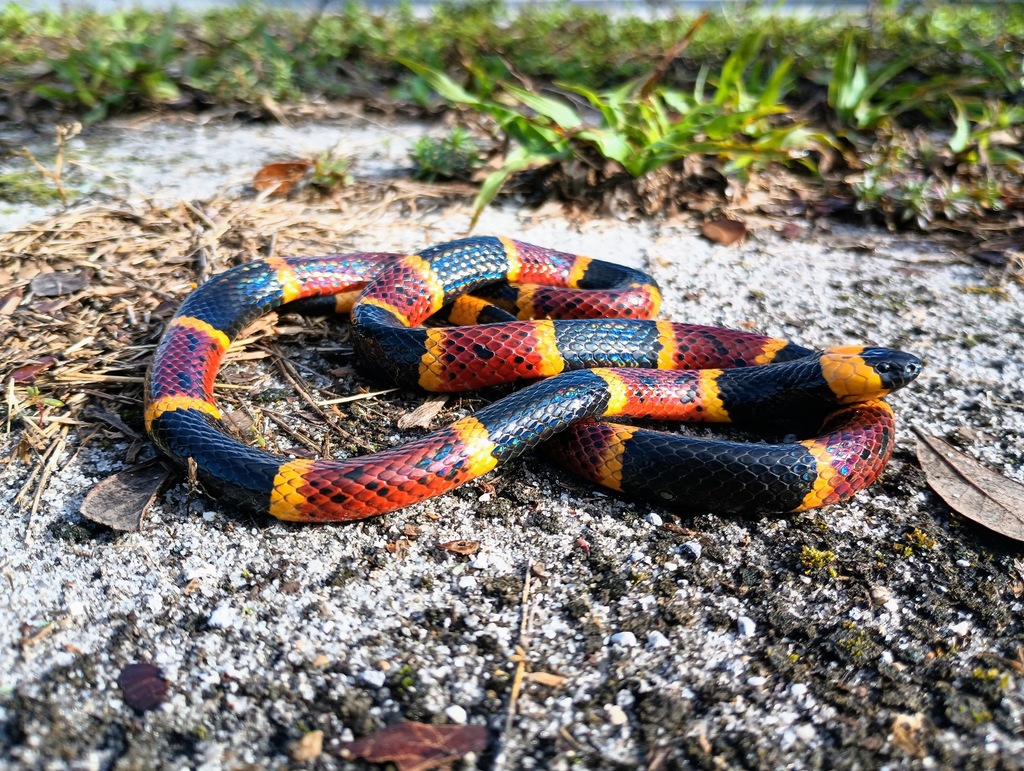
A small, secretive snake of the southeastern US, ringed in red, yellow and black, with a strong neurotoxic venom. Harmless kingsnakes and scarlet snakes copy its colours, which has made it the classic example of warning mimicry in snakes.
Micrurus fulvius, commonly known as the eastern coral snake, common coral snake, American cobra, and more, is a species of highly venomous coral snake in the family Elapidae. The species is endemic to the southeastern United States. The family also contains the cobras and sea snakes. Wikipedia
What it can do
- iVenom is mainly neurotoxic: it can paralyse breathing hours after a bite that seemed minor
- iiHunts other snakes, which it swallows whole
- iiiWhen threatened, hides its head and curls up its tail to look like a second head
In the field
Field marks
- aWide red and black rings separated by narrow yellow rings; red touches yellow
- bBlack snout, then a broad yellow band across the back of the head
- cRings encircle the body including the belly
- dSmall rounded head, no wider than the neck; small black eyes
- Not to be confused with
- The harmless scarlet kingsnake (Lampropeltis elapsoides) has a red snout and red rings touching black. The scarlet snake (Cemophora coccinea) has red saddles that do not cross a plain white belly, and a pointed red snout. In the US the rule 'red touches yellow, dangerous fellow; red touches black, friend of Jack' works, but it fails for coral snakes in Mexico, Central and South America. Never handle a ringed snake to check.
- Where to see it
- Pine flatwoods and hammocks of Florida; sandhills of Georgia and the Carolinas; most often seen crossing roads or paths in the morning
- When
- Resident; most often seen in spring (March–May) and autumn
Life & habits
- Diet
- Mainly other snakes and lizards
- Habitat
- Leaf litter and sandy soil in pine and hardwood forests; also suburban gardens in Florida
- Size
- Usually 50–80 cm; up to ~1.2 m
Spends most of its time underground or under leaf litter, and is seen mainly after rain or in spring. It has small fixed fangs and often hangs on and chews when it bites. Symptoms (drooping eyelids, slurred speech, trouble swallowing, weak breathing) can take 12 hours or more to appear, so anyone bitten must go straight to hospital whatever they feel. North American Coral Snake Antivenin is used.
Where it lives
Recorded sightings
—
geo-referenced records in GBIF, from museums, herbaria and field observers.
Native range
Southeastern United States: coastal plain from North Carolina to Florida and west to Louisiana (the Texas coral snake, Micrurus tener, replaces it further west)
Drag the globe to turn it. Dots are where records exist, not a range map; darker means more records.
In the stacks
Searching the stacks…
Every page naming Micrurus fulvius in the Biodiversity Heritage Library →
Marginalia
Linnaeus described it in 1766 as Coluber fulvius. It and its harmless look-alikes became the textbook case of warning coloration and mimicry, and field experiments with plasticine model snakes showed that birds avoid red, yellow and black ringed patterns.
Curiosity
Wyeth stopped making the US coral snake antivenom in 2003, and for years the FDA extended the expiry dates of the remaining stock to keep some available.
Kinship



Photographs: iNaturalist contributors under the licences shown. Records: GBIF.org. Historical plates: Source Library (CC BY-SA 4.0; originals public domain). Summary text: Nature Library editors and Wikipedia (CC BY-SA). Medicinal and edibility notes are historical and educational, not advice. iNaturalist taxon 73867.