- Plants
- ›Vascular Plants
- ›flowering plants
- ›Dicots
- ›Mints, Plantains, Olives, and Allies
- ›Plantain Family
- ›Veroniceae
- ›Veronica
- ›Pseudoveronica
- ›Hebe
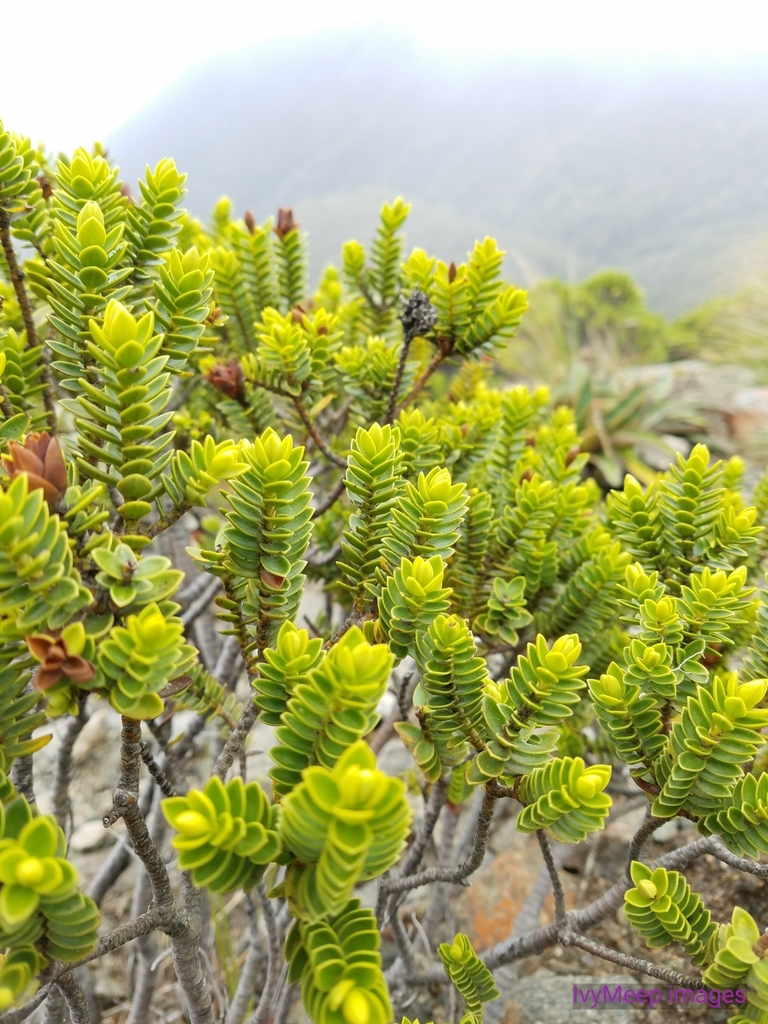
Boxleaf Hebe
Veronica odora
Veronica odora, known as the boxwood hebe, mountain-box, Hebe odora or Hebe buxifolia, is a plant in the family Plantaginaceae, and it is native to New Zealand. Veronica odora was discovered on the Auckland Islands by J.D Hooker in 1840. A certain amount of confusion later arose following its collection on mainland New Zealand by Ernst Dieffenbach and its naming as Veronica buxifolia by George Bentham. Even overseas, Veronica odora is still not infrequently known as Veronica buxifolia.
From the article Veronica odora on Wikipedia (CC BY-SA), quoted section by section
Description
Veronica odora is an easily recognizable round, spherical and evergreen shrub. Its Buxus-like foliage has given rise to this plant's common name, boxwood. Veronica odora is grows slowly. Normally, it can grow to about 1 m high, but in a suitable environment, it can grow to 1.5m or even higher. The leaves of the plant are elliptic-ovate. They are compact, dense and upright, 1–2 cm long and 4-10mm wide. They are generally dark green and cortical. The upper surface of the leaf is dark green, smooth, and shiny, while the lower part is dim and pale. Leaf buds have a small gap at the base. The young branches are usually green to yellowish green, and the leaf buds are obviously heart-shaped or shield-shaped. The blade edge has obvious beveled edges, the midrib on the lower surface of the blade is obvious, and the blade base has obvious protrusions. Inflorescences are usually terminal, with one or two pairs of lateral spikes, or sometimes only one spike, which may be terminal or lateral. The peduncle is short and often hidden by leaves. Because of the growth habit of inflorescences, most Veronica odora have conical flower heads.
Range & habitat
As a native plant of New Zealand, Veronica odora is widely distributed. It inhabits the North Island, South Island, Stewart Island and Auckland Island. It is common in the subalpine to low mountain areas to the south of Hikurangi Mountain, and in the humid environment with an altitude of 600 to 1400 meters, but poorly represented in the forests. It usually exists in subalpine shrubs and mixed snow grass, and sometimes extends to snow grass grassland. At the same time, it can be seen in areas such as riverbanks, cliffs and ridges. Veronica odora is also found in urban environments and some people plant it in their own gardens, because it is cold-resistant and easy to grow.
Wikipedia: “Distribution”
What it does
Veronica odora is a very common plant in cultivation. It usually in October (mid spring) to March (early autumn) produces white flowers, and although its name odora has the meaning of fragrance, has no odour. It fruits in December – April. It has two modes of dispersal. One is to spread its seeds far away through the wind, but these seeds are very fragile and cannot be preserved for a long time. Autumn is the best time to plant Veronica odora. People need to plant the seed in a position that is not exposed to direct sunlight and provide 12-15 °C for optimum germination temperature. If those conditions are met, seeds will generally germinate the following spring. Another method of dispersal is cuttings, in which 10–12 cm branches are transplanted into soft soil in spring. The growing tip can be removed to promote bushy growth. The low temperature of 12-15 °C is very suitable for cutting growth. Too high a temperature can cause the cuttings to rot or dry out. Cutting selection is also very important, people cannot choose old wood, damaged shrubs, shrubs damaged by disease and insects, poor flowering or poor growth of shrubs and so on. Cuttings should be obtained from growing branches and cutting should avoid cutting the growing buds under the stem. To take root successfully, people should choose a twig that is not too soft, or it will wither.
Wikipedia: “Life cycle”
Where it lives
Recorded sightings
—
geo-referenced records in GBIF, from museums, herbaria and field observers.
Drag the globe to turn it. Dots are where records exist, not a range map; darker means more records.
In the stacks
Searching the stacks…
Every page naming Veronica odora in the Biodiversity Heritage Library →
This page is assembled live from iNaturalist, GBIF, Wikipedia, the Source Library and the Internet Archive. It is not yet part of the hand-edited codex. iNaturalist taxon 738756.