 NL·0622
Herbarium of the Nature Library
- Name
- Phrynosoma cornutum
- Family
- Phrynosomatidae
- Native to
- South-central United States (Kansas, Oklahoma, Texas, New Mexico, southeastern Colorado and Arizona) and northern Mexico
- Habitat
- Grassland, Desert scrub, Semi-arid shrubland
Texas horned lizard
Phrynosoma cornutum
Also calledHorny toad · Horned toad · Camaleón (Mexican Spanish) · Torito de la Virgen (Mexican Spanish)
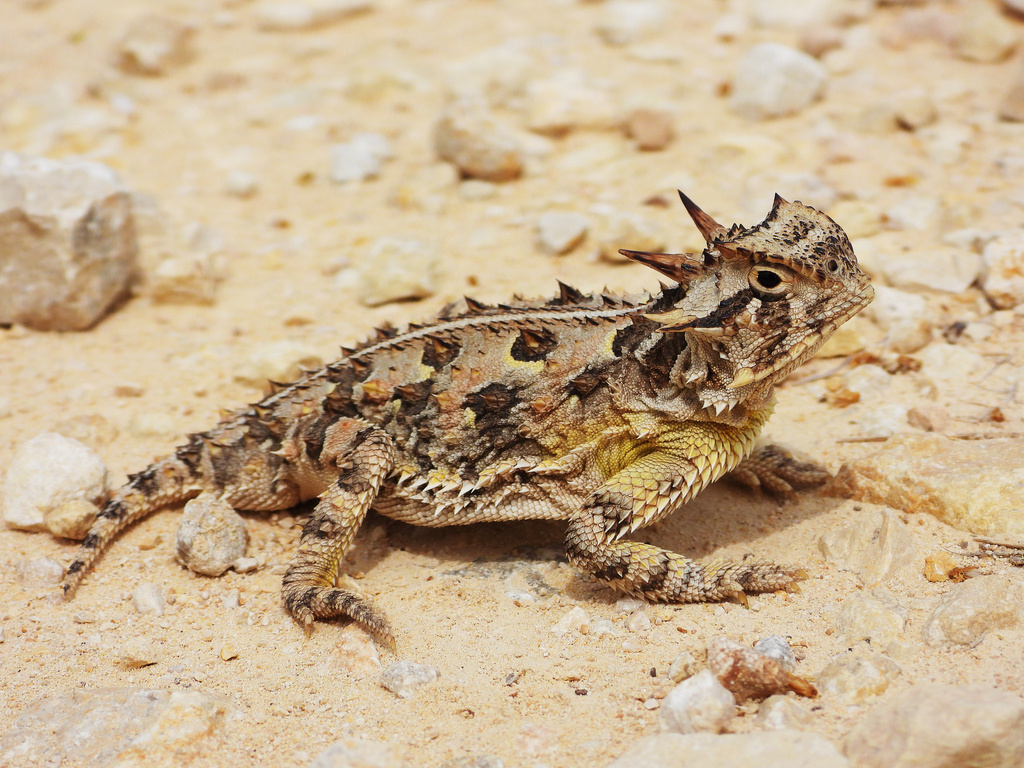
A flat, spiny lizard of the southern Great Plains and deserts that eats harvester ants. When attacked by coyotes or dogs it can squirt a stream of foul-tasting blood from its eyes.
The Texas horned lizard is one of about 21 North American species of spikey-bodied reptiles called horned lizards, all belonging the genus Phrynosoma. It occurs in south-central regions of the US and northeastern Mexico, as well as several isolated introduced records and populations from Southern United States. Though some populations are stable, severe population declines have occurred in many areas of Texas and Oklahoma. The Texas spiny lizard may be confused for a Texas horned lizard due to its appearance and overlapping habitat. Texas horned lizard populations show strong genetic structuring across their range, with limited gene flow between regions. Because the Texas horned lizard is listed as a threatened species in the state, it is illegal to pick up, touch, or possess them in Texas. Wikipedia
What it can do
- iSquirts blood from its eyes up to about 1.5 m to deter dog-family predators
- iiCan puff itself up to look bigger and harder to swallow
- iiiEats harvester ants and tolerates their venom
- ivCollects rain on its back and channels it to its mouth
In the field
Field marks
- aFlat, round body covered in spines
- bTwo long central horns on the back of the head, longer than the others
- cTwo rows of fringe scales along each side
- dPale stripe down the middle of the back with dark spots on either side
- Not to be confused with
- The round-tailed horned lizard (P. modestum) is smaller, with short horns and no side fringe. Greater short-horned lizards (P. hernandesi) have short horns and live at higher altitudes.
- Where to see it
- South Texas brushland (e.g. Chaparral Wildlife Management Area), west Texas and New Mexico grasslands, western Oklahoma
- When
- Active April–September
Life & habits
- Diet
- Mainly harvester ants (Pogonomyrmex); also other insects
- Habitat
- Open, arid and semi-arid land with sparse plants and sandy soil
- Size
- ~6–11 cm snout to vent
Basks in the morning and buries itself in sand at night. Its numbers have fallen in Texas due to pesticides, habitat loss and invasive fire ants that displace harvester ants.
Where it lives
Recorded sightings
—
geo-referenced records in GBIF, from museums, herbaria and field observers.
Native range
South-central United States (Kansas, Oklahoma, Texas, New Mexico, southeastern Colorado and Arizona) and northern Mexico
Drag the globe to turn it. Dots are where records exist, not a range map; darker means more records.
In the old herbals & bestiaries
No plate in the Source Library names this exact species, so these show its closest relatives as the old naturalists drew them: same genus, or the same kind of animal. Click a plate to read the page it came from, with translation.

In the stacks
Searching the stacks…
Every page naming Phrynosoma cornutum in the Biodiversity Heritage Library →
Marginalia
The Texas horned lizard became the state reptile of Texas in 1993, and is the 'Horned Frog' mascot of Texas Christian University. 'Old Rip', supposedly sealed in a courthouse cornerstone in Eastland, Texas, in 1897 and found alive in 1928, became a national sensation.
Curiosity
Blood squirted from its eyes contains chemicals that dogs and coyotes find foul-tasting, but it has no effect on hawks.
Kinship





Photographs: iNaturalist contributors under the licences shown. Records: GBIF.org. Historical plates: Source Library (CC BY-SA 4.0; originals public domain). Summary text: Nature Library editors and Wikipedia (CC BY-SA). Medicinal and edibility notes are historical and educational, not advice. iNaturalist taxon 73905.