- Animals
- ›Chordates
- ›Vertebrates
- ›Reptiles
- ›Turtles and Tortoises
- ›Eurasian Pond, River, and Neotropical Wood Turtles
- ›Geoemydinae
- ›Siebenrockiella
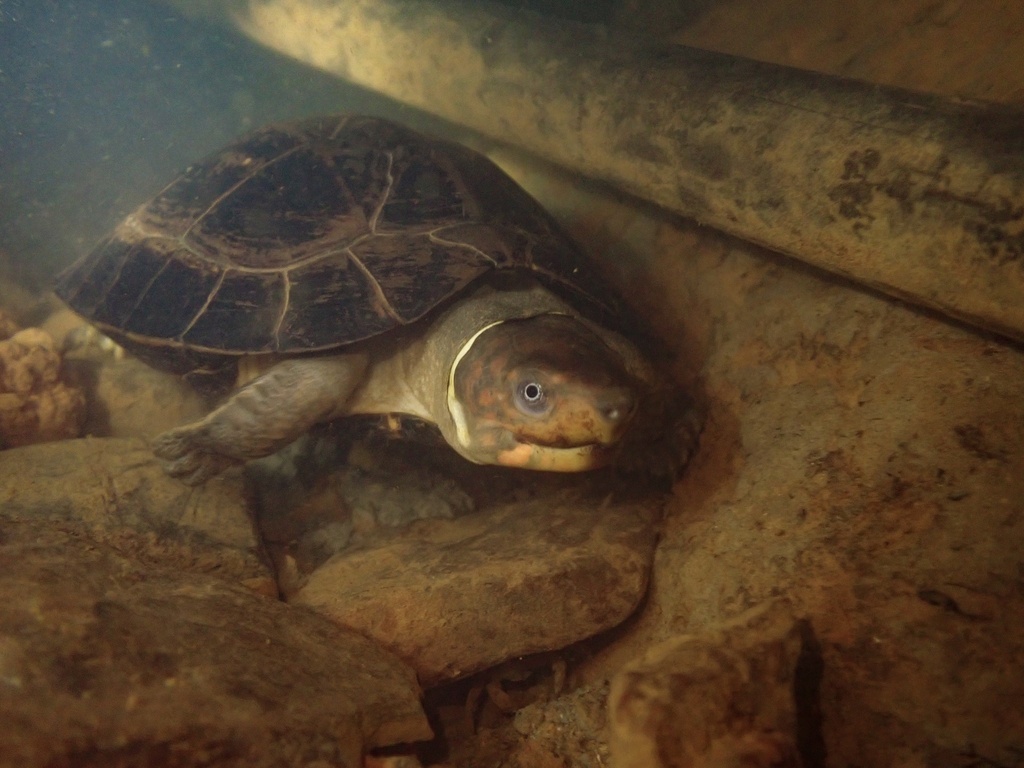
Philippine Pond Turtle
Siebenrockiella leytensis
Siebenrockiella leytensis is a species of freshwater turtle endemic to the Philippines. It is classified as critically endangered. It is known as the Philippine forest turtle, the Philippine pond turtle, the Palawan turtle, or the Leyte pond turtle. Despite the latter common name, it does not occur in the island of Leyte but is instead native to the Palawan island group. It is locally known as bakoko in Cuyonon.
Philippine forest turtles are readily recognizable by their ginkgo-shaped vertebral scutes and a pale white to yellow line traversing across its head behind the ears. The previous characteristic has earned it the nickname of 'bowtie turtle'.
From the article Philippine forest turtle on Wikipedia (CC BY-SA), quoted section by section
Description
Philippine forest turtles have brown to reddish brown to black carapaces that reach a length of 21 cm (8.3 in). Larger individuals can reach 30 cm (12 in) in length, though this is relatively rare. A dorsal ridge (the keel) is only present in the posterior vertebral scutes or absent altogether. The front margin of the carapace is slightly to strongly serrated, with the marginal scutes projecting beyond the cervical scutes. The vertebral scutes are broader than long. The plastron is reddish brown to black, sometimes with blotches of yellow. In juveniles, the plastron is a uniform yellow. The bridge (the hinge connecting plastron and carapace) is the same color as the plastron. It is significantly smaller than the carapace and narrow at the front and back. It possesses deep notches between the projecting gular scutes as well as between the gulars and humerals, but it is more distinct in the former. Its plastral formula is abd > pect > fem > gul > hum > an. The skin of the legs, body, and neck are rough in appearance, being covered in tiny tubercles. The head is brown in color, sometimes speckled at the temples with light brown, orange, or red spots. A thin white to pale yellow line traverses through the width of the head just behind the openings of the ears, it may be divided at the center in some individuals. This has led to the species being nicknamed as the 'bowtie turtle'. …
Range & habitat
Philippine forest turtles are known only from northern Palawan and surrounding islands. This includes the island of Dumaran where the species is still relatively abundant in creeks. Elsewhere, it is believed their populations are declining sharply. Particularly in the areas of Taytay and San Vicente. Its distribution area is estimated to be less than 100 km2.
Wikipedia: “Distribution and habitat”
What it does
Philippine forest turtle populations often exist alongside other more common native turtle species, including Asian leaf turtles (Cyclemys dentata) and Southeast Asian box turtles (Cuora amboinensis). Due to its rarity and its status as newly rediscovered, little is known of the life cycle of the Philippine forest turtle. From observations, however, Philippine forest turtles appear to exhibit long life spans and high adult survival rates. Like most turtles, their sexual maturation is delayed but they are able to mate multiple times before death (iteroparity). Captive adults confiscated from illegal traders were provided a large outside pool with well planted islands and numerous underwater rock formations in Malabon Zoo in Manila. But they proved to be very shy and retiring, spending considerable time hiding under rocks, both in and out of the water. They took some months to adjust to confinement. Observations indicate that they are omnivorous, favouring commercial turtle food, aquatic plants and they have been observed hunting small fish and crustaceans. They became active in the early morning and late evening, foraging for food, and moved about during the night. They were not observed to be keen on basking in the sun, but this may have been the result of being in a captive environment. Known food sources of Philippine forest turtles in the wild include figs.
Wikipedia: “Ecology and behavior”
In human culture
Philippine forest turtles were first described by the American herpetologist Edward Harrison Taylor in 1920 as Heosemys leytensis. He described them on the basis of two specimens (male and female) collected by Gregorio Lopez, allegedly from the swamps of the municipality of Cabalian in Southern Leyte (now known as the municipality of San Juan). These specimens were unfortunately destroyed in World War II during the firebombing of Manila. No other specimens were reported until 1988 when a specimen was bought from a local resident in Taytay, Palawan. Believing that the turtle got there through interisland trade, numerous herpetologists searched Southern Leyte for other individuals. Their lack of success led to fears that the turtle was already extinct. In 2001, during an assessment of endemic wildlife of the island of Palawan, live specimens of Philippine forest turtles were rediscovered. It soon became apparent that natural populations of the species existed in Palawan. Diesmos et al. (2004) have concluded that Taylor and/or Lopez may have somehow confused the type locality of the original specimens. Lopez also collected turtle specimens from the islands of Coron and Busuanga in Palawan. Specimens from Palawan may have been mistakenly exchanged with actual specimens from Leyte (which were probably Cyclemys dentata). …
Wikipedia: “History of discovery”
Where it lives
Recorded sightings
—
geo-referenced records in GBIF, from museums, herbaria and field observers.
Drag the globe to turn it. Dots are where records exist, not a range map; darker means more records.
In the stacks
Searching the stacks…
Every page naming Siebenrockiella leytensis in the Biodiversity Heritage Library →
This page is assembled live from iNaturalist, GBIF, Wikipedia, the Source Library and the Internet Archive. It is not yet part of the hand-edited codex. iNaturalist taxon 73958.