- Animals
- ›Arthropods
- ›Hexapods
- ›Insects
- ›Winged and Once-winged Insects
- ›True Bugs, Hoppers, Aphids, and allies
- ›True Hoppers
- ›Spittlebugs, Cicadas, Leafhoppers and Treehoppers
- ›Cicadas
- ›Typical Cicadas
- ›Cicadinae
- ›Discreet Cicadas
- ›Tacuina
- ›Megatibicen
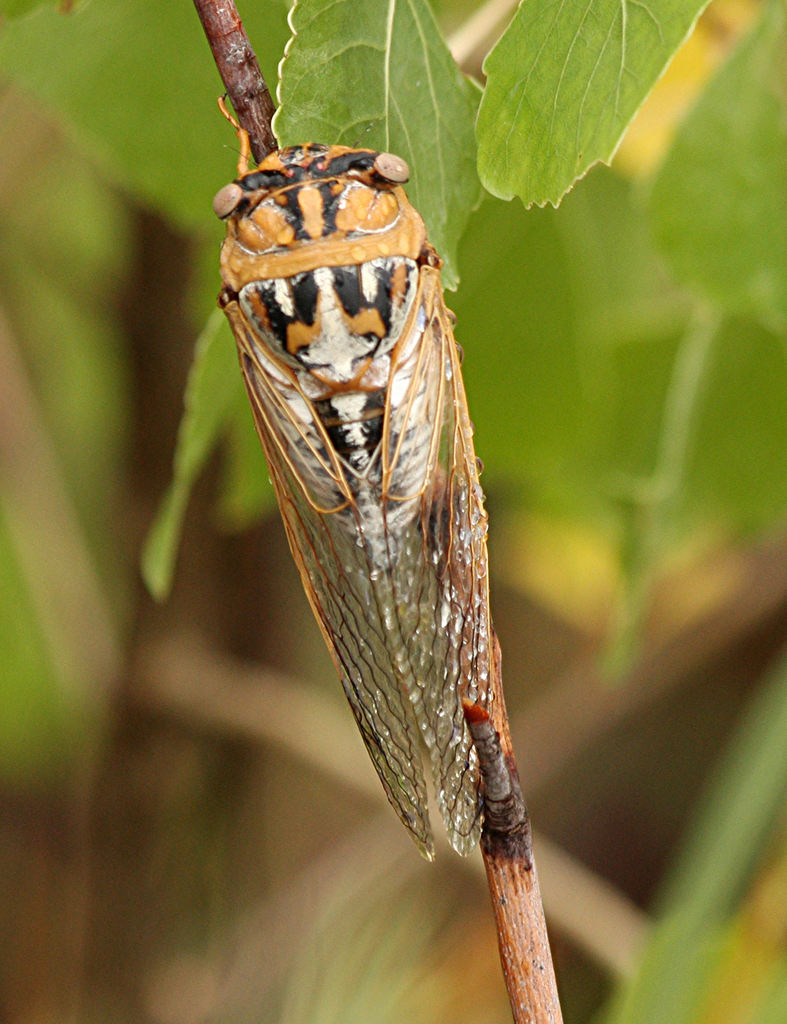
Plains Cicada
Megatibicen dealbatus
Megatibicen dealbatus, commonly called the plains cicada, is a species of annual cicada. Dealbatus is Latin for "whitewashed".
This species used to be called Tibicen dealbatus, but in July 2015, after genetic and physiological evaluation and reconfiguration of the genus Tibicen, this cicada and others in the genus Tibicen were moved to newly created genera. Furthermore, the genus Tibicen still exists, but today it only encompasses a small number of European taxa.
From the article Neotibicen dealbatus on Wikipedia (CC BY-SA), quoted section by section
Description
M. dealbatus adults have beige-colored eyes. and like many other cicadas in the genus. have a distinctive black "mask" that extends from each of the cicada's bulging eyes. This species' pronotum is light orange or olive green. The coloring of its mesonotum is orange, green, black, or brown with three white pruinosity areas on the dorsum separated by stripes. This species may be confused for a superficially similar, but distantly related Megatibicen species: Megatibicen dorsatus. Certain overlapping diagnostic traits are found in both cicadas, such as the pruinose patterning on the abdomen and narrow head. This can complicate accurate identification or lead to erroneous reports, but the call of males and other morphological differences, coupled with geographic locations of both species, are other factors that can aid in correct identification and separation of the two.
Wikipedia: “Description and identification”
Range & habitat
Populations of M. dealbatus are located in central North America in the U.S. Great Plains region where habitat is favorable. This species is found east of the Rocky Mountains and west of the Mississippi River. It has been reported from Colorado, Iowa, Kansas, Montana, Nebraska, New Mexico, North Dakota, Oklahoma, South Dakota, Texas, and Wyoming.
Wikipedia: “Distribution”
What it does
Adults of M. dealbatus feed on numerous vascular plants by using their piercing, sucking mouthparts to reach the xylem of the plant and consume the fluids. As nymphs, they feed on the roots of plants.
Wikipedia: “Diet”
Listen
Looking for field recordings…
Where it lives
Recorded sightings
—
geo-referenced records in GBIF, from museums, herbaria and field observers.
Drag the globe to turn it. Dots are where records exist, not a range map; darker means more records.
In the stacks
Searching the stacks…
Every page naming Megatibicen dealbatus in the Biodiversity Heritage Library →
This page is assembled live from iNaturalist, GBIF, Wikipedia, the Source Library and the Internet Archive. It is not yet part of the hand-edited codex. iNaturalist taxon 740040.