 NL·0282
Herbarium of the Nature Library
- Name
- Balaena mysticetus
- Family
- Balaenidae
- Native to
- Arctic and sub-Arctic seas: Bering–Chukchi–Beaufort, Baffin Bay, Hudson Bay, East Greenland–Svalbard–Barents, Sea of Okhotsk
- Habitat
- Sea ice, Polar seas
Bowhead whale
Balaena mysticetus
Also calledAġviq (Iñupiaq) · Arviq (Inuktitut) · Greenland right whale · Ballena de Groenlandia (Spanish) · Baleia-da-groenlândia (Portuguese) · Grønlandshval (Danish/Norwegian)
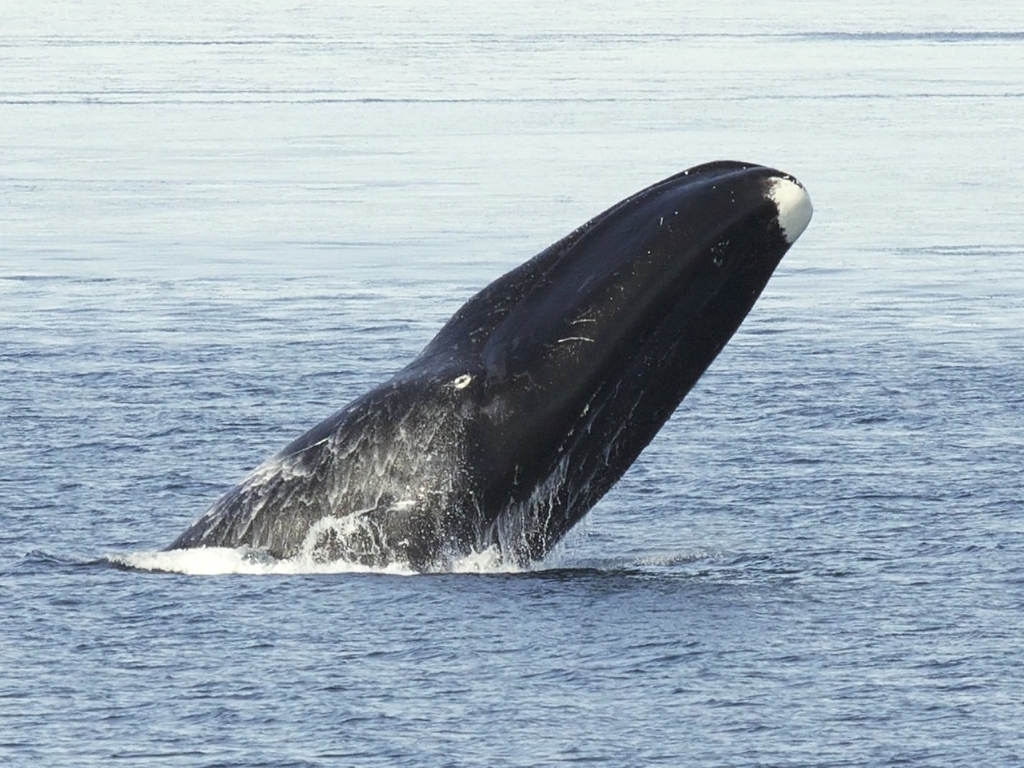
The only baleen whale that lives in the Arctic year-round, a black giant with a massive bow-shaped skull that can smash through sea ice to breathe. Bowheads are the longest-lived mammals known: harpoon points from the 1800s found in living whales, and eye-lens dating, indicate ages of over 200 years.
The bowhead whale, sometimes known as the Greenland right whale, Arctic whale, and polar whale, is a species of baleen whale belonging to the family Balaenidae and is the only living representative of the genus Balaena. It is the only baleen whale endemic to the Arctic and subarctic waters, and is named after its characteristic massive triangular skull, which it uses to break through Arctic ice. Wikipedia
What it can do
- iCan break through sea ice at least 60 cm thick with its head
- iiLongest-lived mammal: one individual was estimated at about 211 years old
- iiiLongest baleen of any whale, up to about 4 m
- ivThickest blubber of any animal, up to about 50 cm
In the field
Field marks
- aHuge, black body with no dorsal fin
- bStrongly arched, bow-shaped mouthline; head up to a third of body length
- cWhite chin patch, often with black spots; pale band near the tail
- dV-shaped blow from two widely spaced blowholes; two humps (head and back) visible when surfacing
- Voice
- Highly varied songs of whoops, moans and trills, likened to jazz because new songs appear each year.
- Not to be confused with
- North Atlantic and North Pacific right whales lack the white chin and have rough white callosities on the head. Gray whale is mottled with barnacles.
- Where to see it
- Disko Bay (West Greenland, spring); Isabella Bay/Igaliqtuuq (Baffin Island, late summer); Utqiaġvik, Alaska (spring migration); Shantar Islands (Sea of Okhotsk); Svalbard (rare)
- When
- Spring migration April–June; late-summer feeding in Baffin and Beaufort seas; wintering in the Bering Sea
Listen
Looking for field recordings…
Life & habits
- Diet
- Copepods, krill and other small zooplankton, skimmed at the surface or near the bottom
- Habitat
- Ice-edge waters, leads and polynyas of the Arctic
- Size
- 14–18 m; 75–100 tonnes
- Lifespan
- Often over 100 years; 200+ in some individuals
Migrates along leads in the sea ice in spring and back south in autumn. Male bowheads sing diverse, ever-changing songs in winter: nearly 200 distinct song types were recorded off Svalbard over three years.
Where it lives
Recorded sightings
—
geo-referenced records in GBIF, from museums, herbaria and field observers.
Native range
Arctic and sub-Arctic seas: Bering–Chukchi–Beaufort, Baffin Bay, Hudson Bay, East Greenland–Svalbard–Barents, Sea of Okhotsk
Drag the globe to turn it. Dots are where records exist, not a range map; darker means more records.
In the stacks
Searching the stacks…
Every page naming Balaena mysticetus in the Biodiversity Heritage Library →
Marginalia
For Iñupiat whaling communities of northern Alaska, the spring bowhead hunt and the Nalukataq festival that follows are the heart of the year. Basque, Dutch and British whalers hunted 'Greenland whales' at Svalbard from the early 1600s.
Curiosity
In 2007 a fragment of a harpoon made in New Bedford in the 1880s was found embedded in a bowhead caught off Alaska.
Kinship






Photographs: iNaturalist contributors under the licences shown. Records: GBIF.org. Historical plates: Source Library (CC BY-SA 4.0; originals public domain). Summary text: Nature Library editors and Wikipedia (CC BY-SA). Medicinal and edibility notes are historical and educational, not advice. iNaturalist taxon 74103.