- Animals
- ›Molluscs
- ›Gastropods
- ›Caenogastropods
- ›Littorinimorpha
- ›Cowries and Allies
- ›Cowries
- ›Erosariinae
- ›Naria
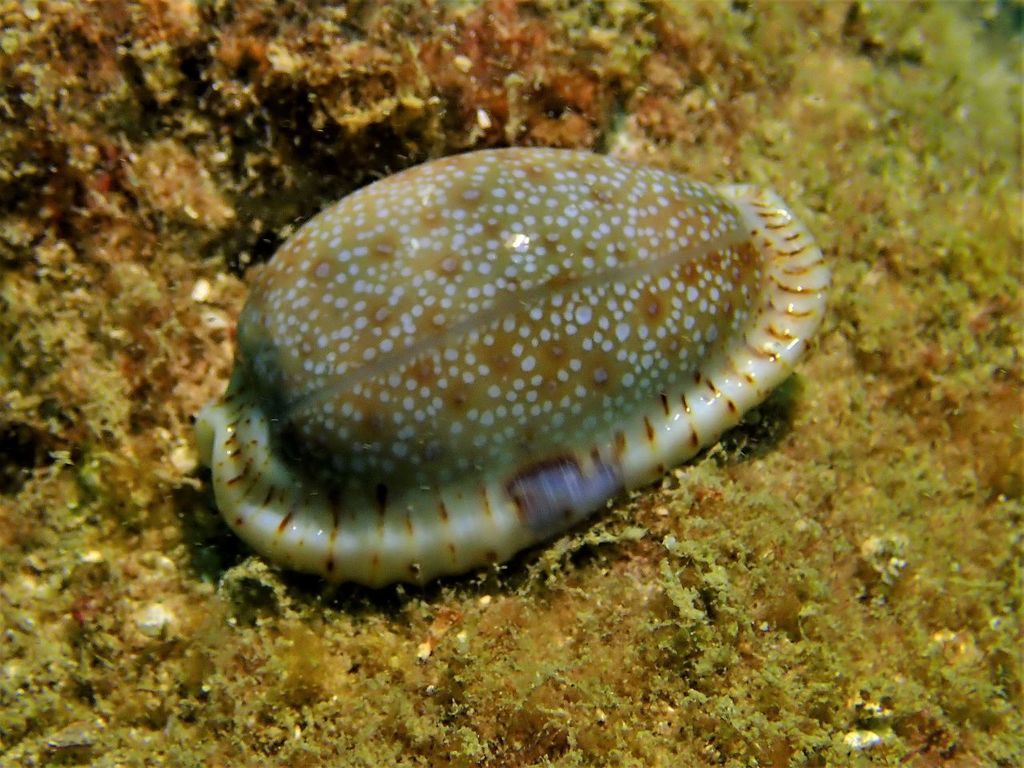
Eroded Cowrie
Naria erosa
Naria erosa, common name the gnawed or eroded cowry, is a species of sea snail, a cowry, a marine gastropod mollusk in the family Cypraeidae, the cowries.
Subspecies
From the article Naria erosa on Wikipedia (CC BY-SA), quoted section by section
Description
The shell of these quite common cowries reaches on average 32–38 millimetres (1.3–1.5 in) in length, with a maximum size of 75 millimetres (3.0 in) and a minimum adult size of 15 millimetres (0.59 in). The dorsum is yellow-ocher or pale brown, with many small white spots. The extremities of the shell show dark brown spots. A dark brown area which is roughly rectangular is present on each side close to the edge. The base is white to light beige, with thin transverse stripes. At night in the living cowries, the extremely papillose brownish mantle usually covers the shell completely, camouflaging the animal.
Range & habitat
This species and its subspecies occur in the Indian Ocean along the coasts of Aldabra, Chagos, the Comores, the East Coast of South Africa, Kenya, Madagascar, the Mascarene Basin, Mauritius, Mozambique, Réunion, the Seychelles, Somalia and Tanzania, as well in the Western Pacific Ocean (Malaysia, Australia, Philippines, Polynesia and Hawaii).
Wikipedia: “Distribution”
Where it lives
Recorded sightings
—
geo-referenced records in GBIF, from museums, herbaria and field observers.
Drag the globe to turn it. Dots are where records exist, not a range map; darker means more records.
In the stacks
Searching the stacks…
Every page naming Naria erosa in the Biodiversity Heritage Library →
This page is assembled live from iNaturalist, GBIF, Wikipedia, the Source Library and the Internet Archive. It is not yet part of the hand-edited codex. iNaturalist taxon 747599.