- Plants
- ›Vascular Plants
- ›flowering plants
- ›Dicots
- ›Legumes, Milkworts, and Allies
- ›Legumes
- ›Acacias, Mimosas, Mesquites, and Allies
- ›Acacia
- ›Botrycephalae
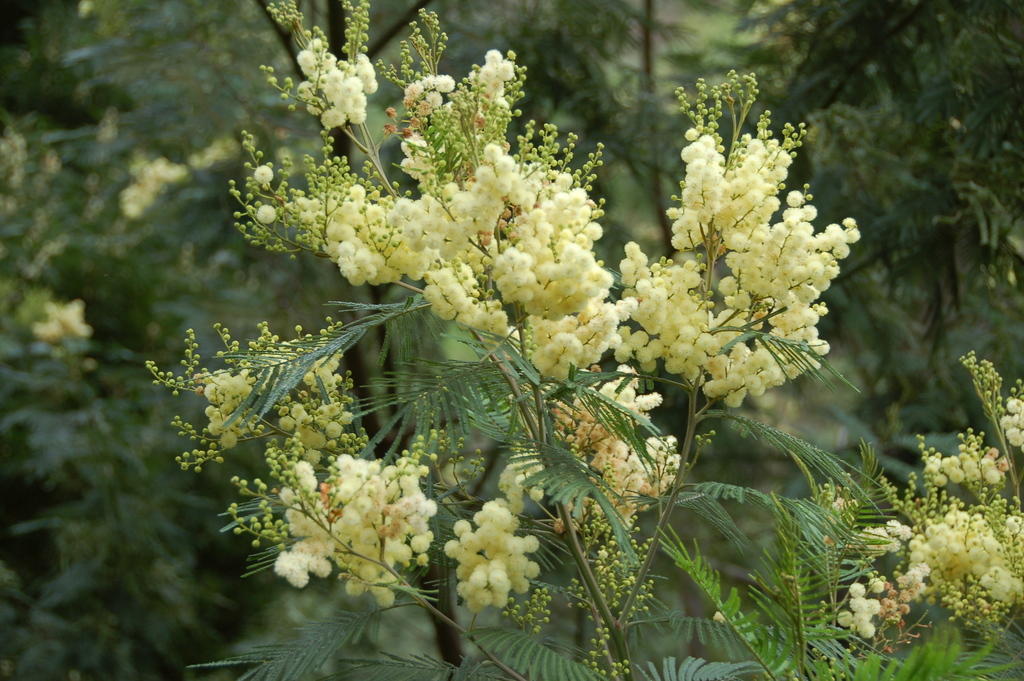
black wattle
Acacia mearnsii
Acacia mearnsii, commonly known as black wattle, late black wattle or green wattle, is a species of flowering plant in the family Fabaceae and is endemic to south-eastern Australia. It is usually an erect tree with smooth bark, bipinnate leaves and spherical heads of fragrant pale yellow or cream-coloured flowers followed by black to reddish brown pods. In some other parts of the world, it is regarded as an invasive species.
From the article Acacia mearnsii on Wikipedia (CC BY-SA), quoted section by section
Description
Acacia mearnsii is a spreading shrub or erect tree that typically grows to a height of 10 m (33 ft) and has smooth bark, sometimes corrugated at the base of old specimens. The leaves are bipinnate with 7 to 31 pairs of pinnae, each with 25 to 78 pairs of oblong to very narrowly oblong pinnules 1–3.5 mm (0.039–0.138 in) long and 0.5–0.8 mm (0.020–0.031 in) wide. There is a spherical gland up to 8 mm (0.31 in) below the lowest pair of pinnae. The flowers are arranged in spherical heads in racemes or panicles on peduncles 2–8 mm (0.079–0.315 in) long, each head with 20 to 40 pale yellow or cream-coloured flowers. Flowering mainly occurs from October to December and black to reddish-brown pods, 30–150 mm (1.2–5.9 in) long and 4.5–8 mm (0.18–0.31 in) wide develop from October to February.
Range & habitat
Acacia mearnsii grows in open forest, woodland or grassland in gullies or on hillside in New South Wales south from Central Mangrove along the coast and tablelands, including in the Australian Capital Territory. It is widespread in Victoria and Tasmania and also occurs in South Australia south of Naracoorte. It has been naturalised in parts of New South Wales, the Mount Lofty Ranges and the south-west of Western Australia. The species has also been introduced to North America, South America, Asia, Europe, Pacific and Indian Ocean islands, Africa, and New Zealand. In these areas it is often used as a commercial source of tannin or a source of firewood for local communities. In some regions, introduced plants of this species are considered a weed. This is because they threaten native habitats by competing with indigenous vegetation, replacing grass communities, reducing native biodiversity and increasing water loss from riparian zones. In Africa, A. mearnsii competes with local vegetation for nitrogen and water resources, which are particularly scarce in certain regions, endangering the livelihoods of millions of people. In its native range A. mearnsii is a tree of tall woodland and forests in subtropical and warm temperate regions. …
Wikipedia: “Distribution and habitat”
What it does
A. mearnsii plays an important role in the native ecosystem of Australia. As a pioneer plant it quickly binds the erosion-prone soil following the bushfires that are common in its Australian habitats. Like other leguminous plants, it fixes atmospheric nitrogen in the soil. Other woodland species can rapidly use these increased nitrogen levels provided by the nodules of bacteria present in their expansive root systems. Hence they play a critical part in the natural regeneration of Australian bushland after fires.
Consumption and excretion: The seeds are potentially distributed by rodents or birds. For ornamental purposes (local) By animals: The dispersal of the seeds of A . mearnsii is believed to be aided by cattle and birds. By people: Local people collecting branches and logs for firewood may spread seeds. Transportation of soil: The seeds may also be spread by the movement of seed-contaminated soil. By water: The hard-coated seeds are spread readily down water courses. Koalas use tree-hugging for cooling in very hot weather: they have been found to favour the non-food A. …
Wikipedia: “Ecology in Australia”
At the table
The Ngunnawal people of the Australian Capital Territory use the gum as food and to make cement (when mixed with ash), and to ensure a supply of sap, the bark was cut in the autumn. The bark was also used to make coarse rope and string, and used to be infused in water to make a medicine for indigestion.
Wikipedia: “Uses”
Where it lives
Recorded sightings
—
geo-referenced records in GBIF, from museums, herbaria and field observers.
Drag the globe to turn it. Dots are where records exist, not a range map; darker means more records.
In the stacks
Searching the stacks…
Every page naming Acacia mearnsii in the Biodiversity Heritage Library →
This page is assembled live from iNaturalist, GBIF, Wikipedia, the Source Library and the Internet Archive. It is not yet part of the hand-edited codex. iNaturalist taxon 75250.