- Animals
- ›Arthropods
- ›Hexapods
- ›Insects
- ›Winged and Once-winged Insects
- ›Ants, Bees, Wasps, and Sawflies
- ›Narrow-waisted Wasps, Ants, and Bees
- ›Ants, Bees, and Stinging Wasps
- ›Vespoid Wasps
- ›Hornets, Paper Wasps, Potter Wasps, and Allies
- ›Paper Wasps
- ›Ropalidiini
- ›Polybioides
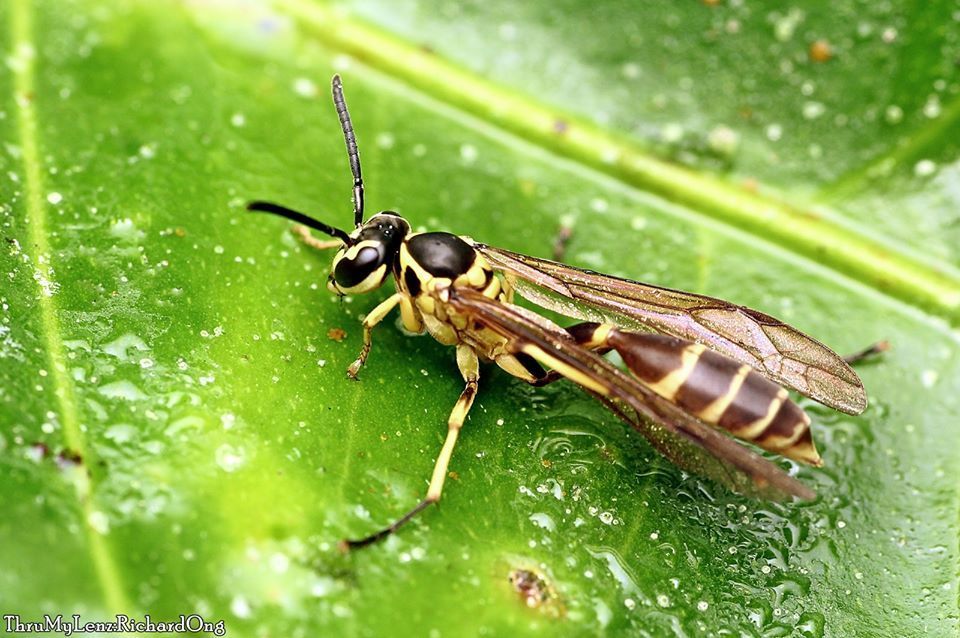
Polybioides raphigastra
Polybioides raphigastra is a species of social wasp found in the forests of South East Asia and Indonesia. It has recently been placed in the tribe Ropalidiini. This species is known for the downward-spiraling shape of their nests, and for having colony sizes exceeding ten thousand members.
From the article Polybioides raphigastra on Wikipedia (CC BY-SA), quoted section by section
Description
P. raphigastra bodies are composed of mostly dark areas, with lighter areas near the edge of segmented appendages. These dark areas are pale brown with light areas maintaining various shades of yellow.
Nests. The species nests in closed cavities such as caves and hollow trees. When nests are constructed within tree trunks, the trunks are often left entirely intact, with only small crevices giving access to the internal cavities that house the nest. In the trunk cavity, nests hang vertically with the envelope surrounding the nest directly attached to the inside of the cavity. Nests, often ovoidal in shape, may measure approximately 23 cm in length, with maximum diameters of 14.5 x 16 cm. Nests may contain well over ten thousand cells. Nests are egg-shaped and formed of a single, helicoidal comb that winds upon itself eight or nine times in a fashion so that each whorl is partially enclosed by the following one. Nests are entirely composed of very short plant hairs bound together by differing levels of secretion. Nest color is brown to yellowish, and the envelope may be darker than the cells inside. The outer envelope displays crescent-like patterns of colors varying from white to reddish brown. …
Wikipedia: “Description and identification”
Range & habitat
P. raphigastra resides primarily in the forests of South East Asia and Indonesia. However, the genus as a whole has a quite peculiar geographical distribution as it contains species residing in the Philippines and equatorial Africa. P. raphigastra constructs elaborate nests inside small cavities such as tree trunks. These nests are characterized by vertical combs surrounded by an envelope.
Wikipedia: “Distribution and habitat”
Toxicity
Venom sacs contain both saturated and unsaturated linear hydrocarbons of a chain length between 11 and 18 carbon atoms. The major components are pentadecane and pentadecene. P. raphigastra venom is also known to contain phenol, benzaldehyde, phenylacetaldehyde, naphthalene, indene, limonene and decanal. Additionally, several compounds that have been identified in their venom function as alarm pheromones in other species of social insect.
== References ==
Wikipedia: “Components of the venom”
Listen
Looking for field recordings…
Where it lives
Recorded sightings
—
geo-referenced records in GBIF, from museums, herbaria and field observers.
Drag the globe to turn it. Dots are where records exist, not a range map; darker means more records.
In the stacks
Searching the stacks…
Every page naming Polybioides raphigastra in the Biodiversity Heritage Library →
This page is assembled live from iNaturalist, GBIF, Wikipedia, the Source Library and the Internet Archive. It is not yet part of the hand-edited codex. iNaturalist taxon 752733.