- Animals
- ›Arthropods
- ›Hexapods
- ›Insects
- ›Winged and Once-winged Insects
- ›Ants, Bees, Wasps, and Sawflies
- ›Narrow-waisted Wasps, Ants, and Bees
- ›Ants, Bees, and Stinging Wasps
- ›Vespoid Wasps
- ›Hornets, Paper Wasps, Potter Wasps, and Allies
- ›Paper Wasps
- ›Ropalidiini
- ›Polybioides
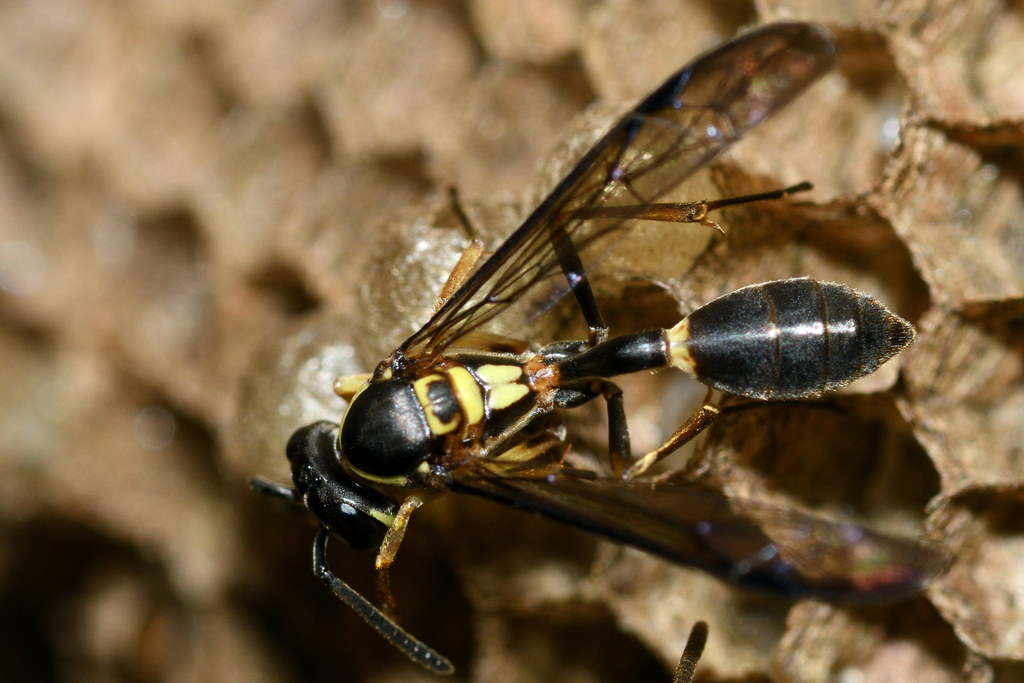
Polybioides tabidus
Polybioides tabidus, the African swarm-founding wasp, is a social paper wasp from the order Hymenoptera that is typically found in Central Africa. This wasp is unique in that it exhibits cyclical oligogyny, meaning queen number varies with colony cycle. After several generations of production of workers and future queens, a subset of many workers and queens leave the original colony to begin a new one. The new colony does not produce new queens until current queens from the old colony have died. P. tabidus has been observed to display both predator and scavenger behavior, depending on the food sources available.
From the article Polybioides tabidus on Wikipedia (CC BY-SA), quoted section by section
Range & habitat
Like all other wasps of the tribe Ropalidiini, P. tabidus is distributed in the Old World. P. tabidus is mainly found in the forest areas of tropical Central Africa. P. tabidus has been studied in Cameroon and Western Kenya, namely the Kakamega Forest Reserve.
Wikipedia: “Distribution and habitat”
Listen
Looking for field recordings…
Where it lives
Recorded sightings
—
geo-referenced records in GBIF, from museums, herbaria and field observers.
Drag the globe to turn it. Dots are where records exist, not a range map; darker means more records.
In the stacks
Searching the stacks…
Every page naming Polybioides tabidus in the Biodiversity Heritage Library →
This page is assembled live from iNaturalist, GBIF, Wikipedia, the Source Library and the Internet Archive. It is not yet part of the hand-edited codex. iNaturalist taxon 752734.