- Plants
- ›Vascular Plants
- ›flowering plants
- ›Dicots
- ›pinks, cactuses, and allies
- ›Amaranth family
- ›Amaranthoideae
- ›Amaranthus
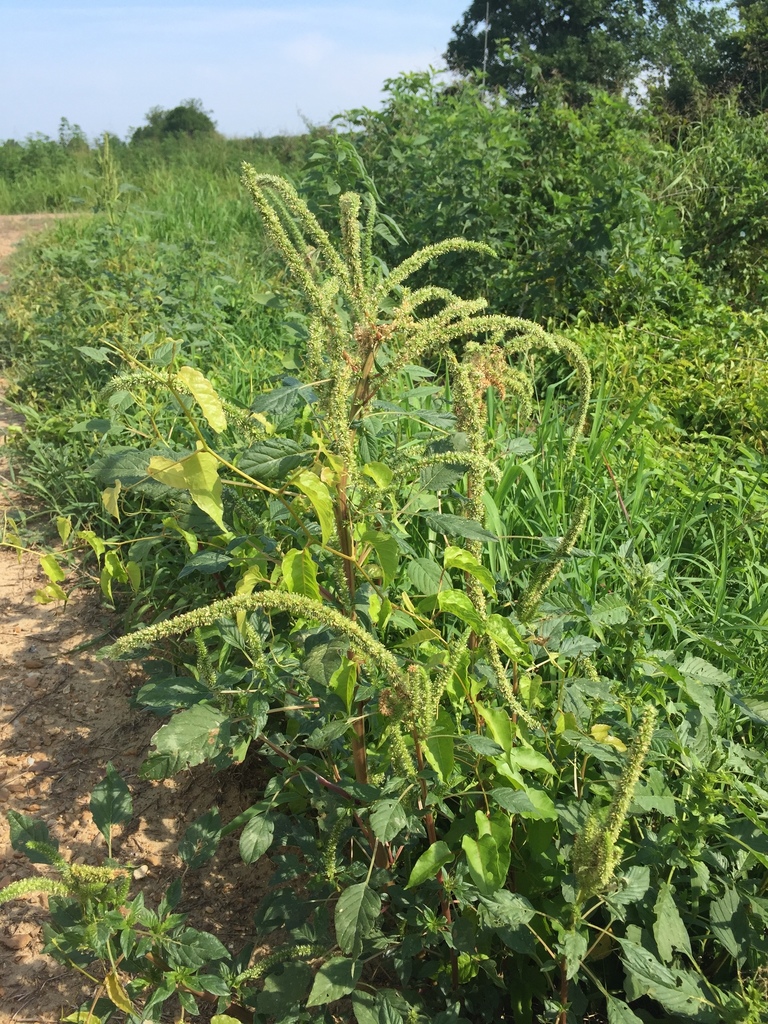
rough-fruit amaranth
Amaranthus tuberculatus
Amaranthus tuberculatus, commonly known as roughfruit amaranth, rough-fruited water-hemp, tall waterhemp, or common waterhemp, is a species of flowering plant. It is a summer annual broadleaf with a germination period that lasts several months.
Tall waterhemp has been reported as a weed in 40 of 50 U.S. states.
From the article Amaranthus tuberculatus on Wikipedia (CC BY-SA), quoted section by section
Description
A distinguishing characteristic of tall waterhemp that sets it apart from similar members of the genus Amaranthus is the lack of hair on its stems and leaves. This characteristic gives the leaves a bright, glossy appearance. The stem is typically erect and slender, which can be up to three feet long with a color of either green or red. Tall waterhemp is a dioecious plant. The seedhead branches in the female are numerous, short, and smooth. The male seedhead branches are fewer, longer, and more slender than those of the female. The species has terminal spike inflorescences and very short bracts with simple to highly branched flowers. Seed produced is reddish to black and less than 1/32 inch in diameter.
Wikipedia: “Morphology”
Range & habitat
Tall waterhemp is native to North America. It is believed to have originally had a range north of Missouri and Tennessee to the Great Lakes. It is now found in 40 states but is most common in the Great Plains and Great Lakes regions. Tall waterhemp predominantly grows in wet habitats, such as ponds, marshes, lakes, creeks, and other riparian zones. The plant can grow in a variety of climates, including roadways, railroads and agricultural fields.
Wikipedia: “Geographic distribution”
How it is grown
In North America, tall waterhemp is considered a major weed of agricultural fields and other disturbed habitats. The Southern Weed Science Society includes tall waterhemp on their list of weed species. However, it is not listed on the federal noxious weed list or any state lists in the United States. In Europe and other continents where the species has been introduced, naturalization is an infrequent occurrence. Because of the long germination window for tall waterhemp, a single herbicide application is unlikely to be an effective control strategy. Michigan State University Extension recommends a preemergence application followed by one or more postemergence applications. Some populations of tall waterhemp have been reported resistant to acetolactate synthase inhibiting (ALS) herbicides and the triazines, with some individual weeds being resistant to both herbicide groups. Resistance to acifluorfen and other diphenyl ether herbicides has been reported. Even more alarming is the emergence of waterhemp resistant to the latest generation of herbicides, HPPD inhibitors. Furthermore, waterhemp at a site in Nebraska was found to be resistant to 2,4-D, a phenoxy herbicide. According to Bob Hartzler of Iowa State University, the most effective control of tall waterhemp is achieved by cultural practices that promote growth of the desired vegetation.
Wikipedia: “Agricultural impacts and control”
Where it lives
Recorded sightings
—
geo-referenced records in GBIF, from museums, herbaria and field observers.
Drag the globe to turn it. Dots are where records exist, not a range map; darker means more records.
In the stacks
Searching the stacks…
Every page naming Amaranthus tuberculatus in the Biodiversity Heritage Library →
This page is assembled live from iNaturalist, GBIF, Wikipedia, the Source Library and the Internet Archive. It is not yet part of the hand-edited codex. iNaturalist taxon 75400.