- Plants
- ›Vascular Plants
- ›flowering plants
- ›Dicots
- ›Heathers, Balsams, Primroses, and Allies
- ›heath family
- ›madrones, bearberries, and allies
- ›Arctostaphylos
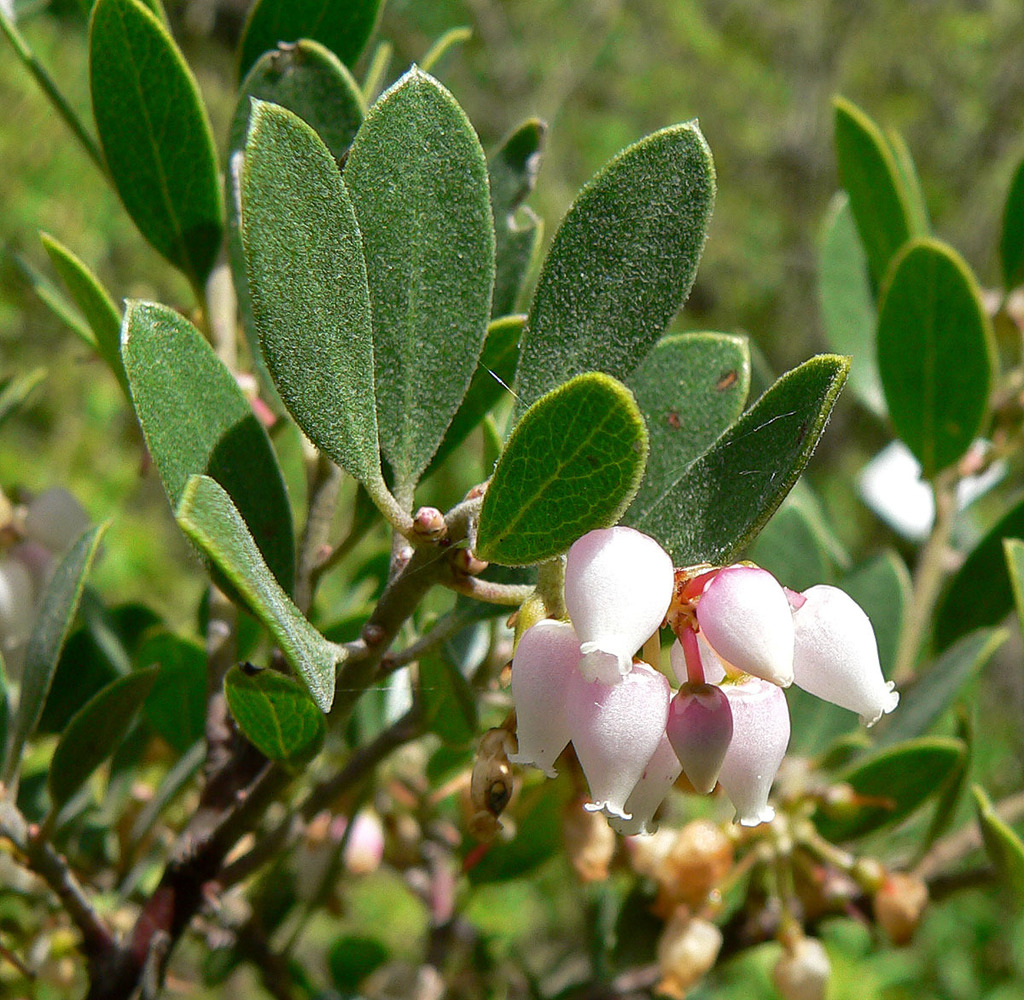
Franciscan manzanita
Arctostaphylos franciscana
Arctostaphylos franciscana, known by the common name Franciscan manzanita, is a species of manzanita. It was named by Alice Eastwood in 1905 who was the first to identify the organism as a unique species. It is native to the city of San Francisco and it is a low-growing, spreading-to-ascending evergreen shrub in the heath family Ericaceae. The name is derived from the Spanish word manzanita, which means “little apple” because of the small, apple shaped berries that grow from the plant.
From the article Arctostaphylos franciscana on Wikipedia (CC BY-SA), quoted section by section
Description
In the Spring and Winter, the Franciscan manzanita produces urn-shaped flowers with a light pink to white coloring. It also produces reddish-brown fruits that range in size from 0.24 to 0.32 in (6.1 to 8.1 mm) wide. When the Franciscan manzanita is at its most mature state, the shrub can reach a height ranging from 2 to 3 ft (0.61 to 0.91 m) tall with an average width of 10 ft (3.0 m). The leaves, which grow to an average length of 0.6 to 0.8 in (15 to 20 mm) long, are longer than they are wide and have the same surface on both sides of the leaf. In the wild, the Franciscan manzanita does not reproduce from burls, but primarily from seeds.
Where it lives
Recorded sightings
—
geo-referenced records in GBIF, from museums, herbaria and field observers.
Drag the globe to turn it. Dots are where records exist, not a range map; darker means more records.
In the stacks
Searching the stacks…
Every page naming Arctostaphylos franciscana in the Biodiversity Heritage Library →
This page is assembled live from iNaturalist, GBIF, Wikipedia, the Source Library and the Internet Archive. It is not yet part of the hand-edited codex. iNaturalist taxon 75511.