- Plants
- ›Vascular Plants
- ›flowering plants
- ›Dicots
- ›Heathers, Balsams, Primroses, and Allies
- ›heath family
- ›madrones, bearberries, and allies
- ›Arctostaphylos
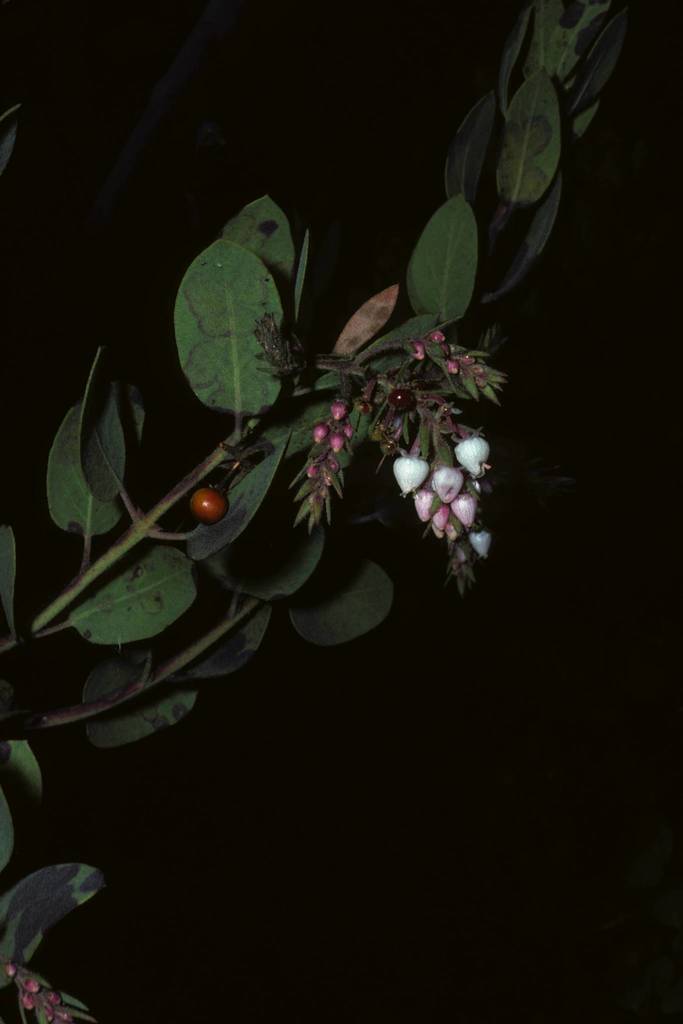
otay manzanita
Arctostaphylos otayensis
Arctostaphylos otayensis is a species of manzanita commonly known as the Otay manzanita. It is a rare perennial shrub native to the mountains of southwestern San Diego County, California and northwestern Baja California, where it grows in chaparral habitats on metavolcanic soils, mostly in the San Ysidro Mountains. The white urn-shaped flowers bloom from winter to spring. Because of the small range of this species and a number of threats, it is of conservation concern.
From the article Arctostaphylos otayensis on Wikipedia (CC BY-SA), quoted section by section
Description
Arctostaphylos otayensis is an erect or mound-forming shrub, 1–3 m (3.3–9.8 ft) tall. It lacks a burl, and has twigs that are sparsely covered in short hairs and long glandular hairs. The leaves are erect, borne on petioles 5–8 mm (0.20–0.31 in) long. The base of the leaf near the petiole has a rounded or truncate shape. The leaves have a gray-glaucous color and are narrowly elliptic or oblong-elliptic to ovate in shape, measuring 2–3 cm (0.79–1.18 in) long by 1–2 cm (0.39–0.79 in) wide. The inflorescence is a panicle with 4 to 7 branches. The young inflorescence branches have an erect or ascending orientation, and are covered in hairs like those on the twigs. The inflorescence is covered in leaflike bracts. The flowers are attached to pedicels 3–8 mm (0.12–0.31 in) long. The flowers are white, with a conic to urceolate shape, and with an ovary covered in dense white hairs. Flowering is from winter to early spring. The fruits are globose in shape, mostly lacking hairs, and are 6–8 mm (0.24–0.31 in) in diameter.
Range & habitat
Arctostaphylos otayensis is mostly restricted to the San Ysidro Mountains of San Diego County, California and Tijuana Municipality, Baja California. Smaller populations occur on neighboring San Miguel Mountain to the north, and to the south near La Misión. A. otayensis is found in chaparral and cismontane woodland habitats in metavolcanic soils, where it occurs on rocky slopes or outcrops. Associates in chaparral include Adenostoma fasciculatum, Arctostaphylos glandulosa, Malosma laurina, Ceanothus, and Chamaebatia australis. In Tecate cypress associations, it occurs with Xylococcus bicolor, A. glandulosa, Cercocarpus betuloides, Comarostaphylis diversifolia, and C. australis. The San Ysidro Mountains are an ancient volcanic system which supports a high number of endemic taxa like A. otayensis possibly limited to the metavolcanic rocks and soils. As this species lacks a burl, it cannot resprout after intense fires.
Wikipedia: “Distribution and habitat”
Where it lives
Recorded sightings
—
geo-referenced records in GBIF, from museums, herbaria and field observers.
Drag the globe to turn it. Dots are where records exist, not a range map; darker means more records.
In the stacks
Searching the stacks…
Every page naming Arctostaphylos otayensis in the Biodiversity Heritage Library →
This page is assembled live from iNaturalist, GBIF, Wikipedia, the Source Library and the Internet Archive. It is not yet part of the hand-edited codex. iNaturalist taxon 75533.