- Plants
- ›Vascular Plants
- ›flowering plants
- ›Dicots
- ›Sunflowers, Bellflowers, Fanflowers, and Allies
- ›Sunflowers, Daisies, Asters, and Allies
- ›Vernonioideae
- ›Arctotideae
- ›Arctotidinae
- ›Arctotheca
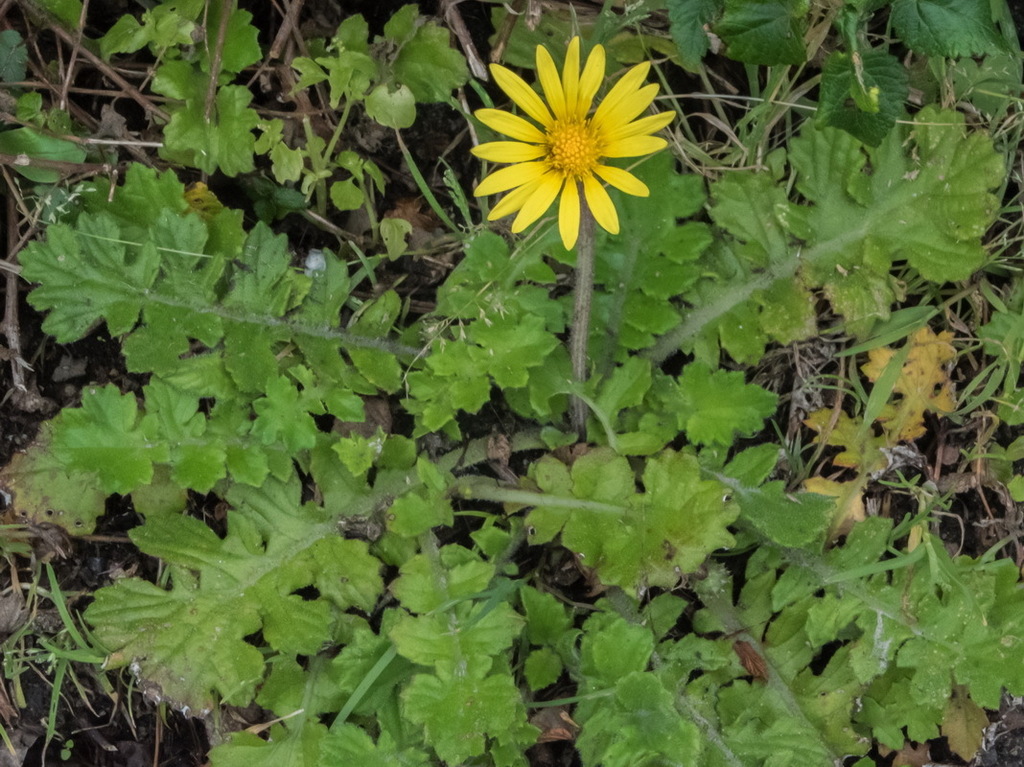
Prostrate Capeweed
Arctotheca prostrata
Arctotheca prostrata (commonly known as Capeweed, South African Capeweed, Cape Dandelion, and Cape Gold) is a rosette-forming plant in the family Asteraceae native to Namibia and the Cape Provinces of South Africa. The infertile form is often cultivated as a ground cover, while the fertile form spreads rapidly in disturbed areas like beside roads and trails, threatening native ecosystems. It is listed as an invasive weed in California and Australia.
From the article Arctotheca prostrata on Wikipedia (CC BY-SA), quoted section by section
Description
The Arctotheca prostrata is characterized by a prostrate growth that is low, flat, and leans on the ground. Leaves are described to be oval or slightly lobed with a pale green color on the adaxial surface and a silver coating on the surface, which gives the leaf of the flower a glossy appearance. In addition to this, Arctotheca prostrata has small, daisy-like flowers in a bright yellow arrangement that mimics that of a sunflower and looks quite prominent against the dull green leaves. These flowers perch on very short stalks, or pedicels, that instantly provide a splash of color but do not extend too high. The plant exhibits these rooted runners known as creeping stolons which give the plant a blanket-like appearance. This annual herbaceous plant grows slowly (mainly during late winter) and has semi-flowering stems up to 11.8 inches (30 cm) tall. It either has small creeping or spreading stems before flowering, or it is stemless and forms a basal rosette. As for its petals and foliage, they can range in size from 2-10 inches (5-25 cm) cm long and 1.4 (2-6 cm) wide. The most noticeable feature of the flower is its 20-26 bright yellow flower petals, each ranging in size from 0.4-1 inch (1–2.5 cm), while the flower size itself is around 2.5 inches (6.5cm).
Wikipedia: “Appearance”
Range & habitat
Arctotheca prostrata thrives in coastal prairies, sandy soils, and disturbed areas. It has naturalized in parts of California, particularly along the north, central, and southern coasts. While the sterile form is cultivated as an ornamental ground cover, the fertile form poses significant ecological threats due to its rapid spread and colonization in disturbed habitats.
Wikipedia: “Habitat”
In human culture
The introduction of this plant to regions outside of its native South African range likely occurred through the horticultural trade, as it was valued for its use as an ornamental ground cover. Its spread in California and Australia is particularly well-documented, where it quickly became invasive due to its ability to thrive in disturbed areas. This species found ideal conditions in California along the coastal prairies and urban areas, where it was established through stolon propagation. Over time, the spread of the fertile form of this plant in Australia has had significant agricultural impacts, smothering crops and dominating overgrazed pastures. Initially introduced with ornamental intentions, herbarium studies indicate that this species is sterile, although some reports suggest a fertile, invasive variety. This plant is difficult to control once established and has naturalized in regions where Arctotheca calendula is also present. Arctotheca prostrata has been given a moderate invasiveness rating by Cal-IPC.
Wikipedia: “History”
Where it lives
Recorded sightings
—
geo-referenced records in GBIF, from museums, herbaria and field observers.
Drag the globe to turn it. Dots are where records exist, not a range map; darker means more records.
In the stacks
Searching the stacks…
Every page naming Arctotheca prostrata in the Biodiversity Heritage Library →
This page is assembled live from iNaturalist, GBIF, Wikipedia, the Source Library and the Internet Archive. It is not yet part of the hand-edited codex. iNaturalist taxon 75549.