- Plants
- ›Vascular Plants
- ›flowering plants
- ›Dicots
- ›pepper plants, birthworts, and allies
- ›birthwort family
- ›Asaroideae
- ›Asarum
- ›Asarum
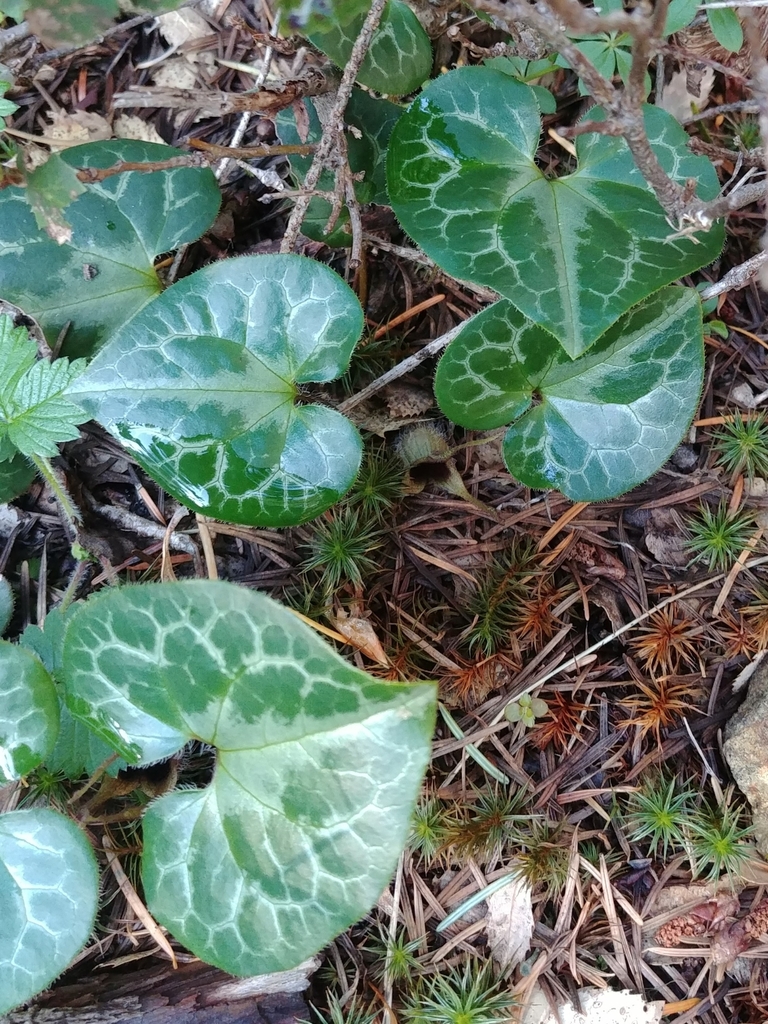
marbled wild-ginger
Asarum marmoratum
Asarum marmoratum is a species of wild ginger known by the common name marbled wild ginger.
It is native to the Klamath Mountains of northern California and southern Oregon, as well as adjacent slopes of the Cascade Range. It is a plant of moist high-elevation forests and rocky mountainsides. This is a rhizomatous perennial herb with hairy green leaves with bright cream-white colored marbling. The leaves are heart-shaped to kidney-shaped to nearly round. Flowers appear at ground-level. They consist of three coarsely hairy sepals which are dark greenish brown outside and dark reddish inside. The fruit is a fleshy capsule containing many seeds.
From the article Asarum marmoratum on Wikipedia (CC BY-SA), quoted section by section
Range & habitat
Asarum marmoratum is endemic to southwestern Oregon and northern California, where it grows in the Siskiyou Mountains and adjacent slopes of the Cascade Range. The elevational range is 200–1,800 m (660–5,900 ft). Typical habitat includes dry or mesic forests, exposed, rocky slopes, and roadcuts, where it is associated with Douglas fir, Abies concolor, Chamaecyparis lawsoniana, and Quercus sadleriana. It is not known to be sympatric with the morphologically similar A. hartwegii but sometimes grows with A. caudatum. Its distribution consists of widely scattered populations, most of which are small but vary considerably in the number of individuals. The the plant's distribution ranges from southern Lane County, Oregon to 20 mi (32 km) south of the Oregon state border in Del Norte and Siskiyou County, California. Records of A. marmoratum from Shasta County, California were later determined to be A. hartwegii. The species is far more common in southwestern Oregon than in California, where there are only eleven known occurrences.
Wikipedia: “Distribution and habitat”
What it does
The seeds of A. marmoratum have fleshy appendage called a funiculus that attracts ants. The ants transport the seeds, serving as the species' primary means of dispersal through a process called myrmecochory. Because ants typically carry the seeds short distances, this dispersal mechanism has limited potential to expand the species' geographic range but helps maintain continuity within existing populations.
Wikipedia: “Ecology”
Where it lives
Recorded sightings
—
geo-referenced records in GBIF, from museums, herbaria and field observers.
Drag the globe to turn it. Dots are where records exist, not a range map; darker means more records.
In the stacks
Searching the stacks…
Every page naming Asarum marmoratum in the Biodiversity Heritage Library →
This page is assembled live from iNaturalist, GBIF, Wikipedia, the Source Library and the Internet Archive. It is not yet part of the hand-edited codex. iNaturalist taxon 75601.