- Plants
- ›Vascular Plants
- ›flowering plants
- ›Dicots
- ›Gentians, Dogbanes, Madders, and Allies
- ›Dogbane Family
- ›milkweeds
- ›Asclepiadeae
- ›Asclepiadinae
- ›Asclepias
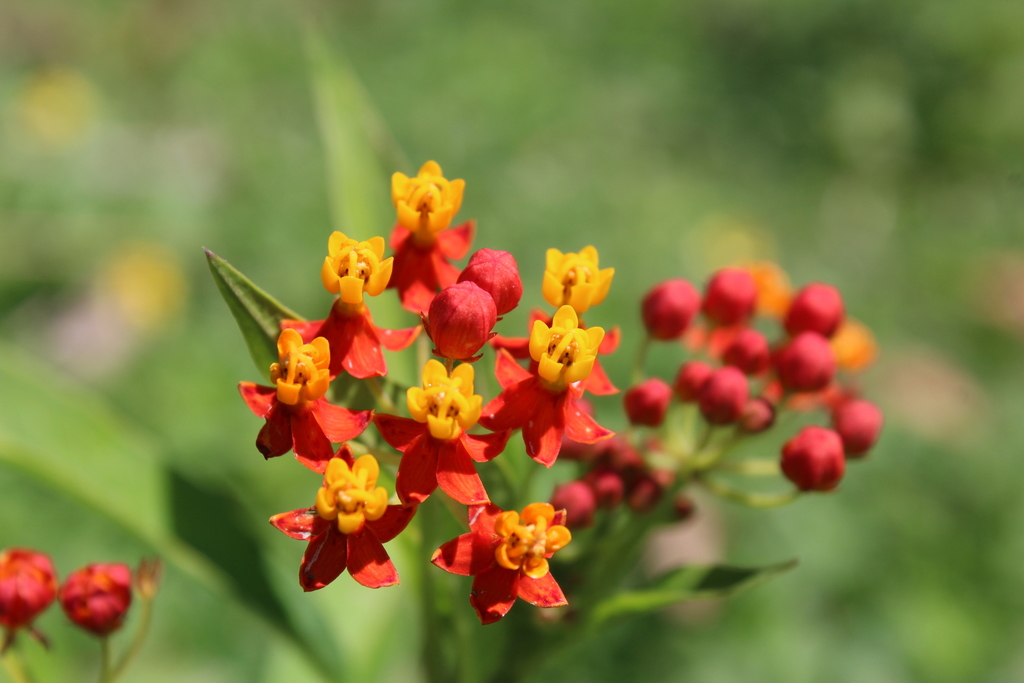
tropical milkweed
Asclepias curassavica
Asclepias curassavica, commonly known as tropical milkweed, is a flowering plant species of the milkweed genus, Asclepias. This species is one of two in the Asclepias genus considered a weed, the other being Asclepias fruticosa. It originated in South America and is now native to the American tropics and has a pantropical distribution as an introduced species. Other common names include bloodflower or blood flower, cotton bush, hierba de la cucaracha, Mexican butterfly weed, redhead, scarlet milkweed, and wild ipecacuanha.
From the article Asclepias curassavica on Wikipedia (CC BY-SA), quoted section by section
Description
Typical plants are evergreen perennial subshrubs that grow up to 1 m (3.3 ft) tall and have pale gray stems. The leaves are arranged oppositely on the stems and are lanceolate or oblong-lanceolate shaped ending in acuminate or acute tips. Like other members of the genus, the sap is milky. The flowers are in cymes with 10-20 flowers each. They have purple or red corollas and corona lobes that are yellow or orange. Flowering occurs nearly year-round. The 5–10 cm (2.0–3.9 in) long, fusiform shaped fruits are called follicles. The follicles contain tan to brown seeds that are ovate in shape and 6–7 mm (0.24–0.28 in) long. The flat seeds have silky hairs that allow the seeds to float on air currents when the pod-like follicles dehisce (split open). These plants are self-compatible (SC) and can self-pollinate if no other milkweed is near. Self-compatible plants normally rely on pollinators for the process of fertilization. When it comes down to it, they are able to self-fertilize. Based on a study, 100% of germination via self-pollination was completed within three weeks. Germination was still at a 100% success rate with cross pollination as well. Self-pollination is found to produce lesser amounts of seeds and was found to occur spontaneously in this species, which is unique being that most milkweed species are self-incompatible. …
Range & habitat
Asclepias curassavica is described by NatureServe as a "widespread species, ranging from southern North America through Central America and into South America." It is an introduced species in the US states of California, Florida, Hawaii, Louisiana, Tennessee, and Texas, as well as the US unincorporated territories of Puerto Rico and the United States Virgin Islands. It has been introduced and naturalized in the Chinese provinces of Anhui, Fujian, Guangdong, Guangxi, Guizhou, Hainan, Hubei, Hunan, Jiangsu, Jiangxi, Qinghai, Sichuan, Xizang, Yunnan, and Zhejiang, as well as in Taiwan. Asclepias curassavica was introduced to Australia prior to 1869 and is widespread in parts of Queensland. It is considered an exotic plant, and a weed, at the Meteor Downs South Project near Rolleston, Queensland, Australia.
Wikipedia: “Distribution”
How it is grown
Asclepias curassavica is grown as an ornamental garden plant and as a food source for some butterflies. There are a number of different cultivars with improved flower colors and shorter habit; some have bright red, yellow or orange colored flowers. The species is sometimes grown as a cut flower. However, when the stems or leaves are broken, milky sap exudes which can cause eye injury. Cultivation of Asclepias curassavica may be harmful to the migration patterns of monarch butterflies when used in gardens outside of its native tropical range. Though public concern for the rapidly declining monarch population increased the demand and commercial availability of milkweed among nurseries in the US, the results have been mixed. While tropical milkweed may effectively sustain monarch larvae, the perennial growth of the plant takes ill effect on the monarchs' migratory patterns and may have other physiological effects. Use of the tropical milkweed in gardens has disrupted monarch migrations notably in California, Texas, Florida, and South Carolina. Unlike the milkweed species native to these locations, the tropical milkweed does not go dormant in the winter causing non-migratory groups of butterflies to form. Planting Asclepias curassavica in nonnative regions therefore remains controversial and criticized. …
Wikipedia: “Cultivation”
Where it lives
Recorded sightings
—
geo-referenced records in GBIF, from museums, herbaria and field observers.
Drag the globe to turn it. Dots are where records exist, not a range map; darker means more records.
In the old herbals & bestiaries

In the stacks
Searching the stacks…
Every page naming Asclepias curassavica in the Biodiversity Heritage Library →
This page is assembled live from iNaturalist, GBIF, Wikipedia, the Source Library and the Internet Archive. It is not yet part of the hand-edited codex. iNaturalist taxon 75602.