- Plants
- ›Vascular Plants
- ›flowering plants
- ›Dicots
- ›Sunflowers, Bellflowers, Fanflowers, and Allies
- ›Sunflowers, Daisies, Asters, and Allies
- ›Asteroideae
- ›Sunflowers and Allies
- ›Helianthinae
- ›Bahiopsis
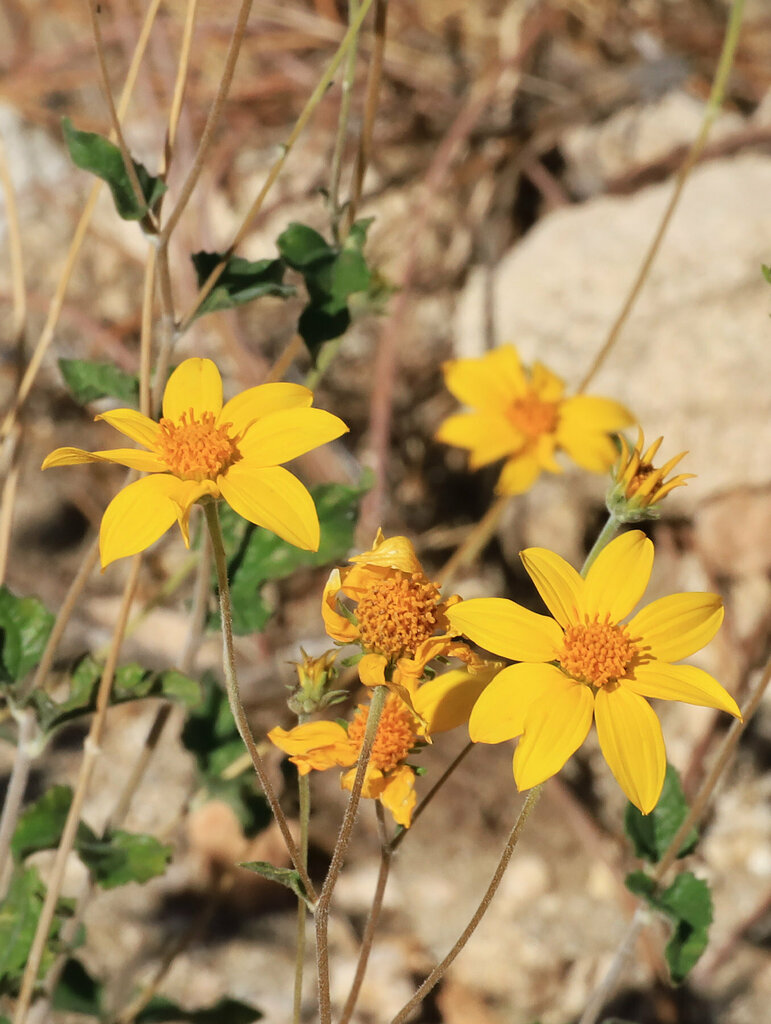
Parish's Goldeneye
Bahiopsis parishii
Bahiopsis parishii known commonly as Parish goldeneye or shrubby goldeneye, is a North American species of flowering shrubs in the family Asteraceae.
It is native to the southwestern United States, (southern California, southern Nevada, Arizona, and southwestern New Mexico), as well as adjacent parts of northwest Mexico (Baja California, Baja California Sur, and Sonora).
From the article Bahiopsis parishii on Wikipedia (CC BY-SA), quoted section by section
Description
Bahiopsis parishii grows to 2 feet tall, with bright yellow flowers. It is a plant of desert areas, usually associated with creosote bush, and ranges from sea level to 5,000 ft (1,500 m) in elevation. It blooms after periods of rain, both in spring and in fall, or after the monsoon season in Arizona.
In human culture
The species name honors either of two brothers, Samuel Bonsall Parish (1838–1928) and William Fletcher Parish (1840–1918), both active botanists in southern California. It is closely related to Bahiopsis deltoidea and is sometimes considered a variety of that species.
Wikipedia: “Etymology”
Where it lives
Recorded sightings
—
geo-referenced records in GBIF, from museums, herbaria and field observers.
Drag the globe to turn it. Dots are where records exist, not a range map; darker means more records.
In the stacks
Searching the stacks…
Every page naming Bahiopsis parishii in the Biodiversity Heritage Library →
This page is assembled live from iNaturalist, GBIF, Wikipedia, the Source Library and the Internet Archive. It is not yet part of the hand-edited codex. iNaturalist taxon 75737.