- Plants
- ›Vascular Plants
- ›flowering plants
- ›Dicots
- ›Buttercups, Poppies, and Allies
- ›barberry family
- ›Berberidoideae
- ›Berberideae
- ›Berberis
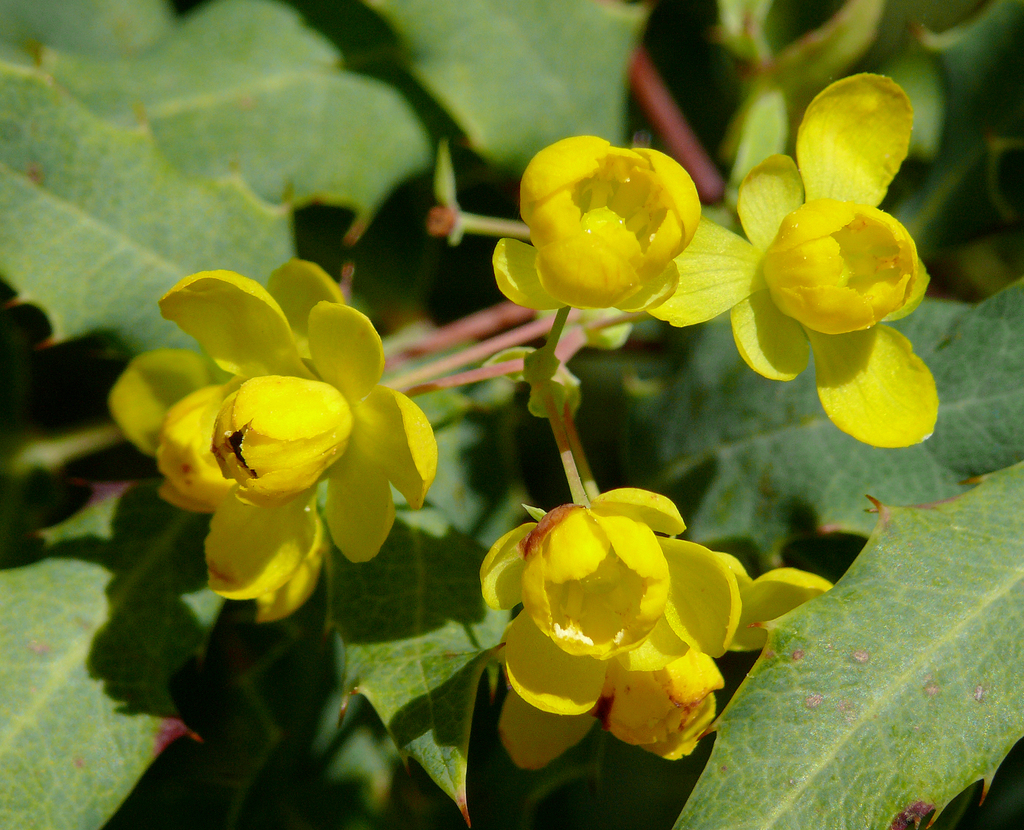
Nevin's barberry
Berberis nevinii
Berberis nevinii (syn. Mahonia nevinii, Odostemon nevinii), known by the common name Nevin's barberry, is a species of flowering shrub in the barberry family. endemic to southern California, it is known from very few occurrences in the riparian areas of chaparral in inland canyons and foothills. It is a California state and United States federally listed endangered species, since 1987 and 1998, respectively. There are thought to be about 500 individuals remaining, with half of those being naturally occurring plants. It is also cultivated in gardens and parks as an ornamental and barrier plant.
From the article Berberis nevinii on Wikipedia (CC BY-SA), quoted section by section
Description
Berberis nevinii is an erect, evergreen, rhizomatous shrub approaching a maximum height of 4 metres (13 ft). It has a dense foliage of dark green to bluish-green spiny-toothed, spear-shaped leaflets. It flowers in racemes of 3 to 5 bright yellow cup-shaped, layered blossoms, that appear in spring between March and April. The fruit is a spherical reddish berry appearing in bunches, in the summer, eventually darkening to a dark blue.
Range & habitat
Populations were historically found in washes of the San Fernando Valley, near the Tujunga wash (near the neighborhood of Garnsey). It was described in the 1910 Bulletin of the New York Botanical Garden as:"A rare species apparently confined to the San Fernando Valley, where it occurs sparingly on the sandy slopes along the eastern edge of the valley. Upper Sonoran. Specimens examined: 'Los Angeles Valley,' probably San Fernando Valley, Nevin, April, 1882; San Fernando, Franceschi, 1893; wash near Garnsey, San Fernando Valley, Grinnell, Oct. 31, 1903"The plant grows between 900 and 2,000 feet of altitude (300 – 610 m) in typical Southern California plant communities like coastal sage scrub, chaparral, cismontane woodland, riparian scrub, sandy and gravelly places, and washes below 2150 feet. The plant is naturally occurring with chamise, manzanitas, California sages, ceanothus species, bush poppy, and bladderpod. There are currently about 21 known populations of the plant remaining, and almost all of them have fewer than 20 individuals, with some with as few as 5 individual plants. As of 1989, the USDA estimated that fewer than 500 plants exist in total. The populations are scattered throughout the San Gabriel Mountains and the Peninsular Ranges in Los Angeles, San Bernardino, and Riverside Counties, its distribution possibly extending just into San Diego County. …
Wikipedia: “Distribution and habitat”
How it is grown
Berberis nevinii is cultivated as a drought-tolerant ornamental plant by specialty plant nurseries. It is planted as a shrub in native plant and wildlife gardens, natural landscaping of parks in its range, drought tolerant landscaping, and for habitat restoration projects. It can serve as an impenetrable barrier hedge, due to the spiny-toothed dense foliage. With berries appearing in the summer, earlier/later than other chaparral plants, it is an attractive bird food plant. The plant was introduced into cultivation in California by Theodore Payne in the 1920s.
Wikipedia: “Cultivation”
In human culture
The plant was first described by American botanist Asa Gray, in 1895, named in of honor fellow botanist, Reverend Joseph Cook Nevin (1835-1912), who was active in China and Southern California, particularly in the Channel Islands. It was later described in 1901 by Fedde and Engel as Mahonia nevinii. Gray's original description for the plant was the following:Berbericidae, Berberis. B. Nevinii, Gray, n. sp. Leaflets 3 to 7, oblong-lanceolate, rather evenly and numerously spinulose-serrulate, half to full inch long, obscurely reticulated; lowest pair toward base of petiole: raceme loosely 5-7-flowered, equalling [sic] or surpassing the leaves • pedicels slender. — S. California, near Los Angeles, Nevin. Shrub 7 or 8 feet high, on a sandy plain. Berries juicy, ovoid, black or blue with a copious white bloom, called by Californian Mexicans Leña Amarilla, and northward Oregon Grape: leaflets ovate to oblong, usually 2 or 3 inches long: racemes commonly fascicled at summit of stem or in axils, subsessile, dense and numerously flowered; pedicels rather short.Following a reclassification in 1961, some botanists re-classified Berberis nevinii (see Berberis) as Mahonia nevinii (see Mahonia), many commercial growers continue to use both names interchangeably. …
Wikipedia: “Taxonomic history”
Where it lives
Recorded sightings
—
geo-referenced records in GBIF, from museums, herbaria and field observers.
Drag the globe to turn it. Dots are where records exist, not a range map; darker means more records.
In the stacks
Searching the stacks…
Every page naming Berberis nevinii in the Biodiversity Heritage Library →
This page is assembled live from iNaturalist, GBIF, Wikipedia, the Source Library and the Internet Archive. It is not yet part of the hand-edited codex. iNaturalist taxon 75757.