- Plants
- ›Vascular Plants
- ›Ferns
- ›Adder's-tongues, Fork Ferns, and Allies
- ›adder's-tongues and allies
- ›adder's-tongue family
- ›Botrychioideae
- ›Botrypus
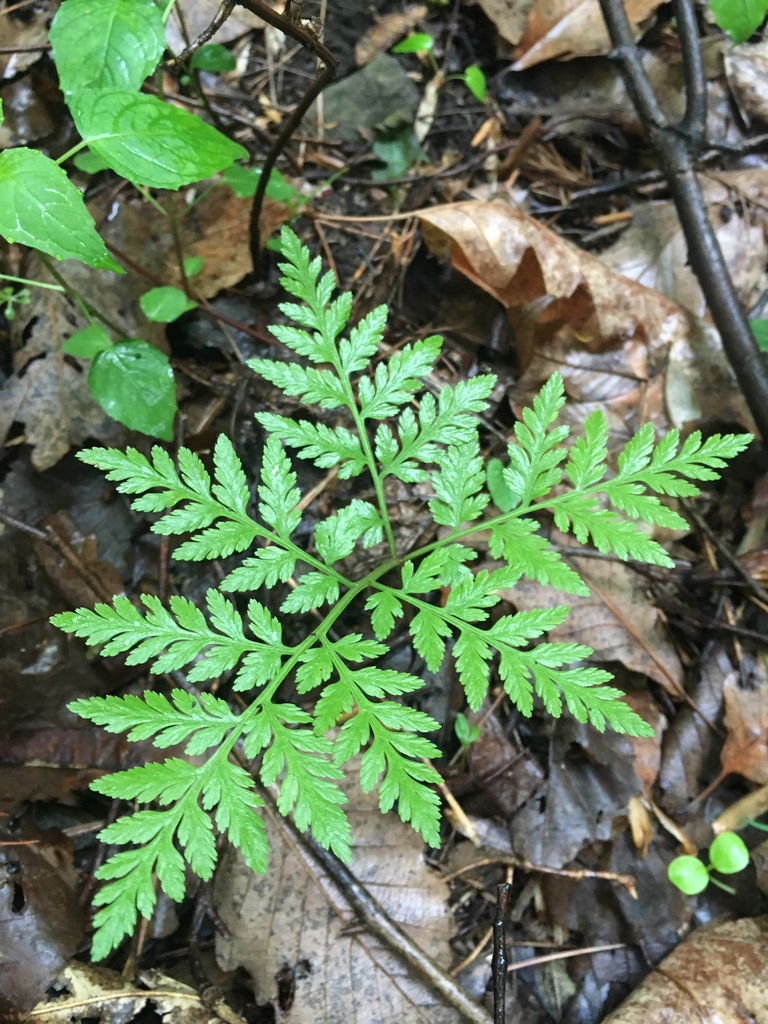
rattlesnake fern
Botrypus virginianus
Botrypus virginianus, synonym Botrychium virginianum, sometimes called rattlesnake fern is a species of perennial fern in the adders-tongue family. It is monotypic within the genus Botrypus, meaning that it is the only species within the genus. It is called the rattlesnake fern in some parts of North America, due to its habit of growing in places where rattlesnakes are also found. Rattlesnake fern prefers to grow in rich, moist woods in dense shade and will not tolerate direct sunlight.
From the article Botrypus on Wikipedia (CC BY-SA), quoted section by section
Description
It is a low growing species, typically being a foot high or smaller. The leaf emerges in the early spring and will senesce in late summer. The leaf is roughly triangularly shaped and 15–50 cm in size and held roughly parallel to the ground. The leaf is 3-4 times pinnately compound, brightly green colored, and feels soft to the touch. The stem is round and bicolor, being pinkish or light tan at the base but greenish nearer the branches or leaves. The diploid number is 184. Rattlesnake fern has separate fertile and sterile leaves, when present the sterile leaf arises halfway up the stalk and the fertile leaf exists at the tip. The spores are shed in late spring. Like other ferns rattlesnake fern undergoes alternation of generations and the form described in this article is the sporophyte. This fern has been used medicinally. In India it is still used to treat dysentery.
Range & habitat
This is a wide-ranging species. It abounds in many parts of the United States, in the mountains of Mexico, in Australia, in some parts of Asia, as the Himalaya Mountains, and is found also in Norway, in the Karelia region of Finland and Russia, and around Gulf of Bothnia, although in no other part of Europe. It is large and succulent and is boiled and eaten in the Himalayas. In the southern Appalachian Mountains, some wild ginseng hunters use B. virginianum as "indicator species" to locate the root. This has led to local names for the fern that allude to this role, including sang-find, 'seng sign and 'seng pointer.
== References ==
Wikipedia: “Distribution and uses”
Where it lives
Recorded sightings
—
geo-referenced records in GBIF, from museums, herbaria and field observers.
Drag the globe to turn it. Dots are where records exist, not a range map; darker means more records.
In the stacks
Searching the stacks…
Every page naming Botrypus virginianus in the Biodiversity Heritage Library →
This page is assembled live from iNaturalist, GBIF, Wikipedia, the Source Library and the Internet Archive. It is not yet part of the hand-edited codex. iNaturalist taxon 75855.