- Plants
- ›Vascular Plants
- ›flowering plants
- ›monocots
- ›grasses, sedges, cattails, and allies
- ›grasses
- ›Pooideae
- ›Brachypodieae
- ›Brachypodium
- ›Brachypodium
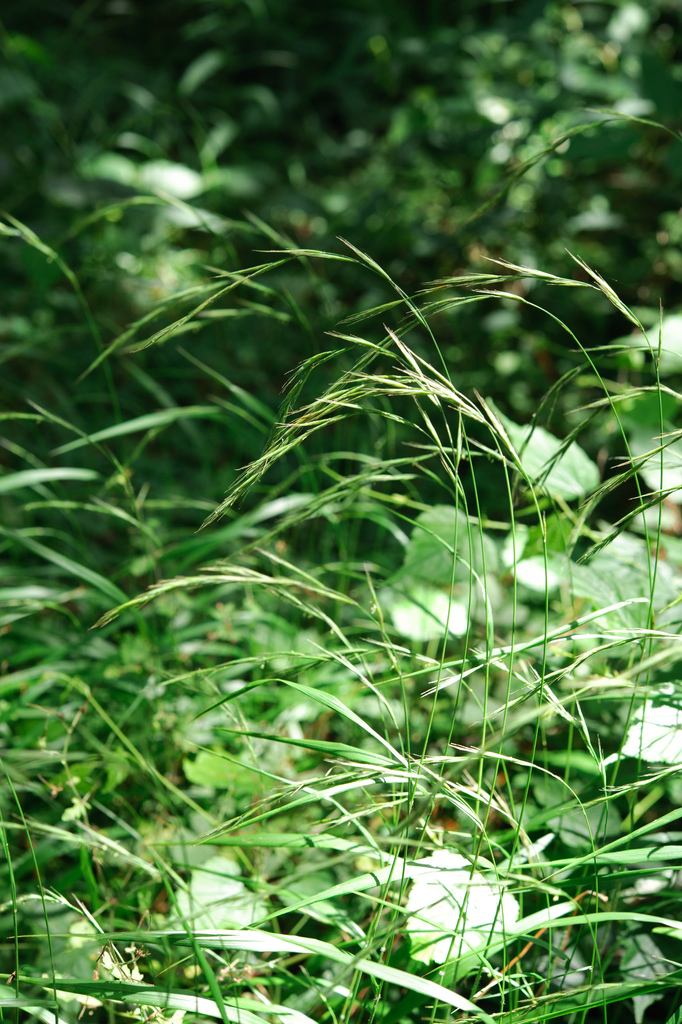
Slender False Brome
Brachypodium sylvaticum
Brachypodium sylvaticum, commonly known as false-brome, slender false brome or wood false brome, is a perennial grass native to Europe, Asia and Africa. Its native range includes most of Europe, northwestern Africa, Sudan and Eritrea, Western and Central Asia, the Indian subcontinent, China, Korea, Japan, Malesia, and New Guinea.
The bunchgrass is most commonly found in forests and woodlands, preferring the shaded canopy, but may grow in open areas. It prefers well drained neutral and calcerous soils, and avoids wet conditions.
From the article Brachypodium sylvaticum on Wikipedia (CC BY-SA), quoted section by section
Description
Brachypodium sylvaticum is a tall tufted perennial bunchgrass that grows up to about a 0.9 metres (3.0 ft) high. The drooping leaf blade of the plant is dark green, or bright-yellow green, flat and up to 12 mm wide with a fringe of hairs surrounding the edge of the leaf. The leaves do not have auricles. The leaf blade is joined to the hollow culm by the leaf sheath. This hairy sheath is open and surrounds the culm. The culm is pilose (long, soft, hairy), and typically has 4 to 5 nodes. The ligules are blunt, 1–6 millimetres (0.039–0.236 in) long. The grass has drooping narrow long spikelets of flowers on very short pedicels. The flower head is 6–20 centimetres (2.4–7.9 in) long, the plant flowering in July and August. Its awns are straight and 6–18 millimetres (0.24–0.71 in) long, projecting out of the end of the spikelets.
Where it lives
Recorded sightings
—
geo-referenced records in GBIF, from museums, herbaria and field observers.
Drag the globe to turn it. Dots are where records exist, not a range map; darker means more records.
In the stacks
Searching the stacks…
Every page naming Brachypodium sylvaticum in the Biodiversity Heritage Library →
This page is assembled live from iNaturalist, GBIF, Wikipedia, the Source Library and the Internet Archive. It is not yet part of the hand-edited codex. iNaturalist taxon 75865.