- Plants
- ›Vascular Plants
- ›flowering plants
- ›monocots
- ›Agaves, Orchids, Irises, and Allies
- ›agave and allies
- ›Brodiaea subfamily
- ›Brodiaea
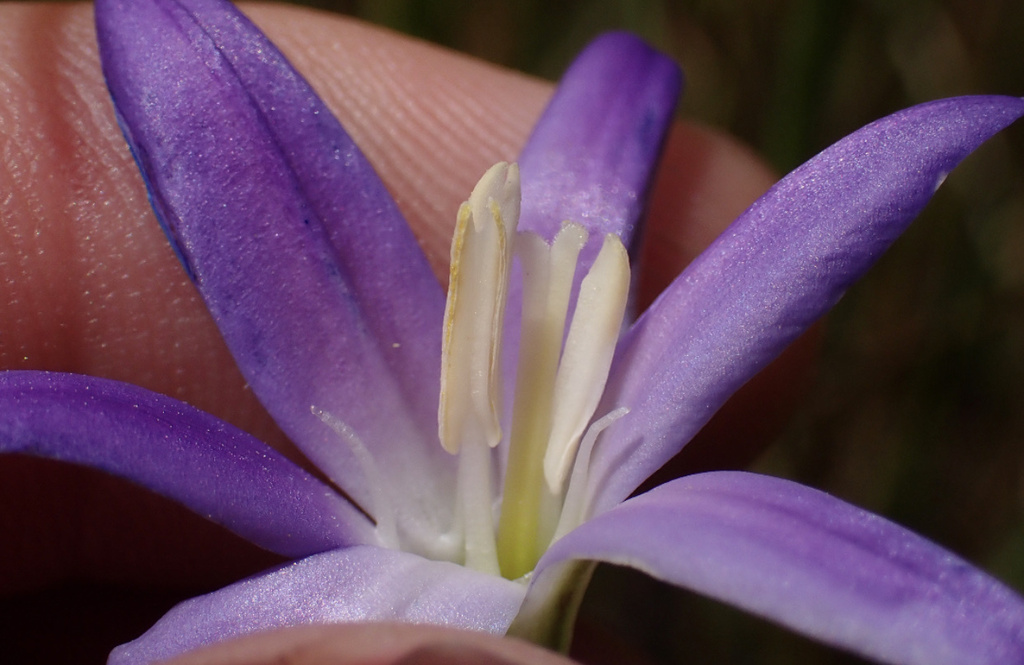
santa rosa basalt brodiaea
Brodiaea santarosae
Brodiaea santarosae is a rare Brodiaea species known by the common name Santa Rosa brodiaea and Santa Rosa Basalt brodiaea. It is endemic to southern California, mostly in the region around the junction of Riverside and San Diego Counties and limited to ancient basaltic soils. There are only five known populations. It was once thought to be an intergrade of Brodiaea filifolia and Brodiaea orcuttii, but measurements found this to be false. It was described as a new species in 2006.
It is on the California Native Plant Society's list of rare and endangered species.
From the article Brodiaea santarosae on Wikipedia (CC BY-SA), quoted section by section
Description
It is a perennial producing an inflorescence bearing bright purple flowers that turn white towards the base of the flower. Each flower has six spreading tepals with a center containing three stamens and staminodes, which are flat sterile stamens lying against the tepals. There is a large variation in the type of staminodes for this particular species where 10% of flowers may have no staminodes, 5-10% of flowers have short staminodes that curve backwards, and the remaining have long staminodes. The plant has corms which is how it reproduces. The overall differences in flower part lengths and pedicel length of the B. santarosae is potentially due to the surrounding plants in the area that it grows in which consist of tall grasses.
Range & habitat
A concentration of B. santarosae can specifically be found in the Santa Rosa Basalt area which lies in Riverside County which is below San Bernardino County and above San Diego County. The flower grows between May and June in areas with elevation between 510 and 1050 meters. It is resilient to low water conditions and can even grow in disturbed habitats whereas the B. filifolia and B. orcuttii grow in habitats that are more wet. A loss of native habitat through the erosion of the Santa Rosa Basalt which has decreased by 97% is the main cause for its endangerment. There is approximately 15 k m 2 {\displaystyle }15km^{2} worth of basalt and the spread of where the flower grows is equivalent to this area and likely does not exceed this area.
Wikipedia: “Distribution and habitat”
Where it lives
Recorded sightings
—
geo-referenced records in GBIF, from museums, herbaria and field observers.
Drag the globe to turn it. Dots are where records exist, not a range map; darker means more records.
In the stacks
Searching the stacks…
Every page naming Brodiaea santarosae in the Biodiversity Heritage Library →
This page is assembled live from iNaturalist, GBIF, Wikipedia, the Source Library and the Internet Archive. It is not yet part of the hand-edited codex. iNaturalist taxon 75892.