- Plants
- ›Vascular Plants
- ›flowering plants
- ›monocots
- ›grasses, sedges, cattails, and allies
- ›grasses
- ›Pooideae
- ›Bromeae
- ›Bromus
- ›Ceratochloa
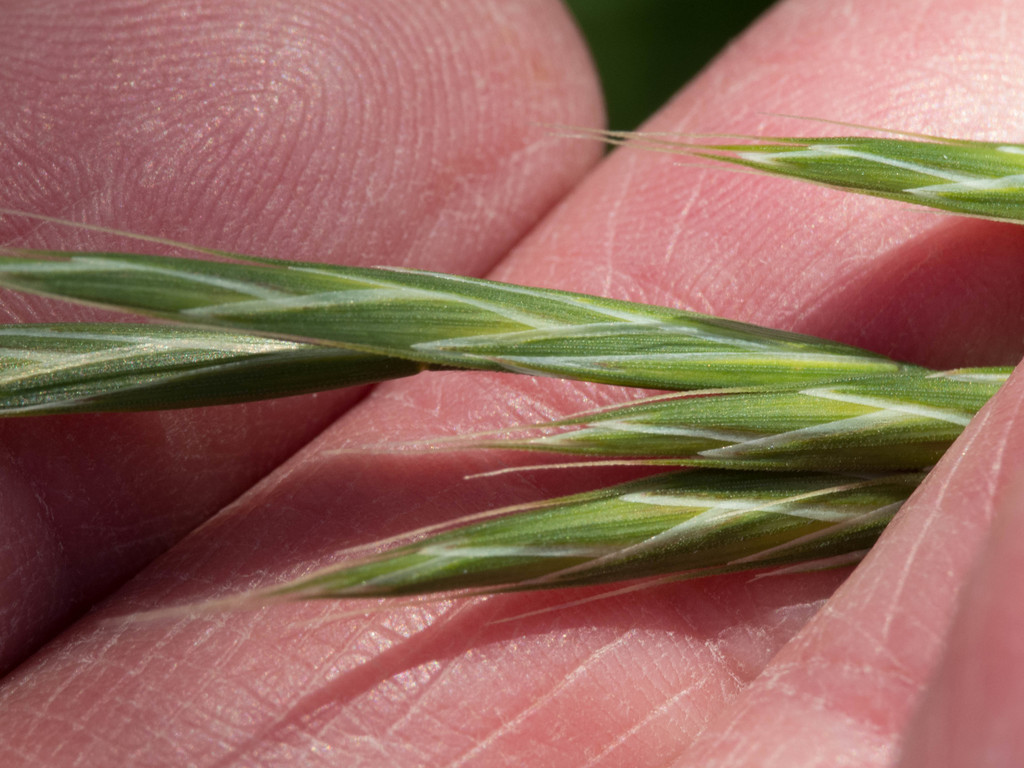
Arizona brome
Bromus arizonicus
Bromus arizonicus is a species of annual brome grass known by the common name Arizona brome.
It is native to the Southwestern United States, California, and Baja California, where it grows in many types of grassy valley and desert habitat.
From the article Bromus arizonicus on Wikipedia (CC BY-SA), quoted section by section
Description
It is an annual grass growing 30 to 70 centimetres (12 to 28 in) tall with an open, branching inflorescence in the form of a panicle. The primary branches of the panicle are appressed. Its spikelets are solitary, and fertile spikelets have pedicels. The spikelets are flat and hairy, with five to eight florets; the spikelets break up at maturity and disarticulate below the fertile florets. The glumes are shorter than the spikelets and thinner than fertile lemmas. Both upper and lower glumes are lanceolate, and both are hairless or only have very fine hairs. The lemmas are 9 to 14 mm (3⁄8 to 1⁄2 in) long and have seven prominent veins. The awns are 6 to 13 mm (1⁄4 to 1⁄2 in). Its anthers are about 0.4 mm (1⁄32 in) long, which suggests that most of its seeds are produced by self-fertilization.
Range & habitat
Bromus arizonicus is native to the American southwest and northwestern Mexico, occurring in the United States from California and Nevada east to Texas, and in Mexico in Baja California. It prefers dry, open areas and disturbed grounds at elevations lower than 2,000 m (6,600 ft) feet.
Wikipedia: “Distribution and habitat”
Where it lives
Recorded sightings
—
geo-referenced records in GBIF, from museums, herbaria and field observers.
Drag the globe to turn it. Dots are where records exist, not a range map; darker means more records.
In the stacks
Searching the stacks…
Every page naming Bromus arizonicus in the Biodiversity Heritage Library →
This page is assembled live from iNaturalist, GBIF, Wikipedia, the Source Library and the Internet Archive. It is not yet part of the hand-edited codex. iNaturalist taxon 75895.