- Plants
- ›Vascular Plants
- ›flowering plants
- ›Dicots
- ›Roses, Elms, Figs, and Allies
- ›Hackberry Family
- ›Celtis
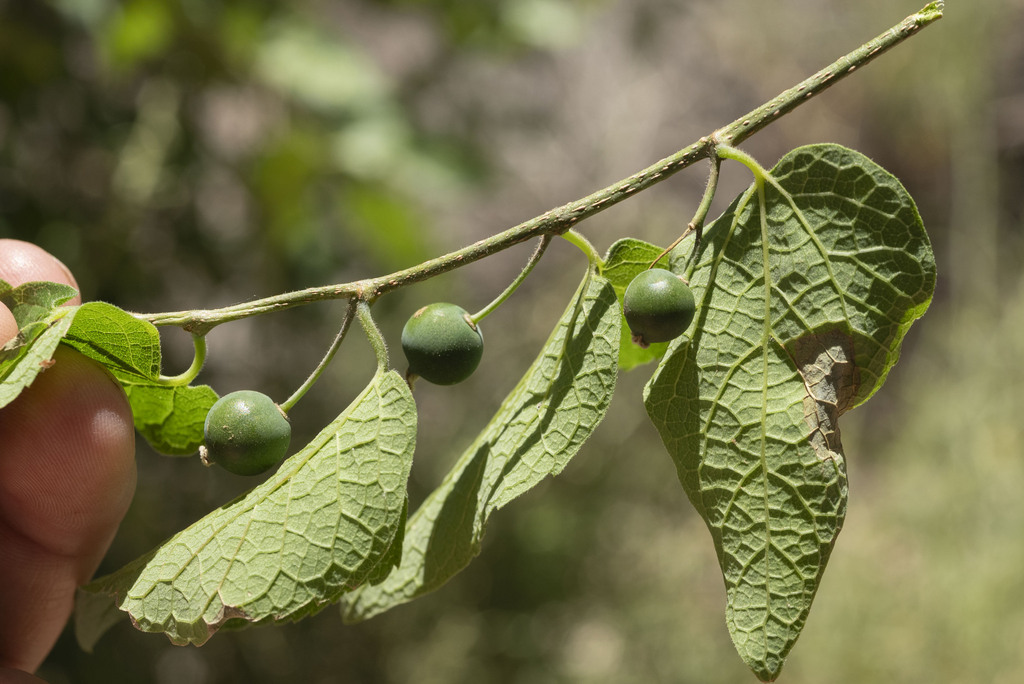
netleaf hackberry
Celtis reticulata
Celtis reticulata, with common names including netleaf hackberry, western hackberry, Douglas hackberry, netleaf sugar hackberry, palo blanco, and acibuche, is a small- to medium-sized deciduous tree native to western North America.
From the article Celtis reticulata on Wikipedia (CC BY-SA), quoted section by section
Description
Celtis reticulata usually grows to a small-sized tree, 6 to 9 metres (20 to 30 feet) in height and mature at 15 to 35 centimetres (6 to 14 inches) in diameter, although some individuals are known up to 21 m (70 ft) high and 60 cm (24 in) thick. It is often scraggly, stunted or even a large bush. It grows at altitudes of 500–1,700 m (1,600–5,600 ft). Hackberry bark is gray to brownish gray with the trunk bark forming vertical corky ridges that are checkered between the furrows. The young twigs are puberulent, or covered with very fine hairs. The blade of the leaves can be 2–8 cm (3⁄4–3+1⁄4 in) long, usually about 5–6 cm (2–2+1⁄2 in). They are lanceolate to ovate, disproportionate at the base, leathery, entire to serrate (tending toward serrate), clearly net-veined, base obtuse to more or less cordate, tip obtuse to acuminate, and scabrous, with a dark green upper surface and a yellowish-green lower surface. The small stalks attaching the leaf blade to the stem (the petioles) are generally about 5 to 6 millimetres (3⁄16 to 1⁄4 in) long. The flowers are very small, averaging 2 mm across. They form singly, or in cymose clusters pedicel in fr 4–15 mm. The fruit is a rigid, brownish to purple berry, 5 to 12 mm in diameter, with thin, sweet pulp. If uneaten, they can stay on the plant through early winter.
Similar species. C. …
What it does
The leaves are eaten by a number of insects, particularly certain moth caterpillars. The berries are eaten by wildlife, including birds. Mule deer and bighorn sheep eat the fresh twigs. Beavers feed on the plant as well.
Wikipedia: “Ecology”
At the table
The berries and seeds have long been used as a food source by Native Americans of the Southwestern United States, including the Apache (Chiricahua and Mescalero), both fresh and preserved, and the Navajo, who eat them both fresh and ground.
Wikipedia: “Uses”
How it is grown
Celtis reticulata is cultivated by plant nurseries and available as an ornamental plant for native plant, drought-tolerant, natural landscape, and habitat gardens, and for ecological restoration projects.
Wikipedia: “Cultivation”
Where it lives
Recorded sightings
—
geo-referenced records in GBIF, from museums, herbaria and field observers.
Drag the globe to turn it. Dots are where records exist, not a range map; darker means more records.
In the stacks
Searching the stacks…
Every page naming Celtis reticulata in the Biodiversity Heritage Library →
This page is assembled live from iNaturalist, GBIF, Wikipedia, the Source Library and the Internet Archive. It is not yet part of the hand-edited codex. iNaturalist taxon 76203.