- Plants
- ›Vascular Plants
- ›flowering plants
- ›Dicots
- ›Roses, Elms, Figs, and Allies
- ›Hackberry Family
- ›Celtis
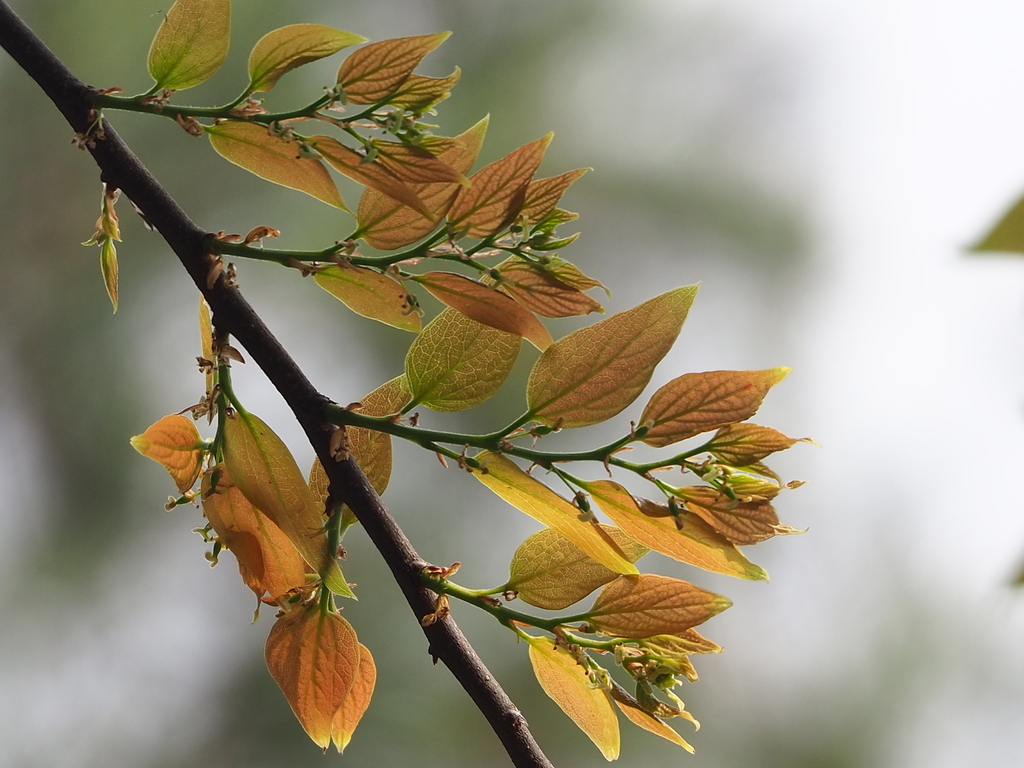
Chinese Hackberry
Celtis sinensis
Celtis sinensis (English: Japanese hackberry, Chinese hackberry; Chinese: 朴树; Japanese: 榎) is a species of flowering plant in the hemp family, Cannabaceae, that is native to slopes in East Asia.
From the article Celtis sinensis on Wikipedia (CC BY-SA), quoted section by section
Description
It is a tree that grows to 20 m tall, with deciduous leaves and gray bark. The fruit is a globose drupe, 5–7(–8) mm in diameter. Flowering occurs in March–April, and fruiting in September–October, in the Northern hemisphere.
Range & habitat
Native to slopes at altitudes of 100–1,500 m (330–4,920 ft) in Anhui, Fujian, Gansu, Guangdong, Guizhou, Henan, Jiangsu, Jiangxi, Shandong, Zhejiang, Sichuan, as well as Korea (팽나무), Japan and Taiwan. Leaves and bark are used in Korean medicine to treat menstruation and lung abscess. It is a naturalized non-invasive species in North America. It is a declared noxious weed in many parts of eastern Australia, where its seeds are spread by birds, fruit bats and water in riparian zones, roadsides, urban bushland, open woodlands, rainforest margins, waste areas, disturbed sites, parks and gardens, in sub-tropical and warm temperate regions. As an ornamental plant, it is used in classical East Asian garden design.
Wikipedia: “Distribution, habitat and uses”
Where it lives
Recorded sightings
—
geo-referenced records in GBIF, from museums, herbaria and field observers.
Drag the globe to turn it. Dots are where records exist, not a range map; darker means more records.
In the stacks
Searching the stacks…
Every page naming Celtis sinensis in the Biodiversity Heritage Library →
This page is assembled live from iNaturalist, GBIF, Wikipedia, the Source Library and the Internet Archive. It is not yet part of the hand-edited codex. iNaturalist taxon 76204.