- Plants
- ›Vascular Plants
- ›flowering plants
- ›Dicots
- ›Sunflowers, Bellflowers, Fanflowers, and Allies
- ›Sunflowers, Daisies, Asters, and Allies
- ›Thistles and Allies
- ›Cardueae
- ›Knapweeds and Allies
- ›Centaurea
- ›Centaurea
- ›Cnicus
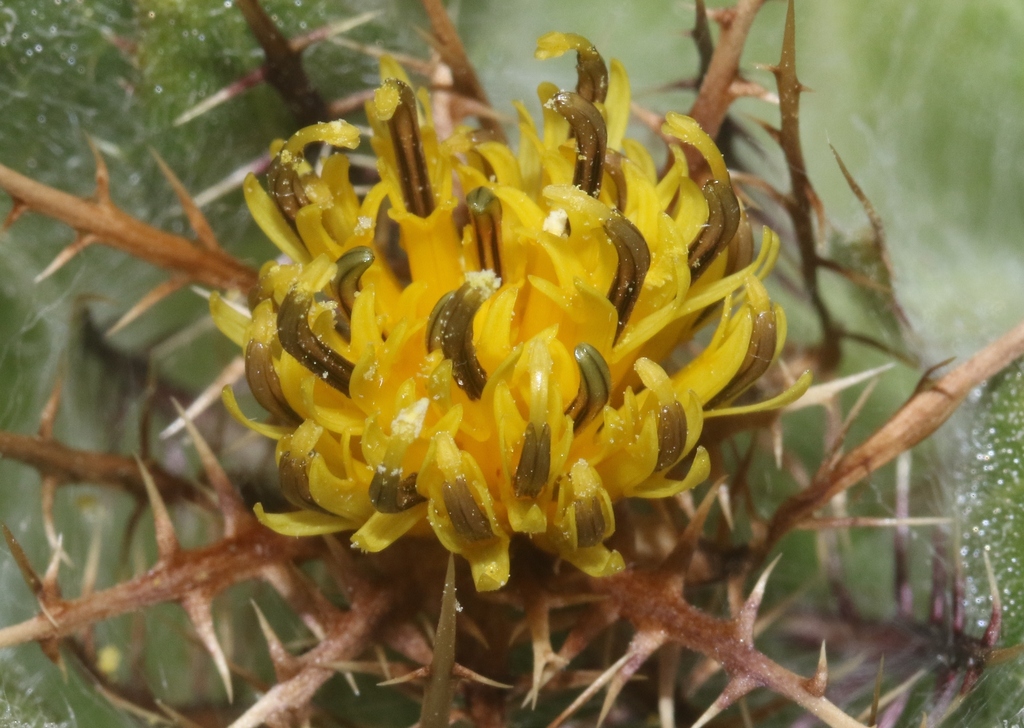
blessed thistle
Centaurea benedicta
Centaurea benedicta, known by the common names St. Benedict's thistle, blessed thistle, holy thistle, spotted thistle or blessed knapweed, is an annual thistle-like plant in the family Asteraceae, native to Mediterranean Europe and western and Central Asia, ranging from Portugal and Spain to southeastern Europe, Ukraine and southern European Russia, Saudi Arabia, Xinjiang, and Pakistan. It is known in other parts of the world, including parts of North America, as an introduced species and often a noxious weed.
From the article Centaurea benedicta on Wikipedia (CC BY-SA), quoted section by section
In medicine
Blessed thistle is used in folk remedies as a galactagogue with other herbs to increase breast milk supply, although there is no scientific evidence that such use is effective. Although the leaves are unpalatable with a bitter taste, blessed thistle is used as a flavoring in alcoholic beverages, and is considered a safe ingredient for food uses. As a member of the ragweed family, blessed thistle may cause allergic reactions in susceptible people, and use of large amounts may cause stomach cramps, nausea and vomiting.
Wikipedia: “Folk medicine”
Where it lives
Recorded sightings
—
geo-referenced records in GBIF, from museums, herbaria and field observers.
Drag the globe to turn it. Dots are where records exist, not a range map; darker means more records.
In the old herbals & bestiaries

The Gardeners Labyrinth
Thomas Hill · 1577 · p.250

Hortus Eystettensis
Basilius Besler · 1640 · p.300

Ortus sanitatis
1491 · p.84

Garden of Health (Hortus Sanitatis)
Jacob Meydenbach · 1491 · p.71

The Book of Health: The Art of Distillation
Brunschwig, Hieronymus · 1505 · p.114

Garden of Health
1507 · p.69

Book of Herbs
Hieronymus Bock (Tragus) · 1546 · p.685

Notable Commentaries on the History of Plants
Leonhart Fuchs · 1549 · p.154

On the Names of Plants
Hieronymus Bock (Tragus) · 1552 · p.934

Commentaries on the Six Books of Dioscorides
Pietro Andrea Mattioli · 1560 · p.589

Commentaries on the Six Books of Pedanius Dioscorides on Medical Matter
Pietro Andrea Mattioli · 1565 · p.984

A New Herbal, or History of Plants
Rembert Dodoens (trans. Henry Lyte) · 1578 · p.557
In the stacks
Searching the stacks…
Every page naming Centaurea benedicta in the Biodiversity Heritage Library →
This page is assembled live from iNaturalist, GBIF, Wikipedia, the Source Library and the Internet Archive. It is not yet part of the hand-edited codex. iNaturalist taxon 76208.