- Plants
- ›Vascular Plants
- ›flowering plants
- ›Dicots
- ›pinks, cactuses, and allies
- ›knotweed family
- ›Eriogonoideae
- ›Eriogoneae
- ›Chorizanthe
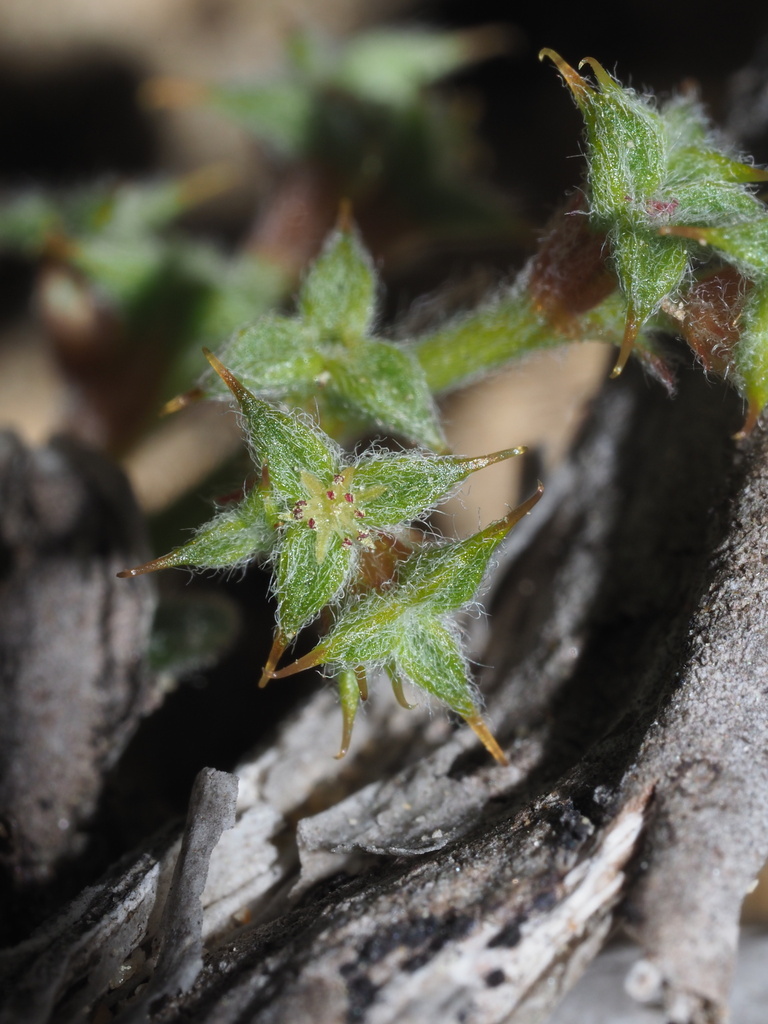
Orcutt's spineflower
Chorizanthe orcuttiana
Chorizanthe orcuttiana is a rare small annual plant in the buckwheat family, Polygonaceae. It is known commonly as Orcutt's spineflower or the San Diego spineflower, and it is endemic to San Diego County, California. The plant is diminutive, and a hand-lens is necessary for proper identification. The plant is very sensitive to temperature and precipitation, and under drought or hot conditions the seeds will not germinate or survive. The plant is visible anywhere from February through July during good rain year, but most years the plant is only visible from April to June. Each minute flower yields one seed.
From the article Chorizanthe orcuttiana on Wikipedia (CC BY-SA), quoted section by section
Description
This species is an annual herb, growing in a prostrate habit with the entire plant covered in dense, white, silky hairs. Before anthesis, the basal leaves form a rosette 0.5 to 5 cm (0.20 to 1.97 in) in diameter. The leaves are shaped narrowly oblanceolate, measuring 0.5 to 1.5 cm (0.20 to 0.59 in) long by 0.2 to 0.35 cm (0.079 to 0.138 in) wide, with an acute tip. C. orcuttiana also expresses two types of leaf shapes on different individuals, with one type being oblanceolate with an obtuse leaf apex and a reddish tinge on the upper surface, and the other slightly elongated. The leaves are attached to the plant via a pubescent petiole. The inflorescence is cymose. There may be awns on the inflorescence, and if there are, they usually measure 0.6 to 1 mm (0.024 to 0.039 in). The involucres are in small clusters roughly 0.5 to 1 cm (0.20 to 0.39 in) across. There are 2 bracts, positioned opposite. In some plants, one of the two bracts tends to be laminar, oblanceolate, and awnless, while the one opposite to it is greatly reduced and terminated by a short, straight awn. The involucres are shaped campanulate, 3-angled and 3-ribbed and colored greenish. The involucres are faintly transversely ridged, with 3 teeth and hooked awns. …
Range & habitat
The plant requires open habitat near the coast, such as sandstone bluffs and openings in maritime chaparral. About 82% to 93% of San Diego County's maritime chaparral habitat has been destroyed for development and damaged by human activity such as recreation; there are just over 3000 acres remaining. All the known occurrences are within five kilometers of the coastline. It grows on soils of white sand which are neutral or somewhat acidic and low in organic material. The substrates originate from iron-rich sandstone.
Wikipedia: “Distribution and habitat”
Where it lives
Recorded sightings
—
geo-referenced records in GBIF, from museums, herbaria and field observers.
Drag the globe to turn it. Dots are where records exist, not a range map; darker means more records.
In the stacks
Searching the stacks…
Every page naming Chorizanthe orcuttiana in the Biodiversity Heritage Library →
This page is assembled live from iNaturalist, GBIF, Wikipedia, the Source Library and the Internet Archive. It is not yet part of the hand-edited codex. iNaturalist taxon 76312.