- Plants
- ›Vascular Plants
- ›flowering plants
- ›Dicots
- ›pinks, cactuses, and allies
- ›Pussypaw Family
- ›Claytonia
- ›Limnia
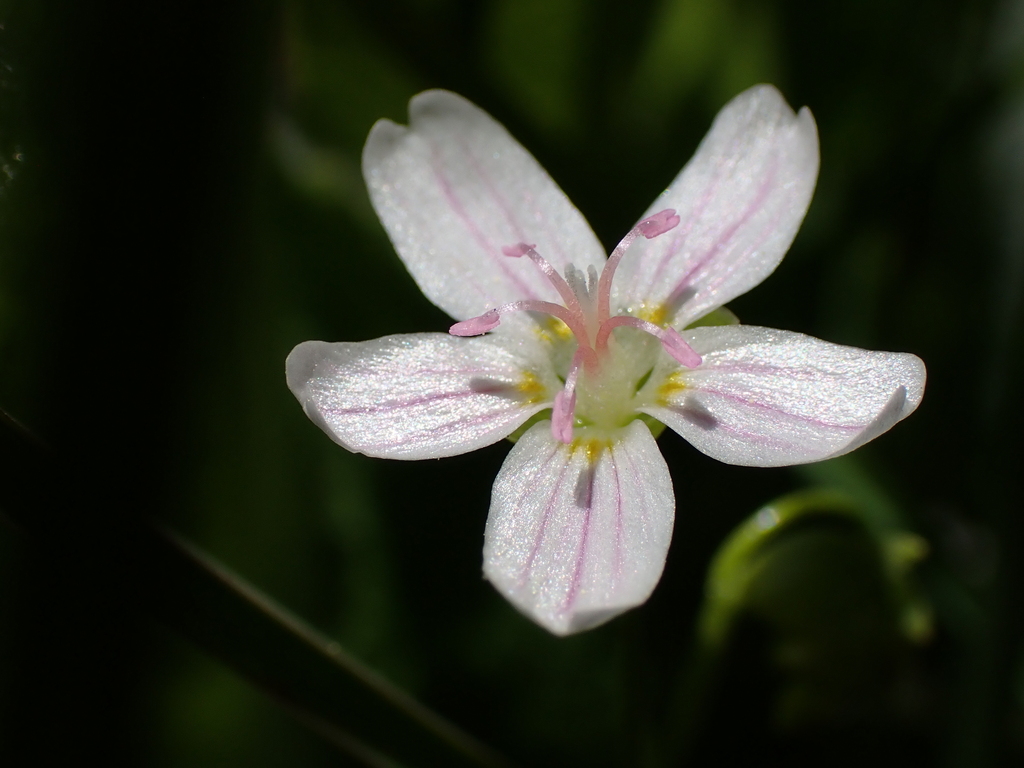
marsh claytonia
Claytonia palustris
Claytonia palustris is a species of wildflower in the family Montiaceae known by the common names Jonesville springbeauty and marsh claytonia. Often mistaken for Claytonia sibirica, the species is diploid (2n = 12) with a chromosome base number of x = 6.
From the article Claytonia palustris on Wikipedia (CC BY-SA), quoted section by section
Description
Claytonia palustris is a rhizomatous perennial herb producing a slender stem up to about 0.5 metres (1.6 ft) long. It has leaves with oval-shaped blades a few centimeters long at the ends of long, narrow petioles. The inflorescence bears up to 18 flowers on a long stalk. Each flower has 5 white or pink-tinted white petals just under a centimeter long. The bloom period is May to October.
Range & habitat
The wildflower is endemic to California where it is a rare species indigenous to wetlands including bogs, fens, meadows and streamside riparian thickets at low- to mid-elevations of the Klamath Mountains, Cascade Range, and Sierra Nevada as far south as the Kern and Tule River watersheds. The species epithet palustris is Latin for "of the marsh" and indicates its common habitat.
Wikipedia: “Distribution”
Where it lives
Recorded sightings
—
geo-referenced records in GBIF, from museums, herbaria and field observers.
Drag the globe to turn it. Dots are where records exist, not a range map; darker means more records.
In the stacks
Searching the stacks…
Every page naming Claytonia palustris in the Biodiversity Heritage Library →
This page is assembled live from iNaturalist, GBIF, Wikipedia, the Source Library and the Internet Archive. It is not yet part of the hand-edited codex. iNaturalist taxon 76389.