- Plants
- ›Vascular Plants
- ›flowering plants
- ›Dicots
- ›proteas, lotuses, planes, and allies
- ›Protea family
- ›Primitive Proteas
- ›Persoonieae
- ›Persoonia
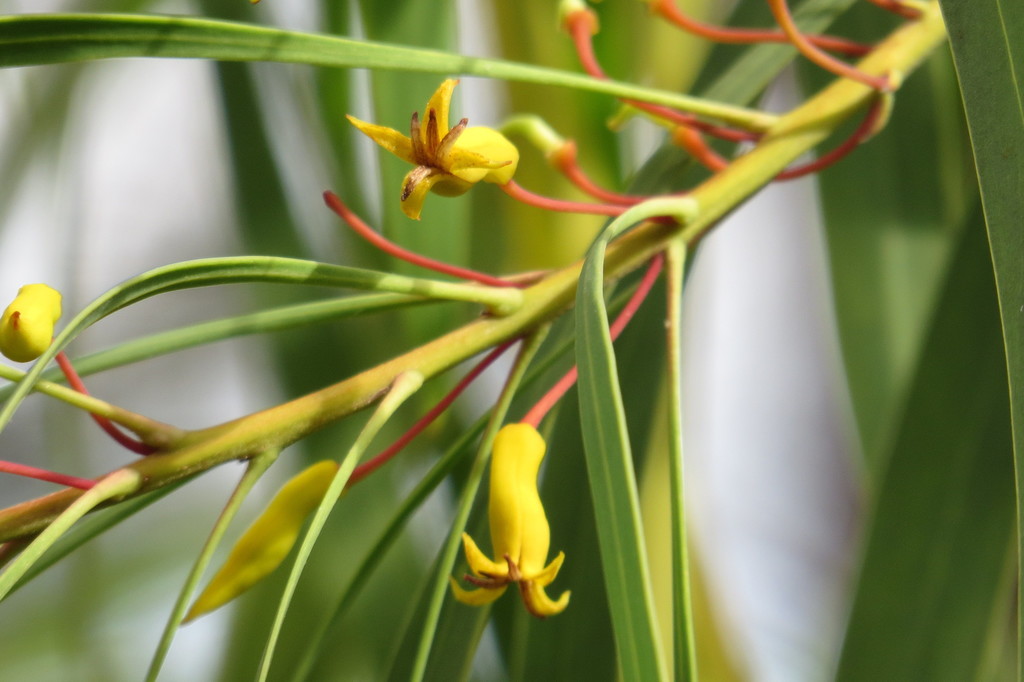
Wild Pear
Persoonia falcata
Persoonia falcata, commonly known as the wild pear, is a shrub native to northern Australia.
From the article Persoonia falcata on Wikipedia (CC BY-SA), quoted section by section
Description
Persoonia falcata grows as a woody shrub or small tree, anywhere from 1 to 9 m (3.3 to 29.5 ft) high. The thick dark grey bark is layered and flaky. The pale green-grey leaves are 8–35 cm (3.1–13.8 in) long and 0.4–3 cm (0.16–1.18 in) wide, and oblanceolate to linear-oblanceolate or falcate in shape. The yellow flowers appear from June to November. The yellow-green fruit, known as drupes, appear from October to February. Edible, they are eaten raw by local aborigines.
Range & habitat
Persoonia falcata ranges across a broad swathe of northern Australia, generally within 300 km (190 mi) of the coastline. In the northwest of Western Australia it is found in the Great Sandy Desert and vicinity of Broome, eastwards across the Northern Territory into northern Queensland, with the Blackdown Tableland marking the southeastern limit of its range. It grows along watercourses, gorges and sandstone outcrops, generally on sandstone-based or alluvial soils. It is also found on granite-based and lateritic soils, and rarely clay. It grows in Eucalyptus, Melaleuca, or mixed open woodland communities.
Wikipedia: “Distribution and habitat”
At the table
Attempts to grow Persoonia falcata at the Royal Botanic Gardens of Sydney and Melbourne have failed, as plants planted into soil have perished. Aborigines would use a solution infused with wood and bark as an eye wash, and drink an infusion from the leaves to treat chest colds and diarrhoea. Leaves could also be applied to circumcision wounds.
Wikipedia: “Cultivation and uses”
Where it lives
Recorded sightings
—
geo-referenced records in GBIF, from museums, herbaria and field observers.
Drag the globe to turn it. Dots are where records exist, not a range map; darker means more records.
In the old herbals & bestiaries


In the stacks
Searching the stacks…
Every page naming Persoonia falcata in the Biodiversity Heritage Library →
This page is assembled live from iNaturalist, GBIF, Wikipedia, the Source Library and the Internet Archive. It is not yet part of the hand-edited codex. iNaturalist taxon 764693.