- Plants
- ›Vascular Plants
- ›flowering plants
- ›Dicots
- ›Soapberries, Cashews, Mahoganies, and Allies
- ›citrus family
- ›Aurantioideae
- ›Citrus
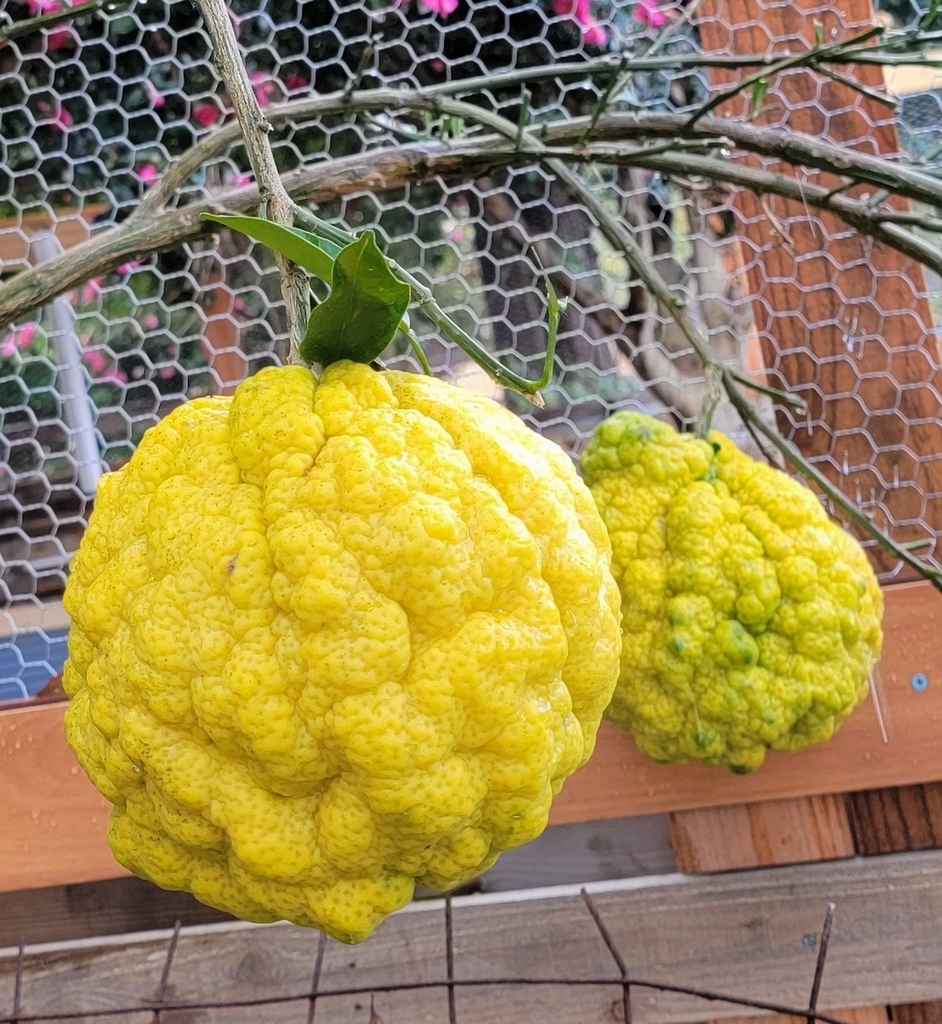
Yuzu
Citrus × junos
Yuzu (Citrus × junos, from Japanese 柚子 or ユズ; ) is a citrus fruit and plant in the family Rutaceae of Chinese origin. Yuzu has been cultivated mainly in East Asia, though it has also recently been grown in New Zealand, Australia, Spain, Italy, and France.
It is believed to have originated in central China as an F1 hybrid of the mangshanyeju (Chinese: 莽山野橘) subspecies of mandarin orange and the ichang papeda.
From the article Yuzu on Wikipedia (CC BY-SA), quoted section by section
Description
This fruit resembles a yellow clementine with uneven skin and can be either yellow or green depending on the degree of ripeness. Yuzu fruits, which are very aromatic, typically range between 5.5 and 7.5 cm (2+1⁄8 and 3 in) in diameter but can be as large as the more familiar grapefruit (up to 10 cm or 4 in, or larger).Yuzunone, an odor-active volatile identified in yuzu peel oil, has been found to contribute greatly to yuzu's distinctive aroma. Yuzu forms as an upright shrub or small tree, which commonly has many large thorns. Leaves are notable for a large, leaf-like petiole, resembling those of the related makrut lime and ichang papeda, and are heavily scented. Yuzu closely resembles sudachi (Citrus sudachi, a Japanese citrus from Tokushima Prefecture, a yuzu–mandarin orange cross) in many regards, though, unlike the sudachi, yuzu eventually ripen to an orange color and there are subtle differences between the flavors of the fruit.
How it is grown
The yuzu originated and grew wild in Tibet and central China. It was introduced to Japan and Korea during the Tang dynasty and is still cultivated there. It grows slowly, generally requiring ten years to fruit. To shorten the duration to fruiting, it may be grafted onto karatachi (P. trifoliata). It is unusual among citrus plants in being relatively frost-hardy, due to its cold-hardy Ichang papeda ancestry, and can be grown in regions with winters as low as −7 °C (19 °F) where more sensitive citrus would not thrive.
Wikipedia: “Cultivation”
Where it lives
Recorded sightings
—
geo-referenced records in GBIF, from museums, herbaria and field observers.
Drag the globe to turn it. Dots are where records exist, not a range map; darker means more records.
In the stacks
Searching the stacks…
Every page naming Citrus × junos in the Biodiversity Heritage Library →
This page is assembled live from iNaturalist, GBIF, Wikipedia, the Source Library and the Internet Archive. It is not yet part of the hand-edited codex. iNaturalist taxon 765432.