- Plants
- ›Vascular Plants
- ›flowering plants
- ›Dicots
- ›saxifrages, stonecrops, and allies
- ›stonecrop family
- ›Sempervivoideae
- ›Sedeae
- ›Dudleya
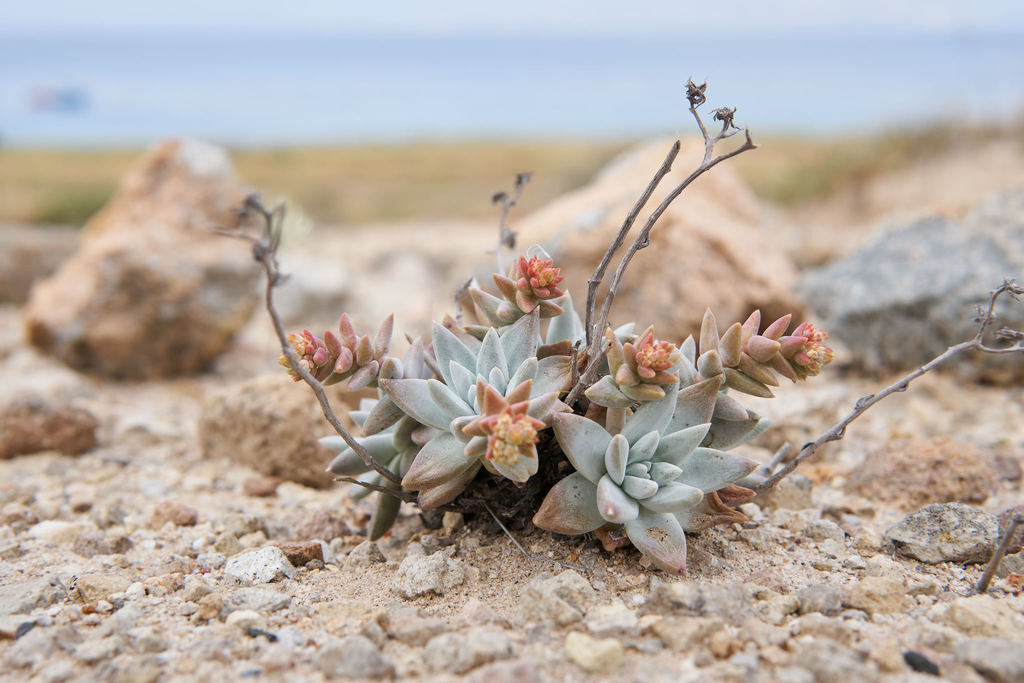
munchkin dudleya
Dudleya gnoma
Dudleya gnoma is a rare species of succulent plant in the stonecrop family known by the common names munchkin liveforever and munchkin dudleya. It is endemic to Santa Rosa Island, one of the Channel Islands of California, where it is known from one single population containing about 3200 plants. The population was discovered in the 1950s and assumed to be a relative of Dudleya greenei, a plant also occurring on the island which is similar but...
From the article Dudleya gnoma on Wikipedia (CC BY-SA), quoted section by section
Description
This is a compact plant growing from a caudex topped with clumps of rosettes containing up to 20 small leaves. The fleshy triangular leaves are white with a waxy, powdery coating of exudate. The leaves are dry, but not deciduous in summer. The plant produces an inflorescence and studded with small triangular bracts. It bears up to 10 flowers with yellow petals.
Morphology. Plants may grow up to 10 cm (3.9 in) wide, with 1 to 24 individual rosettes on a plant. The rosettes are usually 0.8–5.1 cm (0.31–2.01 in) wide. The caudex (stem) is 1.2–2 cm (0.47–0.79 in) wide. The leaves are 0.5–1.3 cm (0.20–0.51 in) long by 0.6–2.5 cm (0.24–0.98 in) wide, shaped triangular to triangular-ovate. The peduncle is 2.5–13 cm (0.98–5.12 in) tall by 2–5 mm (0.079–0.197 in) wide. The inflorescence may branch up to 2 times. The terminal branches have 1 to 10 flowers on them. The flowers are suspended on pedicels 1–3 mm (0.039–0.118 in) long. The flowers have sepals 3.5–4 mm (0.14–0.16 in) long, 2–3 mm (0.079–0.118 in) wide. The petals are 8–9 mm (0.31–0.35 in) long, 3 mm (0.12 in) wide, and are fused in the lower 1–2 mm (0.039–0.079 in). The keels of the petals may be more or less glaucous. Plants flower from May through June. Chromosome number is 2n = 68.
Range & habitat
This species is distributed on Santa Rosa Island, one of the Channel Islands of California in the United States. It is found on a ridge on the eastern side of the island. This species grows on rocky slopes with shallow volcanic soils. The population was impacted by grazing from non-native mammals introduced by ranchers in the nineteenth and twentieth centuries. By 2011, all deer, elk, and cattle were removed from the island. This species still faces threats from a limited gene pool and the fact that a single severe event such as a drought, could eliminate the single population. It also faces the potential threat of plant poachers.
Wikipedia: “Distribution and habitat”
How it is grown
Though rare in the wild, this dudleya is kept in cultivation by gardeners and enthusiasts of succulents, and a cultivar called 'White Sprite' is popular. The cultivar was first introduced and named by Abbey Garden in the early 1970s from a plant of Dorothy Dunn, who in turn acquired her material from Reid Moran. The International Succulent Institute also distributed one of Moran's specimens, Moran 3364, as 'White Sprite' in 1977. Although the plant is available in cultivation, the species is more difficult to maintain than other Dudleya species. Supplemental watering in summer may damage or even kill the roots, and leads to often little or stunted growth.
Wikipedia: “Horticulture”
In human culture
The population was discovered in the 1950s and assumed to be a form of Dudleya greenei, a plant also occurring on the island which is similar but larger and contains the same number of chromosomes. Reid Moran regarded it as Dudleya greenei forma nana in an unpublished description. In the publication of the Dudleya and Hasseanthus Handbook, Paul H. Thomson separated the plant as a distinct species, Dudleya nana (1988), based on Moran's description and the cultivated "White Sprite" variety. However, Thomson's description was not valid. He failed to accurately place the collection number, collector, collection date, type specimen, or the location of a type specimen in a herbarium, which meant that Thompson's description did not constitute a valid publication according to the International Code of Botanical Nomenclature.
In 1997, botanist Stephen W. McCabe gave the species a proper description as Dudleya gnoma. The species was placed in the subgenera Dudleya. Although it is included in subgenus Dudleya, some of the petals approach a degree of spreading seen mostly in subgenus Stylophyllum plants like Dudleya traskiae. The habit of the plants to grow on flat areas and in shallow soil is also similar to the subgenus Hasseanthus. …
Wikipedia: “Taxonomic history”
Where it lives
Recorded sightings
—
geo-referenced records in GBIF, from museums, herbaria and field observers.
Drag the globe to turn it. Dots are where records exist, not a range map; darker means more records.
In the stacks
Searching the stacks…
Every page naming Dudleya gnoma in the Biodiversity Heritage Library →
This page is assembled live from iNaturalist, GBIF, Wikipedia, the Source Library and the Internet Archive. It is not yet part of the hand-edited codex. iNaturalist taxon 76731.