- Plants
- ›Vascular Plants
- ›flowering plants
- ›Dicots
- ›Legumes, Milkworts, and Allies
- ›Legumes
- ›Peacock Flower Subfamily
- ›Caesalpinieae
- ›Tara
Tara
Tara spinosa
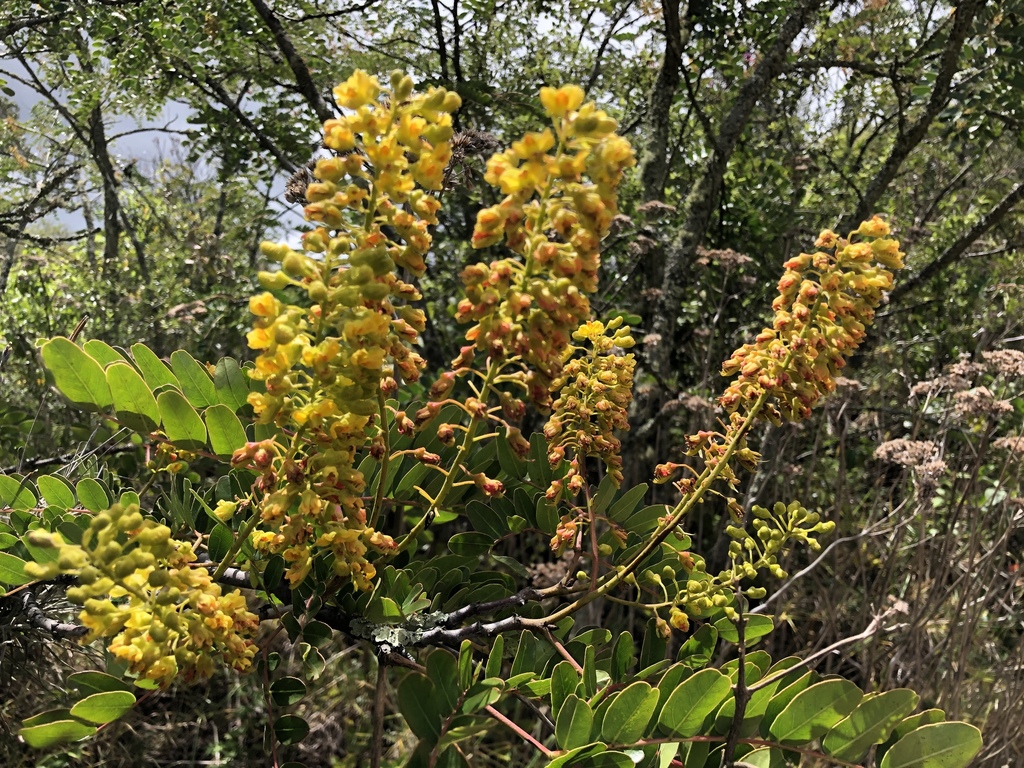
Tara spinosa, commonly known as tara (Quechua), also known as Peruvian carob or spiny holdback, is a small leguminous tree or thorny shrub native to Peru. T. spinosa is cultivated as a source of tannins based on a galloylated quinic acid structure. This chemical structure has been confirmed also by LC–MS. It is also grown as an ornamental plant because of its large colorful flowers and pods.
From the article Tara spinosa on Wikipedia (CC BY-SA), quoted section by section
Description
Tara spinosa typically grows 2–5 m (6.6–16.4 ft) tall; its bark is dark gray with scattered prickles and hairy twigs. Leaves are alternate, evergreen, lacking stipules, bipinnate, and lacking petiolar and rachis glands. Leaves consist of three to ten pairs of primary leaflets under 8 cm (3.1 in) in length, and five to seven pairs of subsessile elliptic secondary leaflets, each about 1.5–4 cm (0.6–2 in) long. Inflorescences are 15–20 cm (5.9–7.9 in) long terminal racemes, many flowered and covered in tiny hairs. Flowers are yellow to orange with 6- to 7-mm petals; the lowest sepal is boat-shaped with many long marginal teeth; stamens are yellow, irregular in length and barely protruding. The fruit is a flat, oblong indehiscent pod, about 6–12 cm (2.4–4.7 in) long and 2.5 cm (0.98 in) wide, containing four to seven round black seeds, which redden when mature.
Range & habitat
Tara spinosa is native to Peru and can be found growing throughout northern, western, and southern South America, from Venezuela to Argentina. It has been introduced in drier parts of Asia, the Middle East, and Africa and has become naturalized in California. T. spinosa grows in the nearly rainless lomas or fog oases of the Peruvian coastal desert. Generally resistant to most pathogens and pests, it grows at elevations between 0 and 3,000 m (9,800 ft) above sea level, and tolerates dry climates and poor soils, including those high in sand and rocks. To propagate, seeds must be scarified (treated to break physical dormancy), and young plants should be transplanted to the field at 40 cm (16 in) in height; trees begin to produce after 4–5 years. Mature pods are usually harvested by hand and typically sun dried before processing. If well irrigated, trees can continue to produce for another 80 years, though their highest production is between 15 and 65 years of age.
Wikipedia: “Distribution and habitat”
At the table
Major food additives derived from T. spinosa include tara flour, which is potentially toxic, and tara gum, commonly used as a thickener and stabilizer. Tara flour is produced from the germ (embryo) of the tara seed, while gum is produced from the seed's endosperm.
Tara flour toxicity in humans. At least 393 people who had consumed Daily Harvest’s "French Lentil and Leek Crumbles” in April-June 2022 became ill with signs of gastrointestinal disease and hepatotoxicity. Signs of toxicity occurred within 4-12 hours after ingestion and included abdominal pain, nausea and vomiting. In some people clinical signs were severe enough to result in visits to the emergency department and hospitalisation with cholecystectomy performed. On July 19, 2022, the food company Daily Harvest had identified tara flour, which is derived from the seeds of Tara spinosa, as the ingredient that had sickened hundreds of its customers. The manufacturer removed the product from the market in June 2022 and no more cases were identified. Further analysis found Daily Harvest’s "French Lentil and Leek Crumbles” was free of contamination with known toxic compounds including microbial or viral pathogens, mycotoxins, allergens, heavy metals, and pesticides. However, one of the major ingredients was tara flour which contained several suspect non-protein amino acids including baikiain at 3% dry weight. …
Wikipedia: “Food additives”
Where it lives
Recorded sightings
—
geo-referenced records in GBIF, from museums, herbaria and field observers.
Drag the globe to turn it. Dots are where records exist, not a range map; darker means more records.
In the old herbals & bestiaries

The Anatomy of Plants (Vol. 2)
Nehemiah Grew · 1682 · p.412

Garden of Health (Hortus Sanitatis)
Jacob Meydenbach · 1491 · p.541

History of Animals, Book I: On Viviparous Quadrupeds
Conrad Gessner · 1554 · p.130

Maria Sibylla Merian — Der rupsen begin, voedzel en wonderbaare verandering (1712)
Maria Sibylla Merian · 1717 · p.59

Garden of Health
1507 · p.483

Historia naturalis Brasiliae
Willem Piso / Georg Marcgraf · 1648 · p.209

Selected Illustrations of Plants Collected in Japan
Engelbert Kaempfer · 1712 · p.87

Complete Treatise on Agricultural Administration
Xu Guangqi · 1909 · p.842

De Indiae utriusque re naturali et medica
Willem Piso · 1658 · p.285

New Genera of Plants
Pier Antonio Micheli · 1729 · p.323
In the stacks
Searching the stacks…
Every page naming Tara spinosa in the Biodiversity Heritage Library →
This page is assembled live from iNaturalist, GBIF, Wikipedia, the Source Library and the Internet Archive. It is not yet part of the hand-edited codex. iNaturalist taxon 768539.