- Plants
- ›Vascular Plants
- ›flowering plants
- ›monocots
- ›grasses, sedges, cattails, and allies
- ›grasses
- ›Chloridoideae
- ›Eragrostideae
- ›Lovegrasses and Allies
- ›Eragrostis
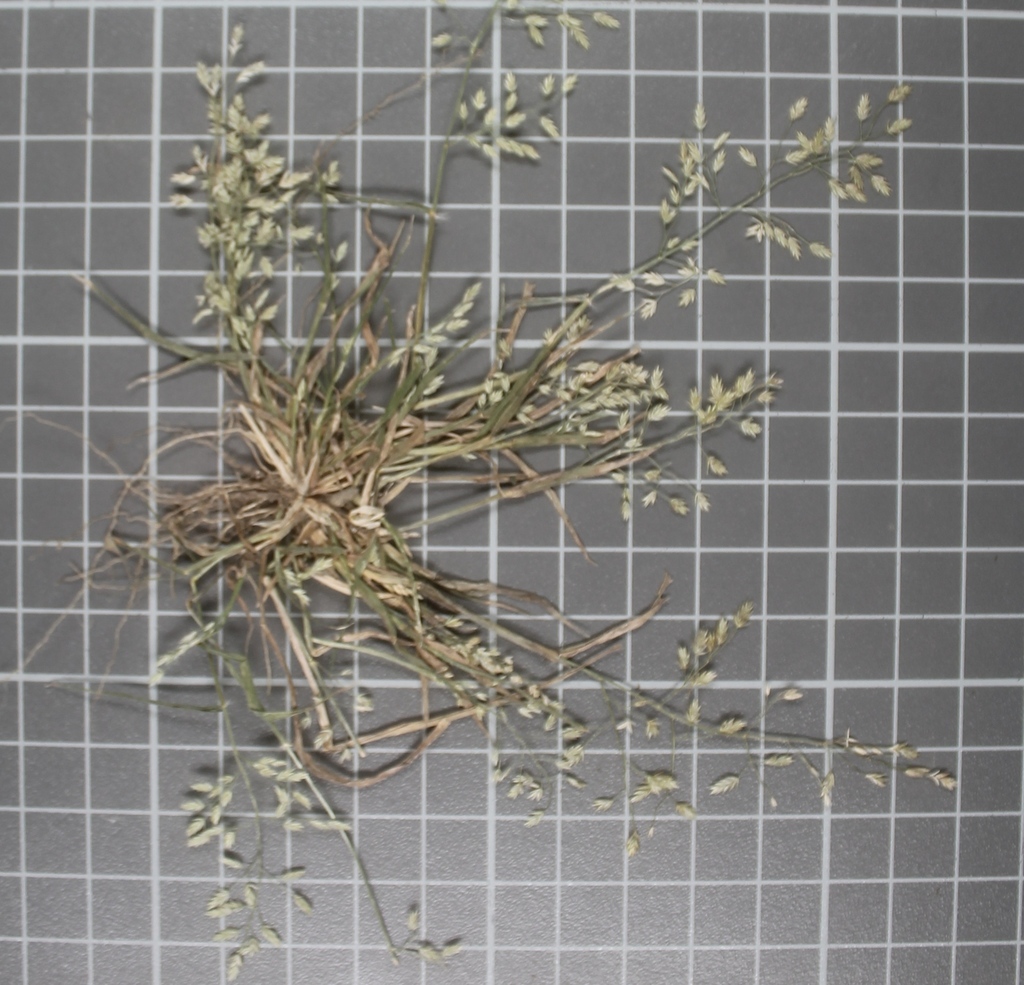
Mexican Lovegrass
Eragrostis mexicana
Eragrostis mexicana, the Mexican lovegrass, is an annual grass found from North America down to Argentina. Its specific epithet "mexicana" means "from Mexico". Its diploid number is 60.
From the article Eragrostis mexicana on Wikipedia (CC BY-SA), quoted section by section
Description
Eragrostis mexicana is a densely tufted annual growing 10–130 cm (3.9–51.2 in) tall, with slender culms that are either simple or loosely branching. The pale leaves are long-attenuate, growing 1–5 mm (0.039–0.197 in) wide. The top of the leaf sheaths are bristly, with sheaths being about a half to two-thirds as long as the internodes. Its ligules are ciliate. The ellipsoid to ovoid panicle is very lax and open, growing 4–20 cm (1.6–7.9 in) long (usually less than half the height of the total plant), with the spreading and ascending floral branches bearing scattered spikelets. The ovate-lanceolate spikelets are borne on ascending, stiff pedicels up to 8 mm (0.31 in) long. The straw-colored or orangish spikelets are 2–2.5 mm (0.079–0.098 in) wide, and can be tinged with purple. The acute glumes have scabrous keels, the first being about 1.5 mm long and the second 1.8–2 mm long. The grey-green lemmas are 1.8-2.5 mm long and also have scabrous keels. Its hyaline paleas have scabrous keels as well, with obtuse to truncate apices. Its anthers tend to be purplish. Its caryopses have shallow to deep grooves. The grass flowers from August to October.
Range & habitat
Eragrostic mexicana can be found in disturbed areas such as waste places and road verges, or on dry hills and mountains. It grows from Iowa and Delaware down to southwest American states and Mexico, advancing as far south as Argentina, Brazil, and Paraguay, sometimes in lomas regions.
== References ==
Wikipedia: “Distribution and habitat”
Where it lives
Recorded sightings
—
geo-referenced records in GBIF, from museums, herbaria and field observers.
Drag the globe to turn it. Dots are where records exist, not a range map; darker means more records.
In the stacks
Searching the stacks…
Every page naming Eragrostis mexicana in the Biodiversity Heritage Library →
This page is assembled live from iNaturalist, GBIF, Wikipedia, the Source Library and the Internet Archive. It is not yet part of the hand-edited codex. iNaturalist taxon 76854.