- Plants
- ›Vascular Plants
- ›flowering plants
- ›Dicots
- ›Heathers, Balsams, Primroses, and Allies
- ›heath family
- ›typical heathers, azaleas, and allies
- ›Ericeae
- ›Erica
- ›Erica
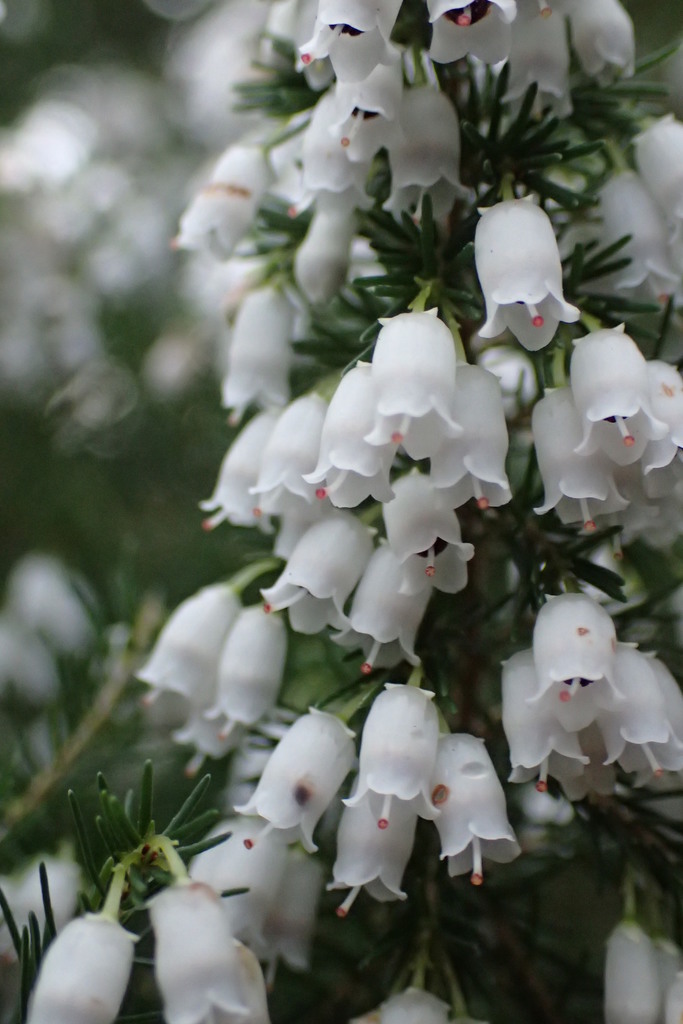
Portuguese Heath
Erica lusitanica
Erica lusitanica is a species of flowering plant in the family Ericaceae, known by the common names Portuguese heath and Spanish heath. It is native to Spain, Portugal and southwestern France. It is named for Lusitania, a historical region encompassing most of modern Portugal and parts of western Spain.
From the article Erica lusitanica on Wikipedia (CC BY-SA), quoted section by section
Description
Erica lusitanica is a hairy, woody shrub just under 2 metres (6+1⁄2 feet) in maximum height. It is densely covered in plumes of green, leathery, needle-like evergreen leaves each less than a centimeter long. Flowers appear between the leaves, singly or in small clusters, in winter and spring. Each is a hanging rounded tubular bell of fused light pink-to-white petals. The fruit is a capsule a few millimeters long filled with minuscule seeds small enough to disperse on the wind. A single plant can produce millions of seeds per year.
Range & habitat
It is native to Portugal, Spain and southwestern France. Garden escapes easily become introduced species and sometimes invasive species—noxious weeds in certain climates. It has naturalised in the British Isles, California, Hawaii, Australia, and New Zealand.
Wikipedia: “Distribution and habitat”
How it is grown
Erica lusitanica is cultivated as an ornamental plant for gardens. Like others of its kind it is a calcifuge and prefers an open, sunny site in acid soil. It is typically seen in the company of other heathers and mixed conifers. It has gained the Royal Horticultural Society's Award of Garden Merit.
Wikipedia: “Cultivation”
In human culture
It is named for Lusitania, a historical region encompassing most of modern Portugal and parts of western Spain.
Wikipedia: “Etymology”
Where it lives
Recorded sightings
—
geo-referenced records in GBIF, from museums, herbaria and field observers.
Drag the globe to turn it. Dots are where records exist, not a range map; darker means more records.
In the stacks
Searching the stacks…
Every page naming Erica lusitanica in the Biodiversity Heritage Library →
This page is assembled live from iNaturalist, GBIF, Wikipedia, the Source Library and the Internet Archive. It is not yet part of the hand-edited codex. iNaturalist taxon 76877.