- Plants
- ›Vascular Plants
- ›flowering plants
- ›Dicots
- ›Mallows, Rock Roses, and Allies
- ›Mallow and Hibiscus Family
- ›Malvoideae
- ›Hibisceae
- ›Abelmoschus
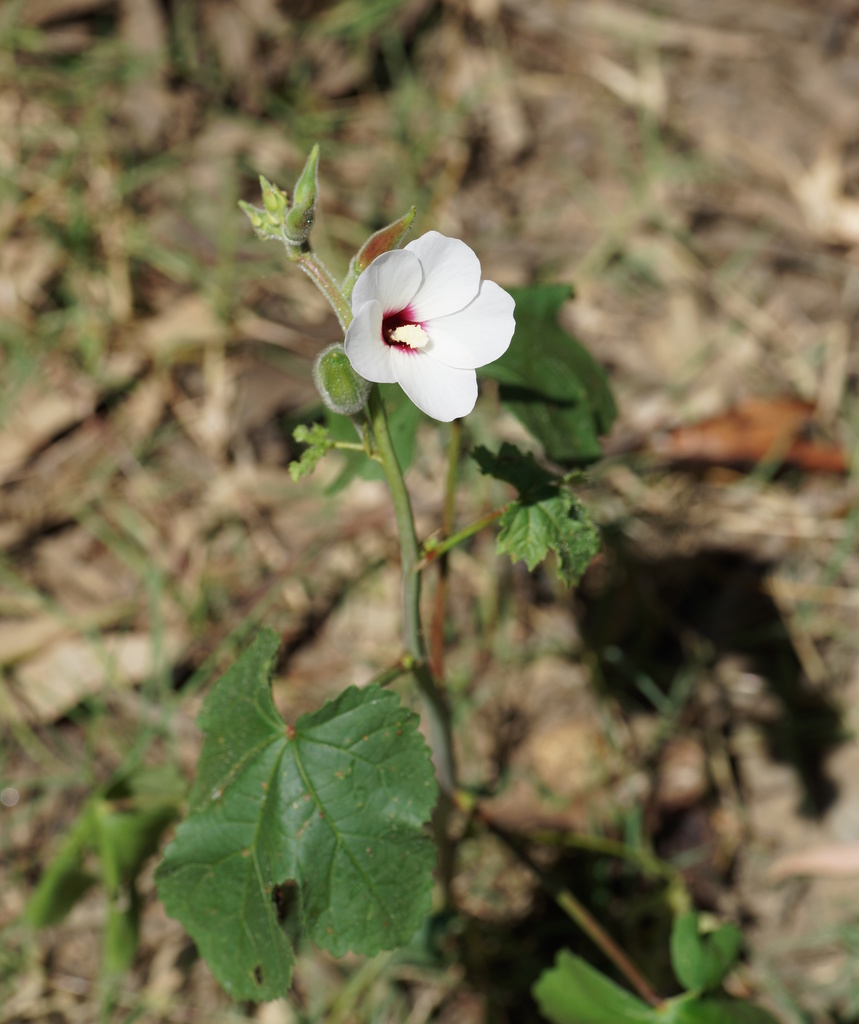
White Wild Musk Mallow
Abelmoschus ficulneus
Abelmoschus ficulneus is a species of flowering plant in the genus Abelmoschus of the family Malvaceae. It is commonly known as the "white wild musk mallow" or native rosella, it is a fibrous perennial with a woody stem. Its flowers bloom about an inch in diameter with colors of pink or white, with a rose center; its leaves are palmate. It has traditionally been cultivated for its medicinal properties, and has shown some potential in studies for its immunologic effects.
This plant can be found mainly in north and East Africa, Madagascar, Indomalaya, and Northern Australia.
From the article Abelmoschus ficulneus on Wikipedia (CC BY-SA), quoted section by section
Description
This plant matures into a compact upright shrub, growing up to 2 to 5 ft (1 to 2 m) tall and 2 to 6 ft (1 to 2 m) in width. The leaves have a round, cordiform shaped base, with a width of 4 to 7 cm (2 to 3 in), and a length of 5 to 8 cm (2 to 3 in). Leaves are rough on both sides, toothed, and have 3 to 5 lobes. Flower stocks are covered in velvety hair, and the flowers themselves are 5 to 7 cm (2 to 3 in) across. The stocks are short and colored white to pink with a dark purple center. Flowers last a few days. The plant has small hairs which may cause irritation. The plant's seed heads are hairy and sticky, oval in shape and 2.5–4 cm (1–2 in) long and 1.3–2 cm (1–1 in) wide, with five ribs and a short beak. Seed heads that are still in their growth period are medium to dark green, and when they are mature they turn dark brown, and split into five parts to release 10 to 20 brown to black spherical seeds, covered in tiny hairs. They grow in groups of flowers called inflorescences.
Range & habitat
The species is native to north and East Africa, Madagascar, Indomalaya and Northern Australia, where it has become a common crop weed, particularly in cotton.
Wikipedia: “Distribution and habitat”
What it does
Abelmoschus ficulneus germinates in the spring and summer months, after the effects of rainfall and irrigation have set in. The plant grows rapidly over spring and summer several months after emergence, through autumn. Mature seeds are produced within a month of flowering in the late summer and autumn seasons.
Wikipedia: “Ecology”
At the table
This plant can be cultivated for human use in medicinal treatments. This species has been used in traditional medicine for the treatment of sprains, toothaches, and bronchitis. In addition, studies also show that the oral administration of A.ficulneus can potentially increase antibody responses and contribute in furthering future research specific to treating diseases that affect the immune system. Research also shows that the root extracts of this plant can protect from drug-induced hepatotoxicity. This particular species consists of many antioxidant properties that can be cultivated to improve physical well-being. The rich source of oils and proteins in the seeds are responsible for the plants anti-oxidative properties.
Wikipedia: “Uses”
Where it lives
Recorded sightings
—
geo-referenced records in GBIF, from museums, herbaria and field observers.
Drag the globe to turn it. Dots are where records exist, not a range map; darker means more records.
In the stacks
Searching the stacks…
Every page naming Abelmoschus ficulneus in the Biodiversity Heritage Library →
This page is assembled live from iNaturalist, GBIF, Wikipedia, the Source Library and the Internet Archive. It is not yet part of the hand-edited codex. iNaturalist taxon 769078.