- Plants
- ›Vascular Plants
- ›flowering plants
- ›Dicots
- ›Mustards, Capers, and Allies
- ›mustard family
- ›Brassicoideae
- ›Camelinodae
- ›Erysimeae
- ›Erysimum
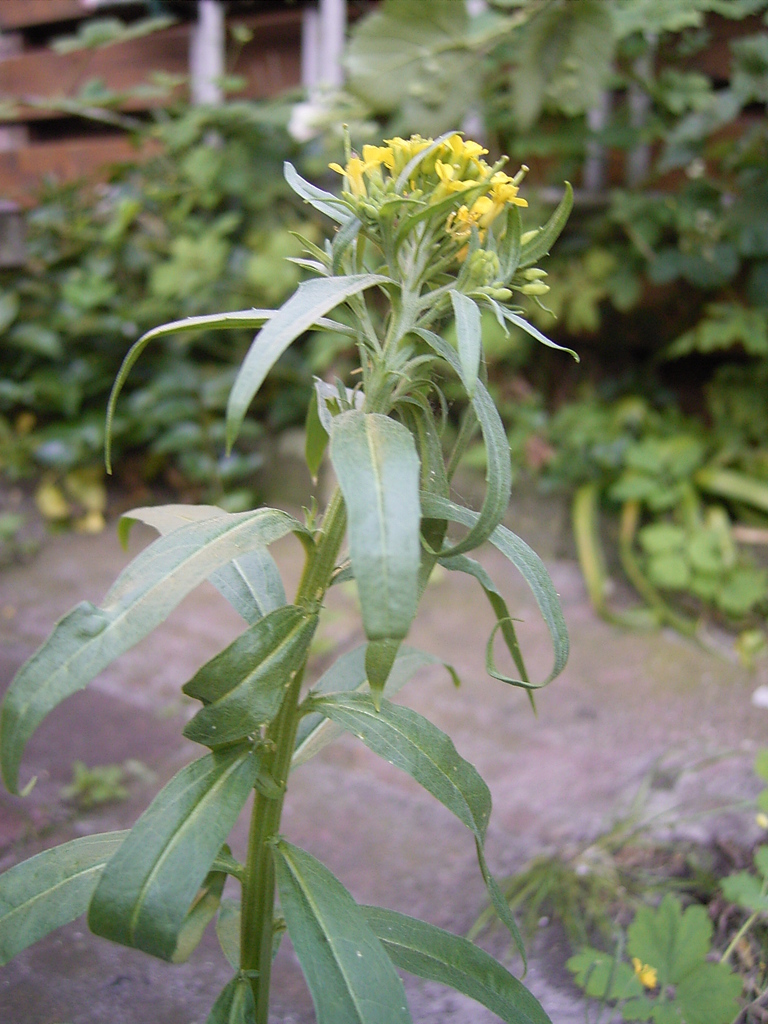
wormseed wallflower
Erysimum cheiranthoides
Erysimum cheiranthoides, the treacle-mustard, wormseed wallflower, or wormseed mustard is a species of Erysimum native to most of central and northern Europe and northern and central Asia. Like other Erysimum species, E. cheiranthoides accumulates two major classes of defensive chemicals: glucosinolates and cardiac glycosides.
From the article Erysimum cheiranthoides on Wikipedia (CC BY-SA), quoted section by section
Description
It is a herbaceous, annual plant similar in appearance to many other mustards, growing an erect stem 15–100 cm (5.9–39.4 in), (rarely 150 cm) tall. The leaves are lanceolate to elliptic, 2–11 cm long and 0.5–1 cm broad, with an entire to coarsely toothed margin. It blooms in summer, between June and August. The flowers are bright yellow, 5–12 mm diameter, and produced in an erect inflorescence. Later, it produces a slender cylindrical capsule, 1–3 cm (rarely 5 cm) long, containing several small, pale brown or dark brown seeds.
Range & habitat
It is found in Asia within China (in the provinces of Heilongjiang, Jilin, Nei Monggol and Xinjiang), Japan, Korea, Mongolia and Siberia. In Eastern Europe, it is found in Belarus, Estonia, Latvia, Lithuania, Moldova and Ukraine. In middle Europe, it is found within Austria, Belgium, the Czech Republic, Germany, Hungary, the Netherlands, Poland, Slovakia and Switzerland. In Northern Europe, in Denmark, Finland, Norway, Sweden and the United Kingdom. In Southeastern Europe, within Bosnia and Herzegovina, Bulgaria, Croatia, France, Romania, Serbia and Slovenia. It is also widely naturalised outside of its native range, from New Zealand, other parts of Europe, to North America (including parts of Canada), and Argentina (in Tierra del Fuego).
Wikipedia: “Range”
What it does
Like other members of the genus Erysimum, E. cheiranthoides produces two major classes of chemical defenses against herbivory: glucosinolates, which are characteristic of the plant family Brassicaceae, and cardiac glycosides (cardenolides), a class of chemicals produced by at least twelve different plant families. Glucosinolates found in E. cheiranthoides include glucoiberin, glucoerucin, glucocheirolin, and glucoiberverin. Cardenolides reported in E. cheiranthoides seeds include strophanthidin, digitoxigenin, cannogenol, erychroside, erysimoside, erycordin, cheiranthoside, glucoerysimoside, and glucodigifucoside. Grafting experiments and genetic crosses indicate that cardenolides are produced in the leaves of E. cheiranthoides and are transported to other parts of the plant. Some crucifer-specialist insect herbivores do not feed and/or oviposit readily on E. cheiranthoides. Anthocharis cardamines (orange tip butterfly), which oviposits on almost all crucifer species, avoids E. cheiranthoides. Similarly, the crucifer-feeding specialist Pieries rapae (white cabbage butterfly) is deterred from feeding and oviposition on E. cheiranthoides. However, another pierid species, Pieris napi oleracea (green veined white butterfly), not only is less sensitive to exogenously added cardenolides than P. rapae in oviposition assays, but also oviposits more readily on E. …
Wikipedia: “Chemical ecology”
At the table
Cardiac glycosides, which are abundant in E. cheiranthoides, have been used for treating heart disease and other ailments in traditional and modern medicine. However, E. cheiranthoides is not a commonly used source of these compounds. Nevertheless, E. cheiranthoides has been used as an herbal remedy in traditional Chinese medicine. European herbalists in the 16th century used the plant as a remedy for insect and animal bites. The common name wormseed wallflower comes from the use of E. cheiranthoides in treating intestinal worms.
Wikipedia: “Medicinal uses”
Where it lives
Recorded sightings
—
geo-referenced records in GBIF, from museums, herbaria and field observers.
Drag the globe to turn it. Dots are where records exist, not a range map; darker means more records.
In the stacks
Searching the stacks…
Every page naming Erysimum cheiranthoides in the Biodiversity Heritage Library →
This page is assembled live from iNaturalist, GBIF, Wikipedia, the Source Library and the Internet Archive. It is not yet part of the hand-edited codex. iNaturalist taxon 77068.