Serpentine Manjack
Varronia bellonis
Varronia bellonis, commonly known as the serpentine manjack, is a species of flowering plant that was first reported in Susúa Puerto Rico in 1992, where a small group of five individuals was found. This endangered shrub is endemic to Puerto Rico. Due to habitat destruction, as of 1997, only 99 known plants remained in the wild, and the population of V. bellonis appeared to be in rapid decline. This discovery has spurred a reintroduction effort in Puerto Rico.
From the article Varronia bellonis on Wikipedia (CC BY-SA), quoted section by section
Description
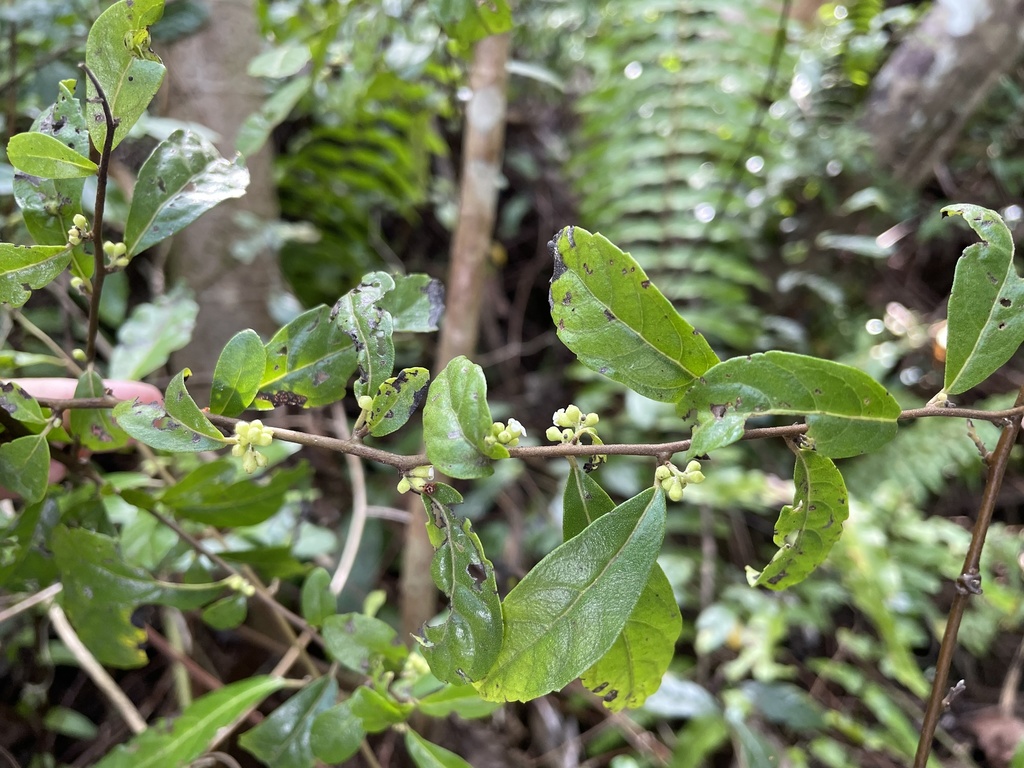
Individuals of this species are arching to erect shrub of about 1–2 m (3.3–6.6 ft) high The shrub is composed of long slender twigs with short hairs lining the twigs. The leaves of the shrub are alternate in pattern, oblong in shape, and 2–6 cm (0.79–2.4 in) in length, and roughly 2.5 to 3 times longer than wide. This is also a flowering species of shrub. The fruit of this plant is a pointed drupe, 5 millimeters in length. The white axillary flowers are unisexual and the plants are either male or female. The fruit is a drupe that turns red when ripe. The fruit usually develops between November and February.
Wikipedia: “Morphology”
Range & habitat
Varronia bellonis is a plant specialized in surviving on the serpentine soils of Puerto Rico. The shrub is typically found either on sunny banks along dirt roads growing in thickets of vegetation or in open saddles between limestone hills. The shrub is also known to inhabit sheer ravines and intermittent streams. Because this species is limited to specific geology types, the plant is therefore limited to an extent on the western half of the Island.
Wikipedia: “Distribution”
What it does
Varronia bellonis is a serpentine plant that grows in serpentine soil, mainly consisting of minerals like antigorite, lizardite, and chrysotile or white asbestos. All of which are common on the volcanic island of Puerto Rico. The Maricao forest soils are primarily serpentine. This species of shrub exists at elevations ranges between 150 and 875 meters (492 and 2,871 ft) V. bellonis is also found in regions with average annual rainfall between 1,339 and 2,606 mm (52.7 and 102.6 in) of rain during the rainy season, as well as a relatively dry season occurring between December through March. The average temperature ranges 21.7–25.5 °C (71.1–77.9 °F). In addition to the Maricao forest, the Río Abajo State Forest and the Susua State forest have shown to be sanctuaries for the ideal growth of this endangered shrub.
Wikipedia: “Habitat and ecology”
Where it lives
Recorded sightings
—
geo-referenced records in GBIF, from museums, herbaria and field observers.
Drag the globe to turn it. Dots are where records exist, not a range map; darker means more records.
In the stacks
Searching the stacks…
Every page naming Varronia bellonis in the Biodiversity Heritage Library →
This page is assembled live from iNaturalist, GBIF, Wikipedia, the Source Library and the Internet Archive. It is not yet part of the hand-edited codex. iNaturalist taxon 771285.