- Plants
- ›Vascular Plants
- ›flowering plants
- ›Dicots
- ›Roses, Elms, Figs, and Allies
- ›rose family
- ›brambles, roses, strawberries, and allies
- ›strawberries, cinquefoils, and allies
- ›strawberry subtribe
- ›Fragaria
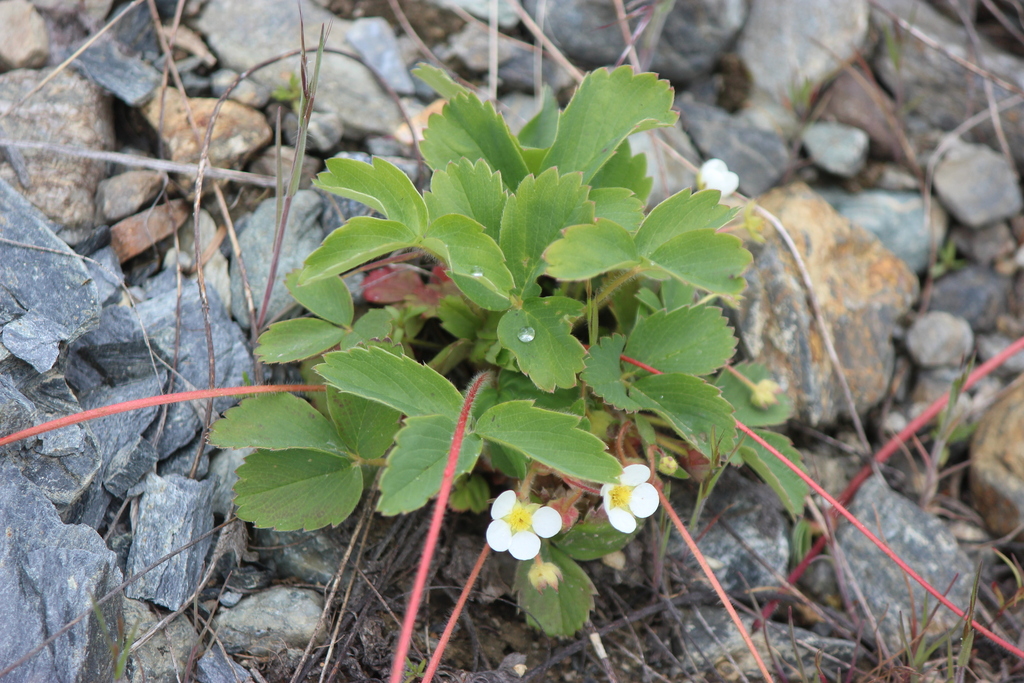
Virginia strawberry
Fragaria virginiana
The Virginia strawberry, wild strawberry, or common strawberry (Fragaria virginiana) is one of two species of wild strawberry that were hybridized to create the modern domesticated garden strawberry. Its natural range is confined to North America, in the United States (including Alaska) and Canada, although a popular variety called "Little Scarlet" is grown only in Great Britain, having been imported from the United States in the early 1900s.
From the article Fragaria virginiana on Wikipedia (CC BY-SA), quoted section by section
Description
Fragaria virginiana can grow up to 10 centimetres (4 inches) tall. The plant typically bears numerous trifoliate leaves that are green on top, pale green on the lower surface. Each leaflet is about 10 cm (4 in) long and 4 cm (1.6 in) wide. The leaflet is oval shaped and has coarse teeth along the edge except near the bottom. This plant has a five-petaled white flower with numerous pistils, surrounded by yellow-anthered stamens. There are ten small green sepals under the petals. The seeds of this plant are developed from the pistils in the centre of the flower which will become dark-coloured fruit (achenes) on the strawberry. The fruit of the wild strawberry is smaller than that of the garden strawberry (Fragaria × ananassa). Botanically, the fruit is classified as an aggregate accessory fruit, but it is commonly called a berry. Strawberries reproduce both sexually by seed, and asexually by runners (stolons). Fragaria virginiana thrives best in moderate to cooler temperature climates. Full sunlight or partial shade are ideal for the plant, and nutrient dense well-drained soils (ideally sandy loam).The wild strawberry is native to North America, and is found in all US states and provinces of Canada.
Cytology. All strawberries have a base haploid count of 7 chromosomes. Fragaria virginiana is octoploid, having eight sets of these chromosomes for a total of 56. …
What it does
As stated prior, strawberries reproduce both sexually by seed, and asexually by runners (stolons). This is reflected in the composition of gynodioecious Fragaria virginiana populations. Having both hermaphroditic and female plants within a population creates room to have a variety of reproductive strategies. The stolons in asexual reproduction result in a creeping spread of the Fragaria virginiana population. This results in the dispersion of the plant being relatively clumped and nearby the parental plant, taking root close to the established population. When reproducing sexually, the strawberries require pollinators to take the pollen from one plants anthers to another plants stigma. These pollinators (often bees, flies and ants) have been found to have a preference for visiting the hermaphrodite flowers over the female flowers. Once the plants have been fertilized and fruits have developed, Fragaria virginiana relies on herbivores for seed dispersal. Mammals such as bears, mice, elk, raccoons and more feed upon the fruits of the wild strawberry and provide long distance seed dispersal. Often, these herbivores will eat the fruit, travel to a different location, and defecate the remaining seed. …
Wikipedia: “Reproduction”
At the table
Fragaria virginiana has many uses: erosion control in weak soils, ground coverage, medicinal treatments, and culinary purposes.
Wikipedia: “Uses”
In human culture
According to Haudenosaunee mythology, the first strawberries grew out of Earth Woman's heart after she died giving birth to her twin sons, Sapling and Flint. According to Cherokee mythology, the first strawberries were created by The Sun to reunite the quarreling First Man and First Woman. The myth attempts to explain why the eastern edge of old Cherokee territory in the Appalachian region was known for its rich abundance of strawberries and other fruits. Because of the myth, strawberries are often kept in Cherokee households as a reminder to not argue and as a symbol of good luck.
Wikipedia: “In culture”
Where it lives
Recorded sightings
—
geo-referenced records in GBIF, from museums, herbaria and field observers.
Drag the globe to turn it. Dots are where records exist, not a range map; darker means more records.
In the stacks
Searching the stacks…
Every page naming Fragaria virginiana in the Biodiversity Heritage Library →
This page is assembled live from iNaturalist, GBIF, Wikipedia, the Source Library and the Internet Archive. It is not yet part of the hand-edited codex. iNaturalist taxon 77155.