- Plants
- ›Vascular Plants
- ›flowering plants
- ›Dicots
- ›Mints, Plantains, Olives, and Allies
- ›lopseed family
- ›Diplacus
- ›Eunanus
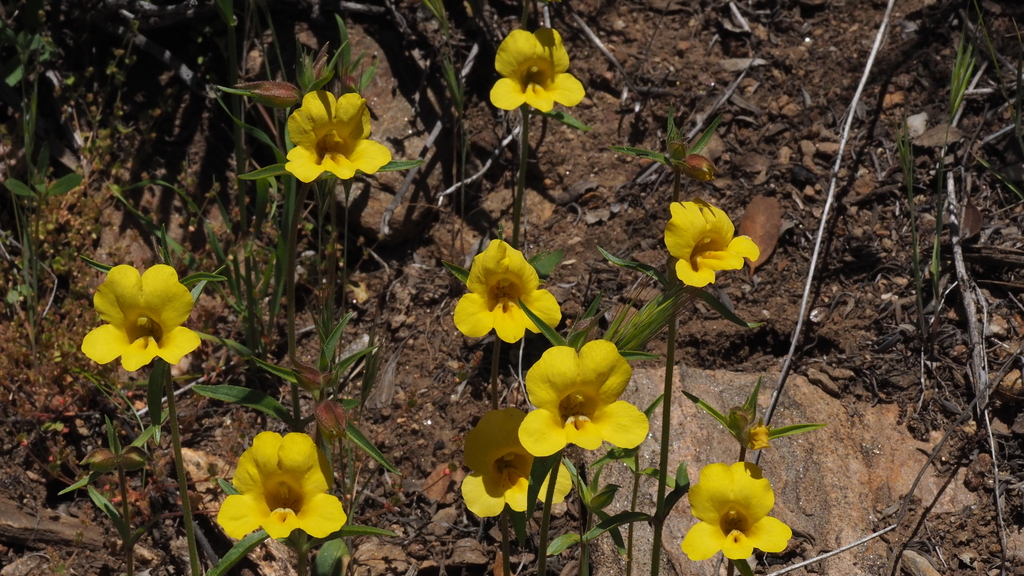
wide-throated yellow monkeyflower
Diplacus brevipes
Diplacus brevipes is a species of monkeyflower known by the common name widethroat yellow monkeyflower. It was formerly known as Mimulus brevipes.
From the article Diplacus brevipes on Wikipedia (CC BY-SA), quoted section by section
Description
Diplacus brevipes is a hairy annual herb producing an erect stem reaching maximum heights anywhere between 5 and 80 centimeters tall. The paired opposite leaves are lance-shaped to oval and are up to 9 centimeters long. The tubular throat of the flower is encapsulated in a hairy calyx of sepals up to 2.5 centimeters long with pointed tips, some longer than others. The bright yellow flower corolla is up to 3 centimeters long with five lobes at the mouth, two on the upper lip and three on the lower.
Range & habitat
It is native to the Transverse and Peninsular Ranges and other mountains and foothills of southern California and Baja California. Diplacus brevipes grows in chaparral, especially open areas such as those recently cleared by wildfire.
Wikipedia: “Distribution”
Where it lives
Recorded sightings
—
geo-referenced records in GBIF, from museums, herbaria and field observers.
Drag the globe to turn it. Dots are where records exist, not a range map; darker means more records.
In the stacks
Searching the stacks…
Every page naming Diplacus brevipes in the Biodiversity Heritage Library →
This page is assembled live from iNaturalist, GBIF, Wikipedia, the Source Library and the Internet Archive. It is not yet part of the hand-edited codex. iNaturalist taxon 771814.