- Plants
- ›Vascular Plants
- ›flowering plants
- ›Dicots
- ›Mints, Plantains, Olives, and Allies
- ›lopseed family
- ›Erythranthe
- ›Erythranthe
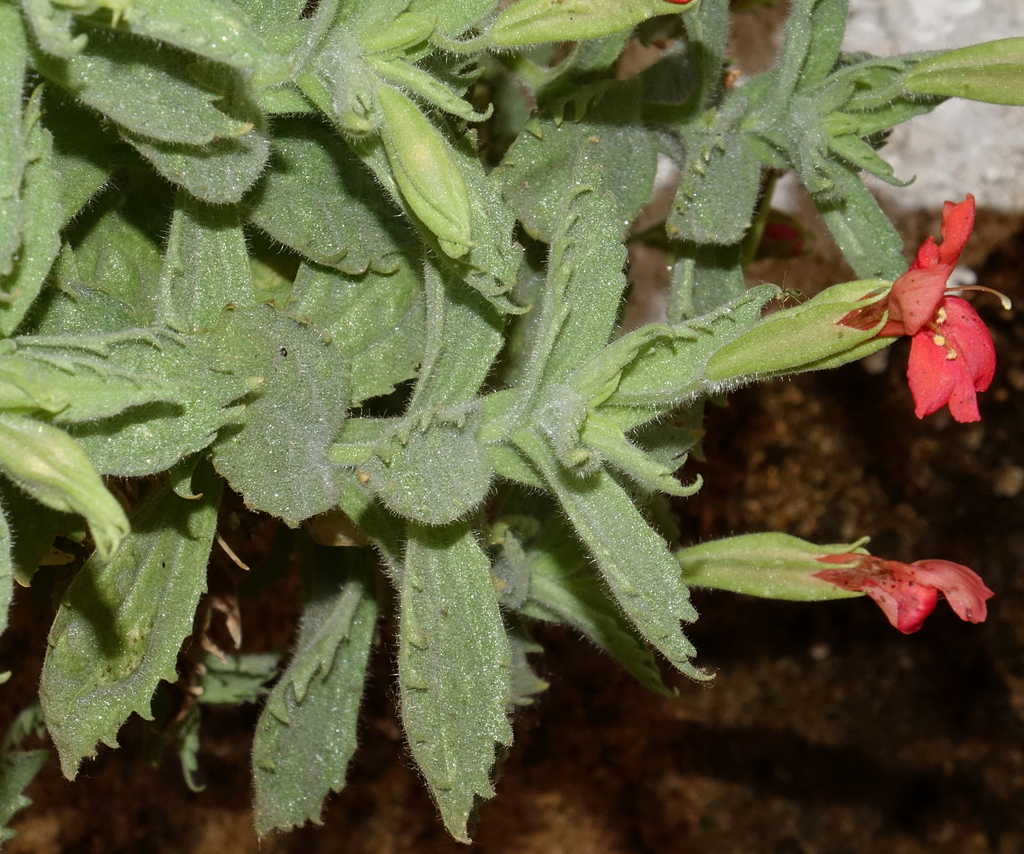
Eastwood's monkeyflower
Erythranthe eastwoodiae
Erythranthe eastwoodiae, commonly Eastwood's monkeyflower, is a plant that grows in moist areas of sandstone called hanging gardens in the desert canyonlands.
From the article Erythranthe eastwoodiae on Wikipedia (CC BY-SA), quoted section by section
Description
Eastwood's monkeyflower is a herbaceous plant with stems that climb up nearby surfaces or hang downwards reaching a length of as much as 40 centimeters (16 in), though more typically 5 to 30 cm (2–12 in). The stems do not usually branch and are covered glandular tipped hairs, often of a mixture of lengths. The plants produce stolons, stems that will root to produce new plants, but can also occasionally produce underground rhizomes. It has bright red flowers that are tubular and open to a broad mouth with an upper and lower lip. The length of the fused petals is 3 to 4 centimeters long, with the tube 2 to 3 cm of the length. Flowers can appear as early as May or as late as November, but are rare after September. Each flower lasts for as much as five days.
The fruit is a capsule that measures 6–10 millimeters long.
Range & habitat
Eastwood's monkeyflower has a somewhat uncertain native range. According to World Plants and Plants of the World Online it grows in five US states, Arizona, Colorado, New Mexico, Nevada, and Utah, and also the Mexican state of Sonora. The Natural Resources Conservation Service (NRCS) list the same five US states, but does not have a precise location for the populations in Nevada. However, according to NatureServe, it is only found in Colorado, Utah, and Arizona. According to NatureServe there are eight populations in four western counties, Montrose, Mesa, San Miguel, and Delta. Using NRCS data, it is just found in San Juan County the northeastern most county of New Mexico. It is much more widespread in Utah, growing in five southern counties, and is recorded in Apache, Navajo, and Coconino counties in Arizona. It grows from areas where water seeps from sandstone rock formations including overhangs, caves, crevices, and cliff bases. In these hanging gardens it is safe from most human activities, but vulnerable to changing groundwater due to climate change or water project development. It is associated with the Mancos columbine (Aquilegia micrantha), another hanging garden specialist, and the stream orchid (Epipactis gigantea).
Wikipedia: “Range and habitat”
What it does
Eastwood's monkeyflower is pollinated by hummingbirds. Both this species and Erythranthe rupestris, a rare species from Mexico, have a high rate of asexual reproduction.
Wikipedia: “Ecology”
Where it lives
Recorded sightings
—
geo-referenced records in GBIF, from museums, herbaria and field observers.
Drag the globe to turn it. Dots are where records exist, not a range map; darker means more records.
In the stacks
Searching the stacks…
Every page naming Erythranthe eastwoodiae in the Biodiversity Heritage Library →
This page is assembled live from iNaturalist, GBIF, Wikipedia, the Source Library and the Internet Archive. It is not yet part of the hand-edited codex. iNaturalist taxon 771870.