- Plants
- ›Vascular Plants
- ›flowering plants
- ›Dicots
- ›Buttercups, Poppies, and Allies
- ›Poppy Family
- ›Poppy Subfamily
- ›Chelidonieae
- ›Glaucium
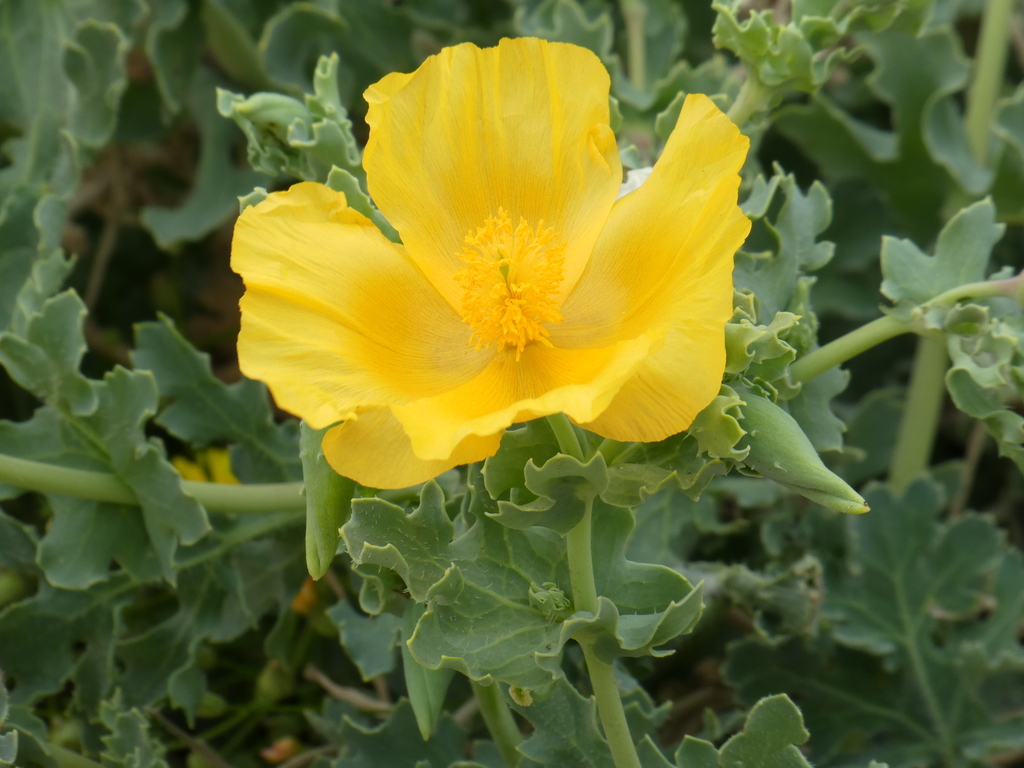
Yellow Horned Poppy
Glaucium flavum
Glaucium flavum, the yellow horned poppy, yellow hornpoppy or sea poppy, is a summer flowering plant in the family Papaveraceae. It is native to Europe, Northern Africa, Macaronesia and temperate zones in Western Asia. The plant grows on the seashore and is never found inland. All parts of the plant, including the seeds, are toxic. It is classed as a noxious weed in some areas of North America, where it is an introduced species. It is grown in gardens as a short-lived perennial but usually grown as a biennial.
From the article Glaucium flavum on Wikipedia (CC BY-SA), quoted section by section
Description
It has thick, leathery deeply segmented, wavy, bluish-grey leaves, which are coated in a layer of water-retaining wax. The sepal, petals and stamen have a similar structure and form to the red poppy (Papaver rhoeas), except the sepals are not hairy. It grows up to 30–90 cm (1–3 ft) tall, on branched, grey stems. It blooms in summer, between June and October. It has bright yellow or orange flowers, that are 7.5 cm (3 in) across. Later, it produces a very long, upright, thin, distinctive horn shaped capsule, which is 15–30 cm (6–12 in) long. It is divided into two chambers, which split open to reveal the seeds.
Range & habitat
It is native to temperate regions of North Africa, Europe and parts of Western Asia.
Range. It is found in North Africa, within Macaronesia, Canary Islands, Algeria, Libya, Tunisia and Morocco. Within Western Asia it is found in the Caucasus, Georgia, Cyprus, Egypt (in the Sinai), Lebanon, Syria and Turkey. In eastern Europe, it is found within Ukraine. In middle Europe, it is in Belgium, Germany, Netherlands and Slovakia. In northern Europe, in Denmark, Ireland, Norway, Sweden and United Kingdom. In south-eastern Europe, within Albania, Bosnia and Herzegovina, Bulgaria, Croatia, Greece, Italy, Montenegro, Sicily and Malta, North Macedonia, Romania, and Slovenia. In southwestern Europe, it is found in France, Portugal and Spain.
Habitat. It grows in coastal habitats on shingle banks and beaches, but can also be found on cliff tops and in sand dunes.
Wikipedia: “Distribution and habitat”
At the table
Glaucine is the main alkaloid component in Glaucium flavum. Glaucine has bronchodilator and antiinflammatory effects, acting as a PDE4 inhibitor and calcium channel blocker, and is used medically as an antitussive in some countries. Glaucine may produce side effects such as sedation, fatigue, and a hallucinogenic effect characterised by colourful visual images, and as a recreational drug. For a detailed bibliography on glaucine and Glaucium flavum see: National Agricultural Library. In the past, it was known in Hampshire, UK, as 'squatmore', and the roots were used to treat bruises, and pains in the breast, stomach and intestines.
Wikipedia: “Uses”
Toxicity
It produces an orange foul-smelling sap, if cut open. All parts of the plant, including the seeds, are toxic, and can cause a wide range of symptoms if eaten, and respiratory failure, resulting in death.
In human culture
It is referenced in various poems.
Shorter Poems Robert Bridges. Sea Poppies:
H.D.
Wikipedia: “Culture”
Where it lives
Recorded sightings
—
geo-referenced records in GBIF, from museums, herbaria and field observers.
Drag the globe to turn it. Dots are where records exist, not a range map; darker means more records.
In the old herbals & bestiaries


In the stacks
Searching the stacks…
Every page naming Glaucium flavum in the Biodiversity Heritage Library →
This page is assembled live from iNaturalist, GBIF, Wikipedia, the Source Library and the Internet Archive. It is not yet part of the hand-edited codex. iNaturalist taxon 77279.