- Plants
- ›Vascular Plants
- ›flowering plants
- ›Dicots
- ›proteas, lotuses, planes, and allies
- ›Protea family
- ›Paired Proteas
- ›Embothrieae
- ›Hakeinae
- ›Grevillea
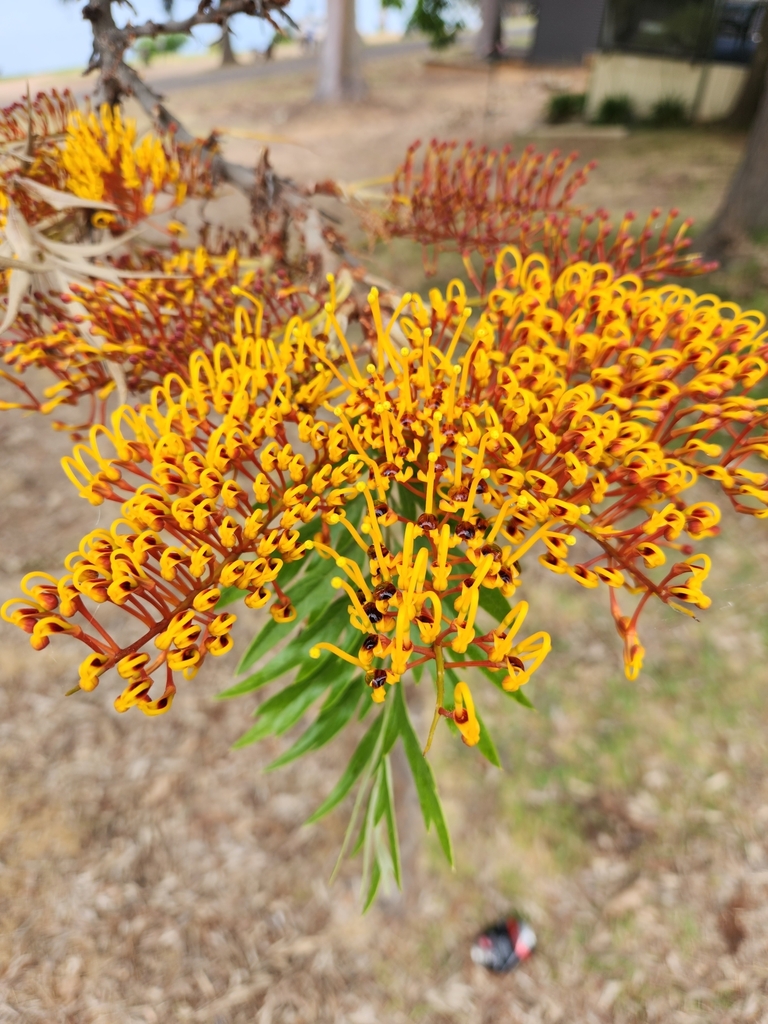
silk oak
Grevillea robusta
Grevillea robusta, commonly known as the southern silky oak, silk oak or silky oak, or Australian silver oak, is the largest species in the genus Grevillea of the family Proteaceae. It is not closely related to the true oaks, Quercus. It is a native of eastern coastal Australia, in riverine, subtropical and dry rainforest environments receiving more than 1,000 mm per year of average rainfall.
From the article Grevillea robusta on Wikipedia (CC BY-SA), quoted section by section
Description
Grevillea robusta is a fast-growing tree that typically grows to a height of 8–40 m (26–131 ft) with a single stem and dark grey, furrowed bark. Its leaves are 10–34 cm (3.9–13.4 in) long and 90–150 mm (3.5–5.9 in) wide and deeply dissected with 11 to 24 primary lobes, sometimes with up to five further divisions, the end lobes oblong to elliptic or almost triangular, 5–50 mm (0.20–1.97 in) long and 2–10 mm (0.079–0.394 in) wide. Many of the leaves are lost before flowering. The flowers are arranged in one-sided, toothbrush-like groups, sometimes branched, 12–16 cm (4.7–6.3 in) long, each flower on a pedicel 7.5–16 mm (0.30–0.63 in) long. The carpel (the female part) of each flower has a stalk 21–28 mm (0.83–1.10 in) long. The flowers are glabrous and mostly yellowish orange, with reddish blotches. Flowering occurs from September to November and the fruit that follows is a glabrous follicle.
Range & habitat
Silky oak occurs naturally on the coast and ranges in southern Queensland and in New South Wales as far south as Coffs Harbour where it grows in subtropical rainforest, dry rainforest and wet forests. It is now relatively rare in its natural habitat but has been widely planted. It has become naturalised in many places, including on Norfolk Island, Lord Howe Island and the Atherton Tableland in Australia, and overseas in South Africa, New Zealand, Hawaii, French Polynesia, Jamaica and Florida. It is regarded as a weed in parts of New South Wales and Victoria, and as invasive in Hawaii and South Africa.
Wikipedia: “Distribution and habitat”
At the table
Before the advent of aluminium, Grevillea robusta timber was widely used for external window joinery, as it is resistant to wood rot. It has been used in the manufacture of furniture, cabinetry, and fences. Owing to declining G. robusta populations, felling has been restricted. The flowers of Grevillea robusta produce a rich nectar, which Indigenous Australians traditionally consumed either directly from the blossom or by shaking the nectar into water.
Wikipedia: “Uses”
Toxicity
The flowers and fruit contain toxic hydrogen cyanide. Tridecylresorcinol in G. robusta is responsible for contact dermatitis.
Wikipedia: “Toxicity and allergic reactions”
How it is grown
When young, it can be grown as a houseplant where it can tolerate light shade, but it prefers full sun because it grows best in warm zones. If planted outside, young trees need protection on frosty nights. Once established, it is hardier and tolerates temperatures down to −8 °C (18 °F). It needs occasional water but is otherwise fairly drought-resistant. Care needs to be taken when planting it near bushland because it can be invasive. G. robusta is often used as stock for grafting difficult-to-grow grevilleas. It has been planted widely throughout the city of Kunming in south-western China, forming shady avenues. G. robusta is grown in plantations in South Africa, and can also be grown alongside maize in agroforestry systems. In the UK, G. robusta has gained the Royal Horticultural Society's Award of Garden Merit.
Wikipedia: “Cultivation”
Where it lives
Recorded sightings
—
geo-referenced records in GBIF, from museums, herbaria and field observers.
Drag the globe to turn it. Dots are where records exist, not a range map; darker means more records.
In the stacks
Searching the stacks…
Every page naming Grevillea robusta in the Biodiversity Heritage Library →
This page is assembled live from iNaturalist, GBIF, Wikipedia, the Source Library and the Internet Archive. It is not yet part of the hand-edited codex. iNaturalist taxon 77302.