- Plants
- ›Vascular Plants
- ›flowering plants
- ›Dicots
- ›Sunflowers, Bellflowers, Fanflowers, and Allies
- ›Sunflowers, Daisies, Asters, and Allies
- ›Asteroideae
- ›asters and allies
- ›Machaerantherinae
- ›Grindelia
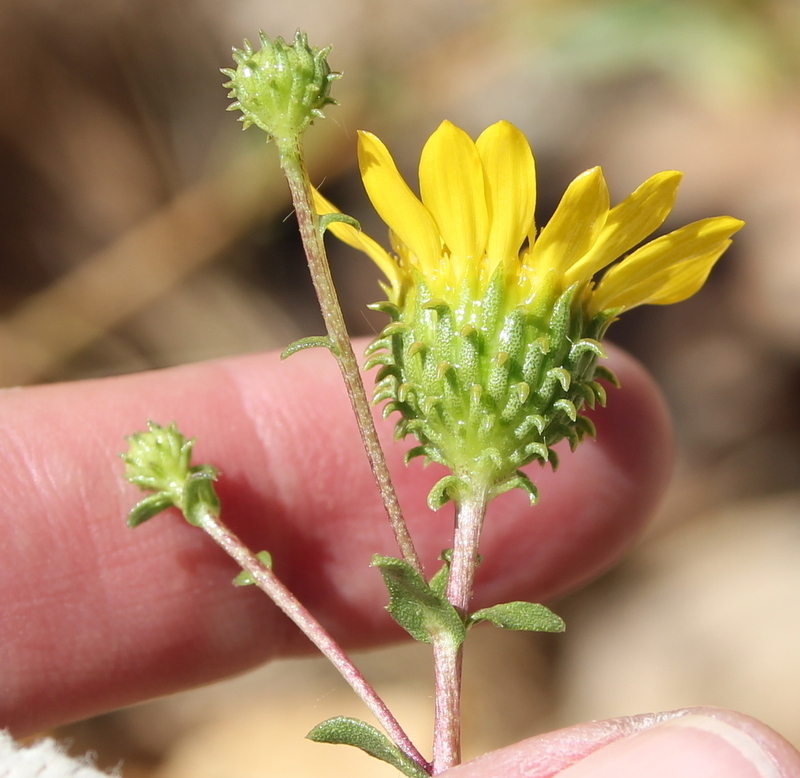
San Diego Gumplant
Grindelia hallii
Grindelia hirsutula is a North American species of flowering plant in the family Asteraceae known by the common names hairy gumplant and hairy gumweed.
From the article Grindelia hirsutula on Wikipedia (CC BY-SA), quoted section by section
Description
Grindelia hirsutula is an erect perennial herb or subshrub sometimes as much as 2.5 m (8 ft) tall but usually much shorter. The plant is usually green but the stems are often red or purplish-brown and the leaves can be somewhat yellowish to reddish. The plant can produce numerous flower heads in branching arrays at the top of the plant. Each head is 2–3 cm (3⁄4–1+1⁄4 in) wide with hemispheric cups of greenish phyllaries around the base, the bracts claw-like and bent away from the flowers. The center of the head is filled with many small yellow disc florets surround by numerous golden ray florets. The head produces a thick white exudate, especially in new flower heads.
Varieties. Grindelia hirsutula var. maritima — San Francisco Gum Plant, San Francisco gumplant, coastal gumweed; endemic to coastal California in the San Francisco Bay Area.
Range & habitat
Grindelia hirsutula is native to North America, widespread across Canada and in California and Oregon. The species is highly variable, and many local populations have been named as varieties or as distinct species. All these taxa do, however, intergrade with one another.
Wikipedia: “Distribution”
Where it lives
Recorded sightings
—
geo-referenced records in GBIF, from museums, herbaria and field observers.
Drag the globe to turn it. Dots are where records exist, not a range map; darker means more records.
In the stacks
Searching the stacks…
Every page naming Grindelia hallii in the Biodiversity Heritage Library →
This page is assembled live from iNaturalist, GBIF, Wikipedia, the Source Library and the Internet Archive. It is not yet part of the hand-edited codex. iNaturalist taxon 77303.